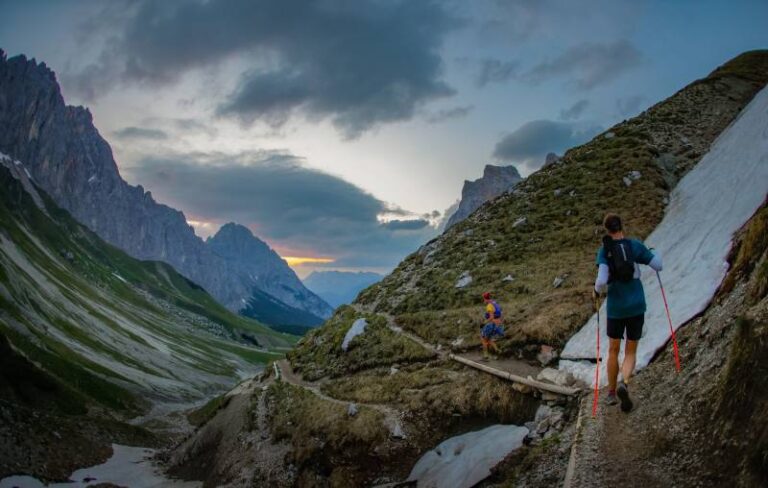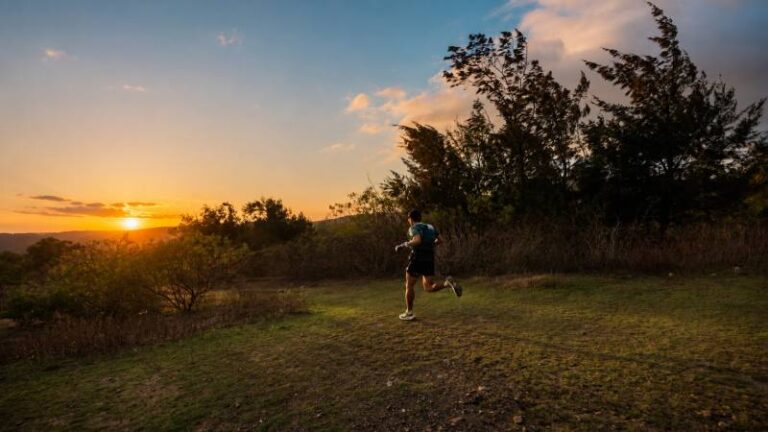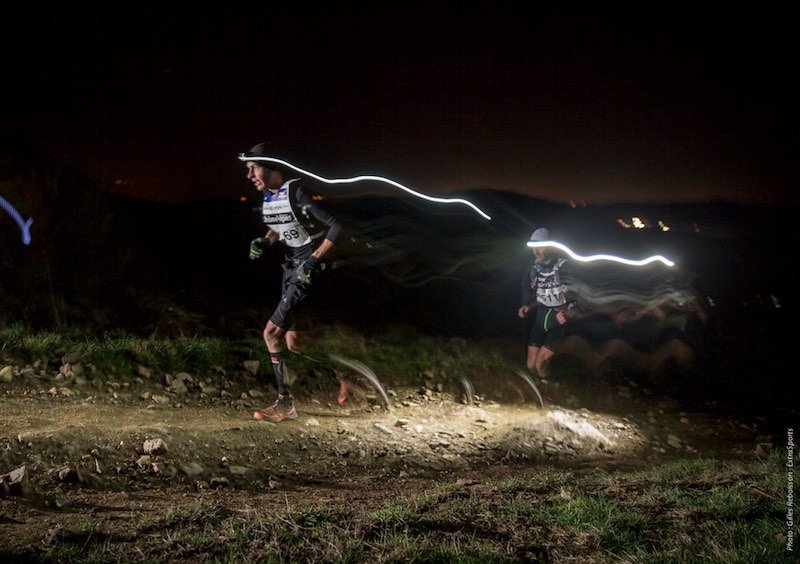

SaintéLyon 2026 takes place overnight from Saturday 28 to Sunday 29 November 2026, between Saint-Étienne and Lyon. For its 72nd edition, France’s oldest nature race offers nine events from 13 to 160 km. The flagship race covers about 80 km (≈ 50 miles), with more than 40% of the course redrawn and around 2,400 m of elevation gain announced.
In this SaintéLyon race guide, you’ll find the dates, start times, cutoff times and mandatory gear. Above all, you’ll get our advice to prepare for a night trail like no other, whether you’re aiming for the SaintéTic or the 80 km.
The short answer
- Date: night of 28 to 29 November 2026. Bib pick-up on 27 and 28 November at the Halle Tony Garnier (Lyon).
- Flagship race: about 80 km and 2,400 m of elevation gain, starting in Saint-Étienne at 23:30 and finishing in Lyon.
- Registration: most races are sold out. As of 28 October 2026, the LyonSaintéLyon (160 km) and the new SaintéVia (35 km) were still open.
- Course closes: Sunday 29 November at 16:00 in Lyon.
- Keys to success: be used to running at night and in the cold, have strong quads for the descents and the tarmac, and fuel regularly from the very first hours.
Contents
- SaintéLyon 2026: dates, venues and key figures
- The 9 SaintéLyon 2026 races: which one should you choose?
- SaintéLyon 2026 registration: can you still get a bib?
- SaintéLyon course: profile and cutoff times
- Aid stations, mandatory gear and logistics
- SaintéLyon training: how to prepare
- They ran the SaintéLyon with RunMotion Coach
- A bit of history: France’s oldest nature race
- SaintéLyon 2026 FAQ
- Ready for your night between Saint-Étienne and Lyon?
SaintéLyon 2026: dates, venues and key figures
The idea hasn’t changed: you set off at night from the Monts du Lyonnais hills and reach Lyon in the early morning. What’s new in 2026 is the scale of the event. There are 20,000 bibs on sale (up from 15,000 last year), a brand-new race and a largely redesigned course for the flagship race.
| Dates | Saturday 28 and Sunday 29 November 2026 (72nd edition) |
| Flagship race start | Saint-Étienne, Saturday at 23:30, in waves |
| Finish | Halle Tony Garnier, Lyon 7th district |
| Distance and elevation gain (SaintéLyon) | About 80 km, about 2,400 m D+ |
| Bibs | 20,000 in total, including 8,000 for the SaintéLyon solo |
| Bib pick-up | Friday 27 November, 12:00 to 20:00; Saturday 28 November, 09:00 to 17:00 |
| Course closes | Sunday 29 November at 16:00 |
The organisers say the 2026 GPX tracks will be released from 29 October. With more than 40% of the course new, take the time to study them, even if you’ve run the SaintéLyon before. Not all your landmarks from previous editions will still apply.
The 9 SaintéLyon 2026 races: which one should you choose?
Every race finishes at the Halle Tony Garnier. What sets them apart is the starting point, and so how much of the course you’ll run in the dark.
| Race | Distance | Start | Start time (Sat 28 Nov) | Price |
|---|---|---|---|---|
| LyonSaintéLyon | 160 km (out and back) | Lyon, Halle Tony Garnier | 09:00 | €235 |
| SaintéLyon solo | ≈ 80 km, ≈ 2,400 m D+ | Saint-Étienne | 23:30, in waves | €125 |
| SaintéLyon relay (2, 3 or 4 runners) | ≈ 80 km as a team | Saint-Étienne | 23:30 | €150, €180 or €225 per team |
| SaintExpress | ≈ 45 km | Sainte-Catherine | 23:00 | €78 |
| SaintéVia (new) | ≈ 35 km, ≈ 650 m D+ | Mornant | 22:30 | See official website |
| SaintéSprint | 24 km | Soucieu-en-Jarrest | 22:45 | €50 |
| SaintéTic | 13 km | Chaponost | 22:30 | €30 |
| SaintéGones (ages 6 to 15) | 0.3 to 3 km | See official website | Friday 27 Nov, around 18:15 | €10 |
SaintéVia, the new race for 2026
Announced at the end of April, the SaintéVia starts in Mornant and follows the route of the Roman Gier aqueduct, which carried water from the Pilat massif to Lugdunum, Roman Lyon. It’s about 35 km with 650 m of elevation gain, two aid stations (Soucieu-en-Jarrest around km 15, Chaponost around km 22) and only 1,000 places. A nice in-between format, sitting between the SaintéSprint and the SaintExpress.
Which distance for your first SaintéLyon?
If you’ve never raced at night, the SaintéTic or the SaintéSprint let you soak up the atmosphere without committing to a full sleepless night. Personally, I won the SaintéSprint in 2018 and I have great memories of it: running by headlamp on the trails between Soucieu-en-Jarrest and Lyon is a one-of-a-kind experience.
The SaintéVia and the SaintExpress are a good fit if you’ve already finished a 30 to 40 km trail race. The 80 km calls for real experience of long efforts: a trail race of 50 km or more, or a marathon where you managed the final stretch well. The relay is also a great way to discover the flagship course as a team. As for the LyonSaintéLyon, it’s for experienced ultra runners. The unranked outbound leg to Saint-Étienne must be completed in 13 hours max, before heading back out at night with the 80 km runners.
SaintéLyon 2026 registration: can you still get a bib?
Registration opened on 17 March 2026 at 13:00, online only on the official SaintéLyon website, on a first-come, first-served basis. As every year, most races filled up fast. As of 28 October 2026, only the LyonSaintéLyon and the SaintéVia were still showing as open.
If you’re taking over another runner’s bib, use the official transfer process, available until 17 November 2026 for a €10 fee. Running under someone else’s name is a real safety issue: if something goes wrong, the rescue teams won’t know who you are.
To enter, you need either a French Athletics Federation (FFA) licence number (Athlé Compétition, Running, Entreprise, Pass’Running…) or to complete the Parcours Prévention Santé (PPS). The PPS is an online health-prevention module you validate on pps.athle.fr. In France, it replaces the medical certificate for runners without an FFA licence. You must be at least 20 for races of 24 km and over, and 18 for the SaintéTic.
SaintéLyon course: profile and cutoff times
The course links Saint-Étienne to Lyon across the Monts du Lyonnais: Saint-Christo-en-Jarez, Sainte-Catherine, Le Camp-Saint-Genou, Soucieu-en-Jarrest, Chaponost, then into Lyon all the way to the Halle Tony Garnier. It’s not a technical mountain trail. You switch between tracks, singletrack, road sections, short climbs and sometimes long descents. A lot of it is runnable, and that takes a heavy toll on your quads.
The real challenge is winter and darkness. Mud, frost, black ice or snow are not unusual in late November, and a few degrees below zero on the ridges changes the race completely. With more elevation gain announced for 2026, expect a slightly tougher race than in previous years.
Here are the SaintéLyon solo cutoff times published by the organisers:
| Checkpoint | Km (approx.) | Cutoff time | Aid station |
|---|---|---|---|
| Saint-Christo-en-Jarez | 17 | 04:00 | Food and drinks |
| Sainte-Catherine | 32 | 07:00 | Food and drinks |
| Le Camp-Saint-Genou | 46 | 09:30 | Drinks only |
| Soucieu-en-Jarrest | 60 | 12:00 | Food and drinks |
| Chaponost | 67 | 13:30 | Food and drinks |
| Lyon, Halle Tony Garnier | 82 | 16:00 | Finish meal |
In practice, if you start in the first wave at 23:30, you have about 16 hours 30 minutes to reach Lyon. That’s an average of barely 5 km/h, stops included. It’s doable, but the intermediate cutoffs are tighter early in the race, so don’t hang around at the first aid stations. To work out your split times for your level, try our Race Strategy tool.
Aid stations, mandatory gear and logistics
Aid stations: a semi-self-sufficient race
On the 80 km, you’ll find five aid stations (four with food and drinks, one with drinks only). There can be more than 15 km between two of them, so you need to carry water and food. There are no disposable cups: bring your own cup of at least 15 cl. Personal crew support is not allowed at aid stations, except for elite runners in a dedicated zone. The SaintExpress has three aid stations, the SaintéVia two, the SaintéSprint just one, and the SaintéTic is run self-sufficient.
SaintéLyon 80 km mandatory gear
- Running pack and at least 1 L of water
- Personal cup, 15 cl minimum
- Working headlamp
- Smartphone with the LiveTrail app
- Survival blanket (1.40 × 2 m), whistle and adhesive elastic bandage (100 × 6 cm)
- Emergency food
- Waterproof jacket with a hood
- ID
Depending on the forecast, the organisers can also make a cold-weather kit mandatory (warm layer, beanie, gloves…), so keep an eye on their messages during race week. The LyonSaintéLyon requires two headlamps and a GPS watch for the outbound leg, and the shorter races have a lighter list. When it comes to lighting, a powerful headlamp with good battery life really changes your night: our guide to the best trail running headlamps will help you make the right choice.
Bib pick-up, shuttles and the Salon du Trail Running
Bib pick-up is at the Halle Tony Garnier on Friday 27 November from 12:00 to 20:00 and Saturday 28 November from 09:00 to 17:00. You collect your own bib in person, with ID. Shuttles take runners from Lyon to the different starts: meeting points and times are listed on each race’s page. A bag drop (bag under 10 kg) is available for solo runners.
The Salon du Trail Running, the race expo, is held at the same venue, with more than 100 exhibitors over more than 7,000 m². Entry is free. Enjoy it, but don’t spend your whole Saturday on your feet wandering the aisles: you’ve got a full night of running ahead.
SaintéLyon training: how to prepare
The SaintéLyon combines three constraints you rarely face together: darkness, cold and runnable terrain that keeps you running for hours. Your training needs to build endurance with long hilly runs, muscular strength to handle the descents and the tarmac, and the habit of running by headlamp.
Training priorities
The foundation is long runs at an easy endurance pace, on terrain that looks like the course: rolling trails, a few road sections and short climbs where you alternate running and power hiking. Add downhill work and quad strengthening, because the quads are often what gives out in the last 20 km. And if there are no hills near you, you can still train for trail running without hills.
Also plan several night runs to get used to your headlamp, test your cold-weather kit and see how your body reacts when it should be asleep. Our tips on trail running at night and running in the cold of winter round out this preparation nicely.
Volume and intensity obviously depend on your distance. For the 80 km and the LyonSaintéLyon, take inspiration from our ultra trail training plan. For the SaintExpress or the SaintéVia, the trail marathon training plan is a better fit, and for the SaintéSprint or the SaintéTic, go for the 20 km trail training plan.
Want a plan that takes into account your race date, your level, your available time and the terrain you train on? The RunMotion Coach app builds and adjusts your trail training week after week, with strength training and nutrition advice. Try it free for 7 days.
The race is a month away: what now?
Four weeks out, most of the work is done. You can still fit in one last race-specific long run, ideally at night and in your race kit, about three weeks before. Then gradually cut your volume while keeping a bit of pace to stay sharp. If you’ve missed sessions, don’t try to make them up: arriving fresh matters far more than one extra run.
Use these weeks to study the 2026 GPX track and upload it to your watch, test your headlamp one last time (including its battery life in the cold) and fine-tune your fuelling strategy.
Sleep, fuelling and race management
The late start throws off your routine. Sleep well in the nights before the race, even more than the night before, and plan a nap on Saturday afternoon. Have a proper meal three to four hours before the start, with foods you know. Our day-before-race checklist covers the routine to follow.
During the race, eat and drink from the first hour, even if you’re not hungry: the cold masks thirst and the night messes with your signals (here’s how to adapt your running nutrition in cold weather). A commonly cited benchmark for long efforts is 60 to 90 g of carbs per hour, to adjust to your gut tolerance and test in training. Hot drinks at the aid stations are a real morale boost. To go further, read our advice on night trail nutrition.
Finally, start conservatively. The excitement, the crowds and the bottlenecks of the first kilometres push you to go out too fast, yet the final section, from Chaponost to Lyon, is very runnable and on hard surfaces. A good SaintéLyon is one where you can still pick up the pace in the streets of Lyon at sunrise.
They ran the SaintéLyon with RunMotion Coach
Nothing beats a first-hand account to picture yourself on race night. Jérôme shared how he finished the SaintéLyon in 14 hours 53 minutes, and Denis told us how he became a finisher of the 2024 edition. David, another RunMotion Coach runner, crossed the line in under 14 hours.
A bit of history: France’s oldest nature race
In 1951, a group of touring cyclists looking for a way to stay fit over winter decided to travel from Lyon to Saint-Étienne on foot, at night, along the GR7 long-distance trail. The SaintéLyon started out as a night raid, then became a timed walking event, before running took over from the 1970s. Its success has never faded: with 20,000 bibs in 2026, it’s one of the biggest trail running gatherings in France.
SaintéLyon 2026 FAQ
When is SaintéLyon 2026?
Overnight from Saturday 28 to Sunday 29 November 2026. The LyonSaintéLyon starts on Saturday at 09:00, the other races between 22:30 and 23:30, and the kids’ races take place on Friday 27 November in the early evening.
How long is the SaintéLyon and how much elevation gain does it have?
The flagship race is about 80 km, with around 2,400 m of elevation gain announced for 2026, up from 2025. The exact distances are confirmed by the GPX tracks published by the organisers.
Can you still register for SaintéLyon 2026?
As of 28 October 2026, most races were sold out. The LyonSaintéLyon (160 km) and the SaintéVia (35 km) were still open. Check live availability on the official website, and use the official transfer process if you’re taking over a bib.
How long does it take to finish the SaintéLyon?
It depends hugely on your level and the conditions. The course closes at 16:00 on Sunday, which gives you about 16 hours 30 minutes from the first start. For example, two RunMotion runners finished in 14 hours 53 minutes and in just under 14 hours.
Do you need a medical certificate for the SaintéLyon?
Not if you hold a licence accepted by the organisers (an FFA licence in particular). Otherwise, you must complete the FFA’s Parcours Prévention Santé (PPS), the online health-prevention module that now replaces the medical certificate for runners without a licence.
Ready for your night between Saint-Étienne and Lyon?
You don’t conquer the SaintéLyon with a single burst of brilliance. You prepare for it with regular long runs, strong quads, plenty of night running and a race strategy that’s realistic given the cutoff times. In the final weeks, the priority is to arrive rested and well equipped, not to make up for lost time.
If you’re already preparing for SaintéLyon 2027 or another winter trail race, RunMotion Coach can build your personalised trail training plan, tailored to your level and your schedule. Start your 7-day free trial.
Updated on 28 October 2026 based on the official website and the 2026 Asics SaintéLyon race rules. Always check the organisers’ latest instructions before the start. Photo credits: Gilles Reboisson Extra Sports.