
We invite you to estimate your future performance over 10km, half-marathon and marathon with RunMotion’s race time predictor!
Based on your past race results, it is possible to predict your future performance over another distance.
The 2 main factors in running performance are velocity at VO2max (vVO2max) and endurance. vVO2max can also be estimated from your training data. Whilst endurance is only determined by racing results.
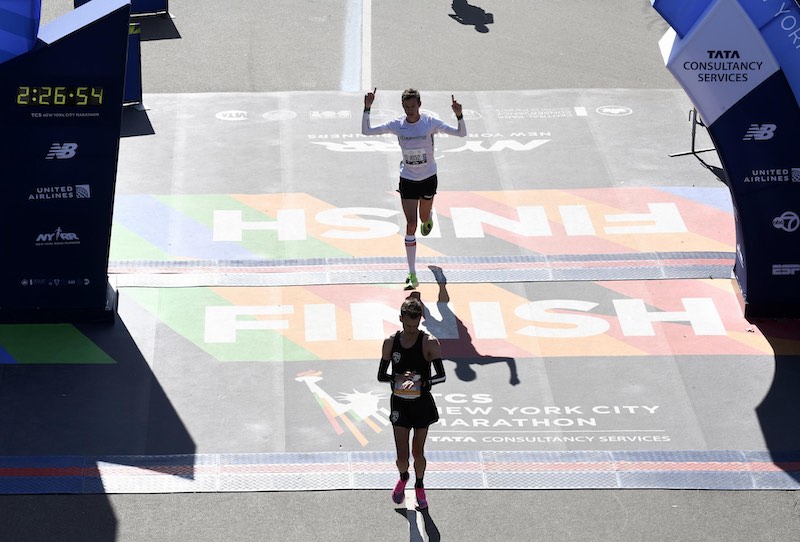
The performance prediction model developed at the CNRS/MIT [1], in which Guillaume ADAM, co-founder of RunMotion Coach took part, has been validated with the results of thousands of runners. Guillaume finished as the top French athlete at the 2019 New York City Marathon (2:26).
Enter at least one of your previous race performances.
If you enter 2 races, your endurance will be calculated. Otherwise, estimate your endurance level between bad, medium or good.
You will receive by e-mail a detailed report with your vVO2max, your endurance, your performance prediction for 5km, 10km, 20km, half marathon, full marathon and advice on areas to prioritise in your training.
How Does a Race Time Predictor Work?
A race time predictor is a tool that estimates your finish time at one distance based on a result you have already run at a different distance. If you recently completed a 10K and want to set a realistic marathon goal, or you have a strong 5K and want to know what half marathon time you are capable of, this race time predictor gives you a science-backed estimate in seconds. It works as both a race time calculator and a performance forecasting tool! Enter your data, and get predicted times across every standard road racing distance.
Most race time prediction tools on the internet rely on the Riegel formula, a power-law equation published by researcher Peter Riegel in 1981. While this formula works reasonably well for shorter distances, multiple studies have shown that it tends to produce overly optimistic marathon predictions for recreational runners. Research by Vickers and Vertosick found that the Riegel formula gave marathon times that were at least 10 minutes too fast for more than half of the runners in their study.
The RunMotion Coach race time predictor takes a fundamentally different approach. Instead of relying on a single formula from the 1980s, our model is built on original research conducted at the CNRS (French National Centre for Scientific Research) and MIT (Massachusetts Institute of Technology). Published in the peer-reviewed journal PLOS ONE, the model was co-developed by Guillaume Adam, RunMotion Coach co-founder.
What Makes This Race Time Calculator Different?
Traditional race time calculators use a single variable to predict your performance: your recent race time. The RunMotion model uses two independent physiological factors that together paint a far more accurate picture of your running ability.
velocity at VO2max (vVO2max)
Your velocity at VO2max, also known as vVO2max, is the speed at which your body reaches its maximum oxygen consumption. You can think of vVO2max as your engine size, a higher vVO2max means you have more aerobic horsepower available. vVO2max is the single strongest predictor of performance in races up to 10K, and it remains a critical factor at every distance. You can calculate your vVO2max using a field test or our calculator can estimate it from your race results.
Endurance
Endurance measures your ability to sustain a high percentage of your vVO2max over long periods. Two runners with identical vVO2max values can have dramatically different marathon times depending on their endurance capacity. In the RunMotion model, endurance is defined as the duration a runner can sustain 90% of their vVO2max, expressed as a score. A score of 5 represents average endurance (roughly 30 minutes at 90% vVO2max), while a score of 8 or higher indicates excellent endurance. Learn more about how vVO2max, endurance, and VO2max interact.
When you enter two race results at different distances, the calculator solves for both your vVO2max and your endurance simultaneously. This is what allows it to produce more accurate predictions than tools that treat every runner as physiologically identical.
The Science Behind our Race Time Prediction Model
The prediction model used by this calculator was co-developed by our co-founder Guillaume Adam, and published in PLOS ONE in 2018 under the title ‘A minimal power model for human running performance’ by Mulligan, Adam, and Emig. The research was conducted in collaboration between CNRS and MIT, and the model has been validated against the results of thousands of runners across distances from 800 meters to the marathon.
Unlike the Riegel formula, which uses a single exponent to extrapolate between distances, the RunMotion model treats running performance as a function of four independent physiological parameters. This allows it to account for individual variation in both speed and endurance, producing predictions that are particularly more accurate at longer distances where endurance plays a dominant role.
This research-backed foundation is what sets the RunMotion predictor apart from every standard race time calculator on the internet. The model does not assume all runners are physiologically identical. Rather, it profiles your individual balance of speed and endurance to deliver a prediction calibrated to you.
The full study is publicly available: Mulligan M, Adam G, Emig T (2018) A minimal power model for human running performance. PLoS ONE 13(11): e0206645.
Example Race Time Predictions: Riegel vs. RunMotion
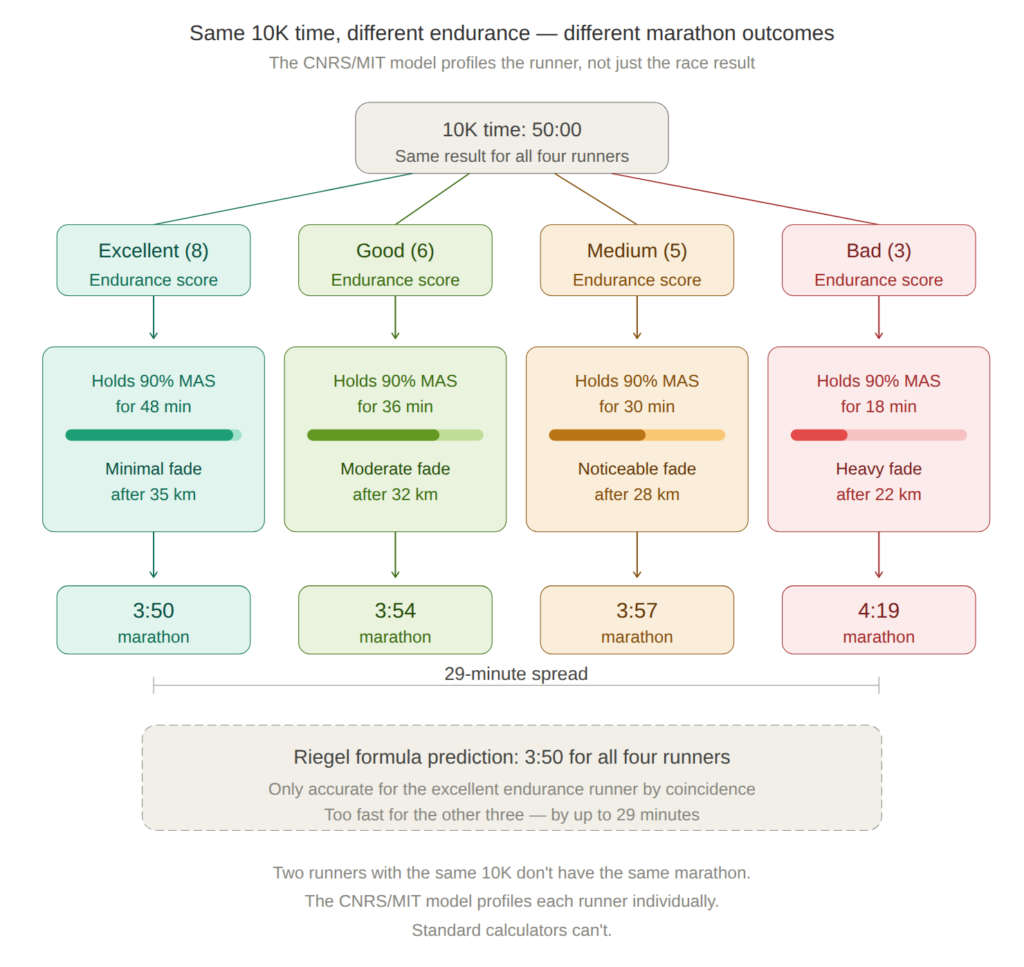
To illustrate how the RunMotion model differs from standard prediction tools, here are sample predictions for a runner with a recent 50:00 10K finish time. The Riegel column shows what most online calculators would predict. The RunMotion columns show how predictions shift depending on the runner’s endurance profile.
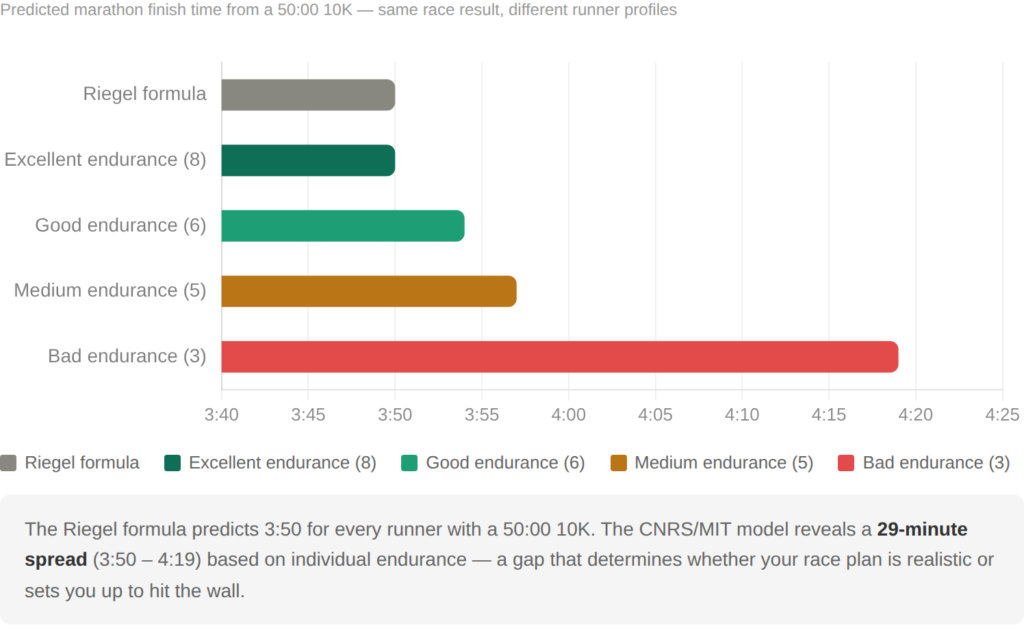
Notice how the Riegel formula produces a single marathon prediction of 3:50 regardless of the runner’s endurance profile. The RunMotion model shows a range from 3:50 to 4:19 depending on individual endurance capacity. Accounting for this 29-minute spread could be the difference between hitting a goal and hitting the wall. For most recreational runners, the Riegel prediction of 3:50 is unrealistically fast, which is exactly what the Vickers and Vertosick research confirmed.
How to Use the Race Time Prediction Calculator
Using the calculator takes less than a minute. Enter at least one recent race result by selecting the distance and your finish time. For the most accurate predictions, enter two races at different distances. Ideally one distance is roughly double the other (for example, a 5K and a 10K, or a 10K and a half marathon).
If you only have one race result, you can still get a prediction by estimating your endurance level as excellent, good, medium, or weak. After submitting your data, you will receive a personalized email report that includes your estimated vVO2max, your endurance score, predicted finish times for the 5K, 10K, 20K, half marathon, and marathon, and specific recommendations on whether to prioritize speed work or endurance training.
Predicting Your Marathon Time from a Half Marathon
One of the most common uses of a race time predictor is estimating marathon performance from a recent half marathon result. This is also where most traditional calculators fall short. The standard approach of simply doubling your half marathon time and adding a few minutes ignores the fact that the marathon places significantly higher demands on your endurance system, your fueling strategy, and your ability to resist fatigue in the final miles.
With the RunMotion model, your half marathon time helps establish your vVO2max, but your endurance score determines how much you will slow down over the full 26.2 miles. A runner with good endurance might multiply their half marathon time by approximately 2.08, while a runner with weak endurance could see a multiplier closer to 2.20 or higher. This is why entering two race results produces a much more reliable marathon time prediction.
Predicting Your Marathon Time from a 10K or 5K
Predicting marathon performance from a 10K or 5K result is trickier because the physiological demands of these shorter races are quite different. A fast 5K time indicates strong vVO2max and speed, but it tells you very little about how your body handles three or more hours of sustained effort. If you are using a single short-distance result, be conservative with your endurance estimate unless you have significant long-run training volume in your legs.
To illustrate the gap, a runner with a 25:00 5K could see marathon predictions ranging from 3:35 to 4:10 depending on their endurance profile. That is a 35-minute spread, which is significantly wider than the 23-minute range produced from a 10K input, because the shorter the input distance, the more the model must estimate about your endurance rather than measure it directly. This is why predictions from shorter distances should be treated as a wider range of possibilities rather than a single target time.
For the best results, pair your 5K or 10K time with a longer race result. If you have run both a 10K and a half marathon recently, entering both will give the calculator enough data to solve for your personal endurance profile and deliver a prediction calibrated specifically to your physiology.
Can This Predictor Help You Qualify for the Boston Marathon?
Setting a Boston Marathon qualifying time (BQ) is one of the most popular goals in North American distance running. The challenge is knowing whether your current fitness puts you within striking distance of the qualifying standard for your age group.
Enter your most recent half marathon or 10K result into the predictor and compare the marathon prediction against the Boston Athletic Association’s qualifying times. If the prediction falls within a few minutes of your BQ target, you likely have the aerobic engine to qualify (but you will need to ensure your endurance and race-day execution are dialed in). If the prediction is more than 10 minutes off, focus your training block on building aerobic volume and long-run endurance before committing to a qualifying attempt.Keep in mind that the Boston Marathon requires you to beat the qualifying standard by a margin (typically 5+ minutes in recent years due to field size). Use the predictor as a reality check, then pair it with a structured marathon training plan to close the gap.
What Factors Affect Race Time Prediction Accuracy?
No prediction tool is perfectly accurate, and several real-world variables can cause your actual race time to differ from the estimate. Understanding these factors helps you set a realistic target pace and adjust your race strategy accordingly.
- Course profile: Hilly courses slow you down. A flat 10K result will not predict an accurate time for a mountainous marathon without adjustment.
- Weather conditions: Heat and humidity have a measurable impact on performance. Running a marathon in temperatures above 70°F (21°C) can add several minutes to your finish time.
- Training specificity: The calculator assumes you have trained appropriately for the target distance. A fast 5K time does not guarantee a strong marathon if your longest training run was only 10 miles.
- Race-day nutrition and pacing: Poor fueling or going out too fast in the early miles can cause your performance to deviate significantly from the prediction.
- Recency of results: Use race times from the past two to three months for the most accurate estimate. Older results may not reflect your current fitness.
- Altitude: Racing at elevation reduces oxygen availability and slows performance. If your input race was at sea level and your target race is at altitude, expect a slower finish time.
How to Use Your Predicted Time for Training
Once you have your predicted finish times, use them to structure your training. Your predicted marathon pace becomes the foundation for your goal-pace long runs and tempo workouts. Your predicted 10K pace guides your threshold training, and your vVO2max informs your interval and track sessions. RunMotion Coach calculates all of these training paces automatically.
Use your predicted pace to calculate your target split times so you can pace your race evenly from start to finish. You can also convert your predicted time into average speed using our pace calculator.If you are training for a specific distance, pairing this predictor with the right training plan is the fastest path to race-day success. Explore our training plans for 10K, half marathon, and marathon distances.