
10K Training Plan: Run Faster and Hit Your Goal
A 10K plan built around your target time, your level and your schedule, whether you want to finish your first 10K or set a new personal best.
The short answer
- Training period: 8 to 12 weeks for a first 10K, 6 to 10 weeks if you already run regularly.
- Sessions per week: at least 3; 4 to 6 for a wider range of workouts.
- Paces: calculated from your target time, not just as a percentage of your vVO2max.
4.7/5 from 14,000+ reviews 1.2 million runners coached 88% reach their goal
Build your 10K plan
Target time
Training period
With RunMotion, start whenever you like: your plan adapts to the weeks left before your race.
Sessions per week
Target 10K pace
5′00″/km
Your plan
10 weeks · 3 sessions/week
7 days free, cancel anytime
The 3 phases of your 10K training
Phase 1
Endurance base
You run at an easy, conversational pace until you are comfortable running for an hour. Short intervals come in gently, for example 8 × 400 m.
Phase 2
Speed and endurance
Time for vVO2max sessions (up to 12 × 400 m, or 500 to 600 m repeats) and 10K-pace workouts such as 5 to 8 × 1 km or 4 × 2 km. Short hill repeats (12 × 20 seconds) build strength and running form.
Phase 3
Taper
In the final days, you cut the volume and keep a few 10K-pace reminders so you arrive fresh, with your race rhythm in mind.
Free tools for your 10K
10K training FAQ
How long does it take to train for a 10K?
Allow 8 to 12 weeks to finish your first 10K in good shape. If you already run regularly, 6 to 10 weeks is enough to prepare for a time goal. With RunMotion, start whenever you like: your plan adapts to the weeks you have left.
How many sessions per week?
At least 3: an easy endurance run, a quality session (intervals or race pace) and a recovery run. With 4 to 6 sessions, you can vary your training even more.
Are interval sessions essential to improve?
Yes. Intervals improve your speed, your cardiovascular capacity and your ability to hold a fast pace. Workouts like 5 to 8 × 1 km or 4 × 2 km are especially effective for a 10K.
How do I run a 10K in under 50 minutes?
You need to average 5 min/km. Your training combines race-pace sessions, intervals and regular easy runs to build both speed and endurance.
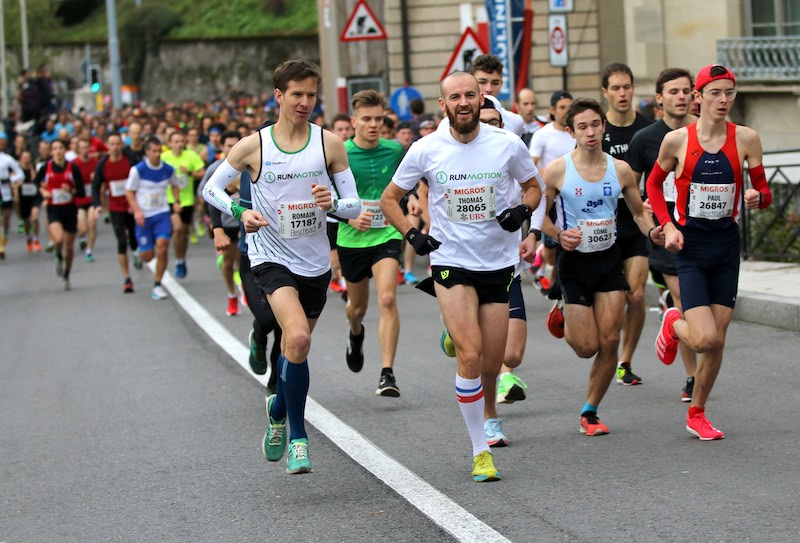
Are you looking to improve your 10K performance or simply finish your first 10K? A personalized 10K training plan will clearly help you succeed, whether you’re a beginner or an experienced runner. In this article, we’ll explain the key principles of a solid 10K training plan and share tips to help you nail your race.
The 10K is a race that is accessible to everyone, yet when you want to perform, breaking through certain barriers can take time. Some runners want to break 1 hour for 10K (10 km/h), others want to go under 50 minutes (12 km/h), under 40 minutes (15 km/h), or even under 35 minutes for 10K!
How many workouts per week do you need for a 10K?
The time goal you’re aiming for is not just a matter of training frequency. You also need to consider several factors: your experience as a runner, your current fitness, your training schedule, and your key paces (vVO2max, 10K pace, threshold, easy pace, etc.).
We recommend at least 3 workouts per week to prepare for a 10K. Of course, if you can train 4, 5, or even 6 times per week, you’ll be able to include a more complete mix of workouts in your 10K training plan.
For every runner, easy aerobic running, also called an easy run, is the foundation of the training pyramid. It’s the pace where you can run while still talking comfortably.
For a beginner, the first goal is simply to feel comfortable running continuously for 1 hour at an easy pace. You learn to manage your effort and build step by step, while more experienced runners can move on to more demanding workouts.
Interval training is essential in a 10K training plan
By doing interval sessions regularly, a runner’s body adapts to intense effort and learns to hold a faster pace than it could over a longer continuous run. The goal is to improve speed, stamina, and endurance.
Work on your speed (vVO2max)
To improve speed, it’s important to do short intervals, especially intervals at velocity at VO2max, or vVO2max. vVO2max is a speed you can hold for around 6 to 7 minutes. So it’s slower than a sprint, but faster than your 5K race pace. vVO2max intervals are a form of interval training that alternates hard efforts with active recovery.
For a beginner, or a runner with very little interval training under the belt, short intervals should be introduced more progressively. The number of reps should stay reasonable, for example 8 x 400 m. This helps you learn and memorize a target pace without making the effort too difficult.
For an experienced runner, 10K training is mainly focused on improving vVO2max and extending the time you can sustain a hard effort, so you can shave a few seconds or even minutes off your personal best. vVO2max sessions then include more repetitions, for example 12 x 400 m, or even 500 m or 600 m reps.
Calculate your vVO2max with the vVO2max test.
Build speed endurance with 10K-specific workouts
Over 10K, you quickly notice that your breathing ramps up and lactate levels in the muscles gradually rise. Some runners start to fade after kilometer 6. They either went out too fast, or they haven’t done enough work on their speed endurance at 10K pace.
A 10K training plan is therefore a smart balance between speed and speed endurance. Here are a few examples of 10K-specific workouts.
Workout: 5 to 8 x 1 km
Here is a 10K-specific workout included in RunMotion Coach 10K training plans: 5 to 8 x 1 km with 1:30 to 3:00 recovery, depending on the runner’s level.
Workout: 4 x 2 km
Another great session: 4 x 2 km with 3:00 recovery. It is generally tougher than 1 km repeats. This workout has the advantage of pushing your ability to hold 10K pace even further.
If you complete this workout successfully, you can head into race day at that pace with confidence. You should be able to hold it over the full race. You’ll be fresher at the start, and you’ll have locked in the rhythm you need to maintain during your race.
Other 10K workouts
To prepare well for a 10K, short hill sessions can also be very useful, such as 12 x 20 seconds, to build strength, improve posture and running technique, and raise your heart rate.
You also need to keep a solid aerobic base to build endurance, with easy runs and, why not, a few threshold workouts.
Here is a sample 12-week 10K training plan
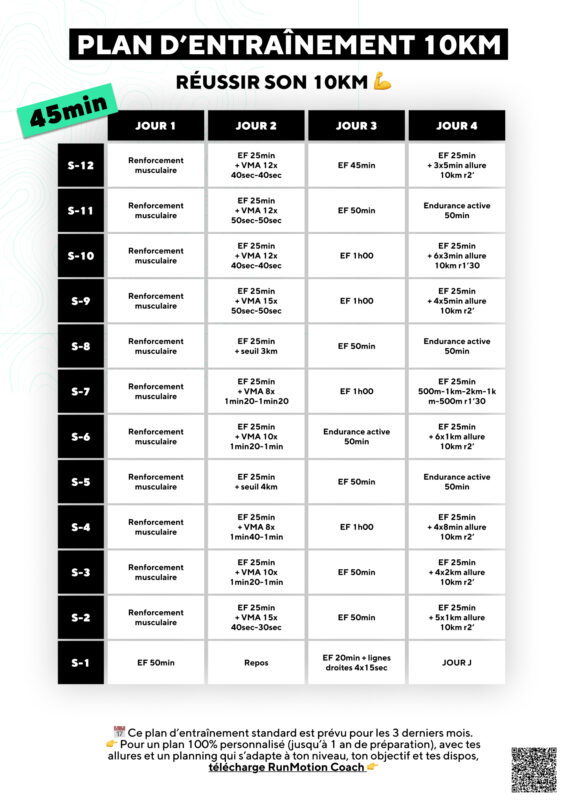
Here are the 10K training programs based on your experience and time goal:
But to go even further, nothing beats a personalized RunMotion Coach training plan that adapts to your goal, your progress, your fitness level, and your schedule!
Watch out for mistakes in some 10K training plans
Be careful, you can sometimes find 10K training plans online that prescribe paces as a percentage of vVO2max. That is not always very suitable, because in reality you need to take both your vVO2max and your endurance index into account. Calculating this endurance index requires entering two previous race times.
On top of that, many plans confuse % of vVO2max and % of Maximum Heart Rate…
Find your personalized 10K training plan
The key elements of a personalized 10K training plan include workout variety, gradual progression in distance and intensity, and proper recovery between sessions.
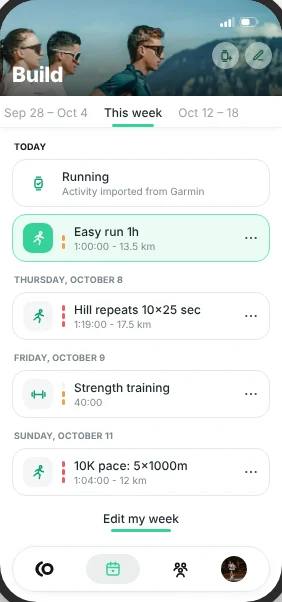
In the RunMotion Coach app, you’ll find a personalized 10K training plan whatever your experience or time goal. Your program is calculated according to your profile and availability, and your training paces are calculated directly for you.
Your 10K training plan on RunMotion Coach adapts to your availability every week. You can change your training days and choose when to schedule your long runs and interval sessions. So you no longer have to ask yourself, “What should I do if I missed one session or several sessions?” Your plan then adapts to your feedback. That’s exactly what gives you the best chance to beat your 10K personal best, or simply finish your race.
By following a 10K training plan that matches your level, you can improve your running performance. Even better than a standard plan, download the RunMotion Coach app to get a personalized 10K training plan. 😉
The 10K is a distance open to everyone, and it can also be a gateway to longer races. One of its big advantages is that it works well as either a main goal or an intermediate goal. Take a look here for the day you need a half marathon training plan.
FAQ – 10K training plan
How long does it take to prepare for a 10K?
The ideal duration depends on your current level. A beginner can plan on 8 to 12 weeks of preparation to finish a first 10K in good conditions. A more experienced runner can prepare for a specific time goal in 6 to 10 weeks.
How many workouts per week?
We recommend a minimum of 3 workouts per week. This allows you to combine easy aerobic running, a quality workout (intervals or race-pace work), and recovery. More advanced runners can add one or more extra sessions.
Is interval training essential for making progress?
Yes. Interval training helps improve speed, cardiovascular fitness, and your ability to maintain a fast pace. Workouts such as 5 to 8 x 1 km or 4 x 2 km are especially effective for preparing for a 10K.
How do you run a 10K in under 50 minutes?
To break 50 minutes, you need to hold an average pace of 5:00/km. Your preparation should include race-pace workouts, interval training, and regular easy aerobic running so you can develop both speed and endurance.
Why choose a personalized training plan?
Every runner has a different level, schedule, and goal. A personalized plan adapts the workouts, paces, and progression to your profile so you can maximize your chances of success while reducing the risk of injury.