For trail running, the right Garmin depends first on how long you run and on what terrain: a barometric altimeter is enough for a short marked trail, while maps and real battery life become essential once you spend hours on unfamiliar paths. In the 2026 range, five models stand out, from $249.99 / £219.99 to $999.99 / £859.99. Here’s which one to pick for your race format.
The short answer
- Short marked trails (up to 30 km): Forerunner 170 ($299.99 / £259.99), light and with a barometric altimeter.
- Tight budget, very rugged watch: Instinct 3 (from $249.99 / £219.99), with a flashlight and multi-band GPS, but no maps.
- Long trails and unfamiliar routes: Forerunner 970 ($749.99 / £629.99), with maps, ClimbPro and 26 hours of GPS.
- Ultra-trails and multi-day races: Enduro 4 ($899.99 / £799.99), up to 80 hours in normal GPS mode.
- One watch for the mountains and everyday life: fenix 9 (from $999.99 / £859.99).
Contents
Garmin list prices in the US and the UK as of November 10, 2026. You’ll often find them cheaper at retailers.
What a Garmin watch needs for trail running
On the trails, your watch does more than measure: it helps you pace your climbs and stay on course. Five criteria make the difference, in this order.
A barometric altimeter
It’s the bare minimum. It measures altitude from air pressure, far more precisely than GPS alone, and gives you reliable elevation gain. In the running range, only the Forerunner 70 lacks one: it isn’t made for trails. To understand why two watches never show the same elevation, read our article on how elevation gain is calculated in trail running.
Battery life that covers your longest run
Look at battery life in the mode you’ll actually use, not the record figure obtained with solar charging or one GPS point per minute. Keep at least a 30% margin: active navigation, cold and backlight all cut real-world battery life. For a 6-hour run, 8 rated hours are enough; for a 15-hour trail race, aim for at least 20.
Navigation: GPX course or maps
Every Garmin in this selection follows a GPX course and alerts you if you go off route. Topographic maps on your wrist (Forerunner 970, Enduro 4, fenix 9) are a game changer on unfamiliar trails, at night or when the course markings are gone. To load your race course, follow our guide on how to upload a GPX file to your watch.
Multi-band GPS
It picks up two frequency bands and limits errors in dense forest, deep valleys or near rock faces, where a standard watch cuts switchbacks and underestimates distance. It isn’t essential, but it’s a real plus in the mountains. The Forerunner 170 doesn’t have it.
Screen and toughness
An AMOLED screen is nicer to read; a MIP screen (Enduro 4, Instinct 3 Solar) uses far less power and stays readable in full sun. Cases with sapphire glass and a titanium bezel better withstand falls and scrapes against rocks.
Which Garmin for your type of trail running?
Short trails, up to 30 km: Forerunner 170
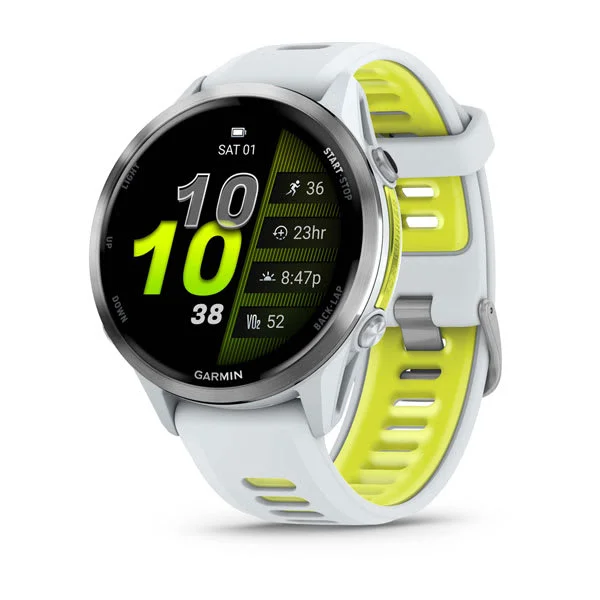
For 1 to 4-hour runs and well-marked races, you need reliable elevation data and a light watch, not maps. The Forerunner 170 ($299.99 / £259.99) ticks every box: barometric altimeter, compass, 20 hours of GPS and 41 g on your wrist. It’s also perfect for your road sessions. Its limit: no multi-band GPS, which you’ll notice in dense forest.
Who is it for? You’re new to trail running or training for a 20 km trail race, and you also run on the road.
Tight budget and rough terrain: Instinct 3
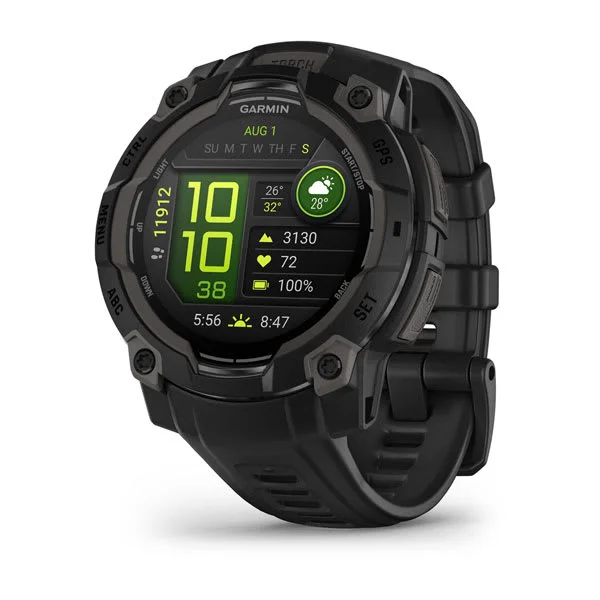
The Instinct 3 (from $249.99 / £219.99) is the toughest Garmin at this price. It has a barometric altimeter, multi-band GPS, a built-in flashlight and grade-adjusted pace. Garmin rates it at up to 40 hours of GPS for the AMOLED version, and 60 hours for the Solar version without sun. It lacks maps, ClimbPro and the estimate of your remaining energy (Stamina).
Who is it for? You run technical trails, you’re hard on your gear and you follow known routes.
Long trails, from 40 km to around 20 hours: Forerunner 970
It’s the most balanced trail watch in the range. The Forerunner 970 ($749.99 / £629.99) adds topographic maps with navigation, ClimbPro, Stamina, an LED flashlight and 26 hours of GPS, in a 56 g case with sapphire glass. It’s still light enough for everyday training.
Who is it for? You’re training for a trail marathon or 50K or longer, you often run unfamiliar routes, or you want one watch for both trails and roads.
Ultra-trails and multi-day races: Enduro 4
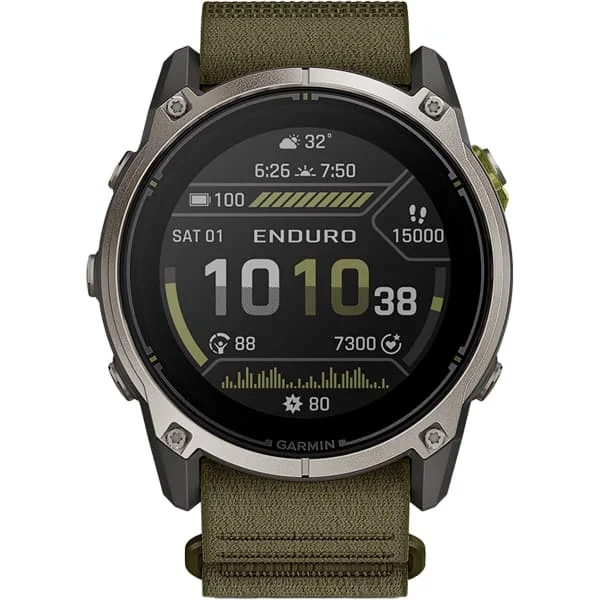
Beyond 24 hours, battery life comes first. The Enduro 4 ($899.99 / £799.99) is rated at up to 80 hours in normal GPS mode and 60 hours in max accuracy mode, without sun; the 320-hour figure is for the power-saving extended battery mode with solar charging. Solar MIP screen, maps, flashlight and 66 g: it’s built for nights out on the trail.
Who is it for? You’re aiming for a 100 km ultra, a 100-miler or a backyard ultra. To compare with other brands, read our guide to GPS watches for ultra-trail running.
Mountains, multisport and everyday life: fenix 9
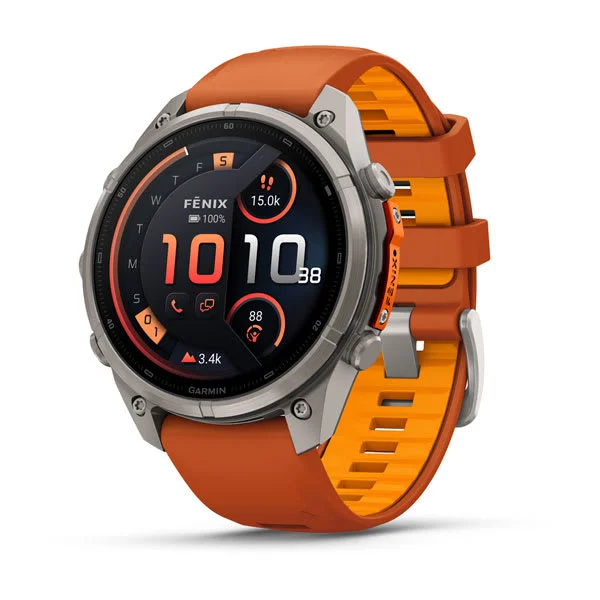
The fenix 9 (from $999.99 / £859.99) has the same trail tools as the 970 and the Enduro 4, with an AMOLED screen, 64 GB for maps and a very tough case. For the 47 mm model, Garmin rates it at 32 hours in normal GPS mode: enough for most trail races, tighter for a 100-miler.
Who is it for? You also hike, ski tour or ride, and you want one premium watch for everything.
What about the Forerunner 570?
It works for occasional trail running: altimeter, multi-band GPS, 18 hours of GPS. But with no maps or ClimbPro, it’s mainly a road watch. If trails are your main thing, the 970 is worth the extra cost. To compare it with the rest of the range, see our guide to the best Garmin watch for running.
A watch measures your elevation gain; a plan teaches you to manage it. RunMotion Coach builds your trail plan around your race distance, its elevation and the time you have, and sends your sessions to your Garmin watch. Try the app free for 7 days.
Garmin trail watch comparison
| Model | List price (US / UK) | Best for | GPS battery (standard mode) | Multi-band battery | Maps | ClimbPro | Stamina | Flashlight |
|---|---|---|---|---|---|---|---|---|
| Instinct 3 | from $249.99 / £219.99 | Rough terrain, tight budget | 40 h (AMOLED), 60 h (Solar) | 30 h (AMOLED) | No | No | No | Yes |
| Forerunner 170 | $299.99 / £259.99 | Short trails | 20 h | — | No | No | No | No |
| Forerunner 570 | $549.99 / £429.99 | Occasional trails | 18 h | 13 to 14 h | No | No | No | No |
| Forerunner 970 | $749.99 / £629.99 | Long trails | 26 h | 21 h | Yes | Yes | Yes | Yes |
| Enduro 4 | $899.99 / £799.99 | Ultra, multi-day | 80 h | 60 h | Yes | Yes | Yes | Yes |
| fenix 9 (47 mm) | from $999.99 / £859.99 | Mountains, multisport | 32 h | 26 h | Yes | Yes | Yes | Yes |
Battery life as rated by Garmin without solar charging. “Standard mode” = GPS only or normal activity mode; “multi-band” = all systems + multi-band, or max accuracy on the Enduro and fenix. All of them have a barometric altimeter.
The Garmin features that really matter on the trails
Garmin watches pile up metrics. On the trails, four features really change your race; the rest is mostly useful afterwards, in the app.
ClimbPro (Forerunner 970, Enduro 4, fenix 9). When you follow a course, the watch splits it into climbs and shows the elevation and distance left on the one you’re on. Knowing you have 250 m of climbing left rather than 600 completely changes how you pace yourself.
Grade-adjusted pace. It converts your uphill or downhill pace into its flat equivalent. You can compare hilly runs with each other and spot whether you start the first climb too fast. On the Enduro 4, it can also be used as a workout target.
Stamina (Forerunner 970, Enduro 4, fenix 9). The watch estimates how much energy you have left from your heart rate and pace. It’s a guide, not the truth: on an ultra, muscle fatigue, heat and fueling often matter more than the algorithm can see.
Navigation and TracBack. Course following with off-course alerts is available on every model in this selection. TracBack takes you back along the path you came, useful if you need to turn around in the mountains. Topographic maps (970, Enduro 4, fenix 9) add context: nearby trails, streams, terrain.
One last tip: keep your data screens simple. Time, distance, elevation gain and ClimbPro are enough on race day. To decide how to spread your effort over the course, build your trail race plan too.
Frequently asked questions
What is the best Garmin watch for trail running?
For most trail runners, the Forerunner 970: maps, ClimbPro, a flashlight and 26 hours of GPS in a watch light enough for every day. If you mostly run short races, the Forerunner 170 is enough; if you run ultra after ultra, the Enduro 4 is the safer bet.
Do you need maps on your watch for trail running?
Not on a well-marked race: a GPX course with off-course alerts is enough. Maps become very useful at night, when markings are missing or when you train on routes you don’t know.
Forerunner 970 or Enduro 4 for an ultra?
It depends on how long your race lasts. The 970 lasts about 21 hours in multi-band mode and 26 hours in GPS-only mode: it suits ultras you finish in under 20 hours. Beyond that, the Enduro 4 and its 60 hours in max accuracy mode spare you from charging mid-race.
Is multi-band GPS essential for trail running?
No, but it’s a real plus in dense forest and deep valleys, where a standard watch cuts switchbacks and underestimates distance. It uses more power: check battery life in that mode before a long race.
Can you follow a RunMotion Coach trail plan on a Garmin watch?
Yes. Once Garmin Connect is linked to the app, your runs sync with their elevation and your plan’s sessions are exported to your watch. Here’s how: sync your activities with RunMotion Coach.
The bottom line
To choose your Garmin trail watch, start from your longest run: the Forerunner 170 for short races, the Forerunner 970 as soon as you spend hours on unfamiliar trails, the Enduro 4 for ultras and nights out. The Instinct 3 and the fenix 9 meet more specific needs: toughness on a budget, or one premium watch for everything. Then test everything in training: course, data screens and battery life are validated on a long run, not on race day.
Ready to give your new watch a goal? Start your 7-day free trial: RunMotion Coach builds your trail plan and sends it to your Garmin. You can also browse our trail running training plans.
Article updated on November 10, 2026. List prices and battery life from Garmin’s US and UK websites, subject to change.