 In trail running, cumulative elevation is just as important as distance. The higher the cumulative elevation, the harder the course. Let’s see how to calculate the different types of elevation, and why cumulative elevation gain is the one used in trail running. This will help you choose the trail that suits you best.
The short answer
- Positive elevation gain (D+) is the sum of all the climbs on a route, in meters.
- To calculate it, add up the altitude gained on each climb, without subtracting the descents.
- Example: +200 m, -300 m, +600 m, -100 m gives 800 m of D+ and 400 m of D-.
- To compare two trails, use km-effort: distance in km + D+ divided by 100.
Contents
- What is elevation?
- How is cumulative elevation calculated on a race?
- Is D+ the number one difficulty in trail running?
- How do you calculate the percentage of a slope?
- How can you know the D+ of a route before running it?
- How do GPS and barometric watches calculate elevation?
- Frequently asked questions about positive elevation gain
- Sources
What is elevation?
Elevation is the difference in altitude between the start and the finish of your race. Imagine a start at 100 m altitude and a finish at 600 m. That gives a positive elevation of 500 m: finish altitude – start altitude = 600 – 100 = 500.
The UTMB (Ultra-Trail du Mont-Blanc) has an elevation of… 0 meters! Yes, the start and finish are in the same place. That is why cumulative elevation is much more useful to measure the difficulty of a trail!
How is cumulative elevation calculated on a race?
For a race, the organizers add up the altitude gained and lost on every climb and descent: this is the cumulative elevation.
Imagine a route with 200 m of climbing and 300 m of descent, then another 600 m of climbing and 100 m of descent. That gives 1,200 m of cumulative elevation. The famous 6000D in La Plagne uses this calculation. It is also often used for hiking.
When you only look at the climbs, you talk about positive cumulative elevation: the famous D+. In our example, the positive cumulative elevation is 800 m. In trail running, D+ is the figure everyone remembers. On the UTMB, the D+ is 10,000 m!
Negative cumulative elevation (D-) is also a useful indicator. The higher it is, the more your muscles need to be ready to absorb the impact of the descents.
Step-by-step D+ calculation example
Take a route starting at 400 m altitude. Note the altitude at each change of slope, then calculate the variation of each section.
| Section | Start altitude | End altitude | Variation | Counts in |
|---|---|---|---|---|
| 1. Climb | 400 m | 600 m | +200 m | D+ |
| 2. Descent | 600 m | 300 m | -300 m | D- |
| 3. Climb | 300 m | 900 m | +600 m | D+ |
| 4. Descent | 900 m | 800 m | -100 m | D- |
| Total | D+ = 800 m, D- = 400 m |
Total cumulative elevation is 1,200 m (800 + 400), while the difference between start and finish is only 400 m.
Is D+ the number one difficulty in trail running?
In trail running, difficulty comes down to two main factors: distance and positive cumulative elevation. On a 20 km race with 1,000 m of D+, the difficulty will be higher than on a trail with 500 m of D+ over the same distance.
To compare two trails, we use the kilometer-effort (km-effort), defined by the ITRA: each kilometer counts for 1, and every 100 m of D+ adds 1 km-effort. In the example above, a 20 km trail with 1,000 m of D+ represents 20 + 10 = 30 km-effort. The ITRA uses it in particular to rank trail races.
km-effort = distance (km) + D+ (m) ÷ 100
| Trail | Distance | D+ | Km-effort |
|---|---|---|---|
| Short rolling trail | 20 km | 500 m | 25 |
| Short mountain trail | 20 km | 1,000 m | 30 |
| Mountain trail marathon | 42 km | 2,500 m | 67 |
| Mountain ultra | 100 km | 6,000 m | 160 |
However, km-effort is theoretical, and other coefficients are more accurate to calculate an equivalent flat pace and take into account the technicality of the course and the steepness of the slopes.
Choose your trail according to your abilities and experience. Before signing up, study the course carefully.
How do you calculate the percentage of a slope?
Slope percentage is calculated by dividing the elevation by the horizontal distance, then multiplying by 100. A 150 m climb over 1 km therefore has an average gradient of 15%. On a map, the distance measured is horizontal; on your watch, it follows the terrain, but the difference remains small as long as the gradient does not exceed 20 to 30%.
Another useful benchmark: average D+ per kilometer. A 20 km trail with 1,000 m of D+ climbs an average of 50 m per kilometer. Above 50 m/km, expect to walk some of the climbs. Our tips to improve your uphill running.
How can you know the D+ of a route before running it?
For a race, the organizers usually publish the D+ and the GPX track of the course. For a run you plan yourself, draw the route on an online map with an elevation profile, such as your national mapping service or a route planner, or in your watch’s route creation tool. The profile shows you the D+, the D- and where the climbs are. Compare several sources: they can differ by a few percent.
How do GPS and barometric watches calculate elevation?
Smartwatches calculate distance, time, positive and negative elevation, and pace. There are two types of watches to measure the difference in altitude: GPS watches and barometric watches. Some watches now even use both technologies.
A GPS watch calculates its position from the signal of several satellites. You need to wait for the watch to sync with the satellites before starting your session.
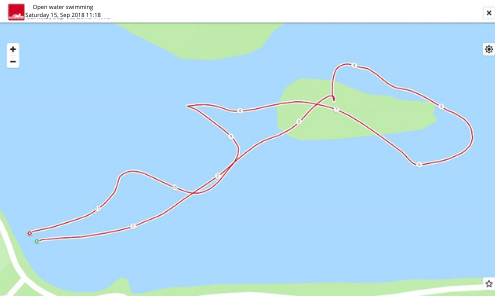
It is sometimes difficult to get good satellite reception in a forest or in the mountains, which causes irregularities in your GPS track (like below: the GPS track of a swim… we ended up on the island).
Barometric watches have a sensor that measures variations in atmospheric pressure and uses them to calculate changes in altitude and elevation. They are more accurate than GPS watches, but they are sensitive to external factors such as changes in weather conditions.
Atmospheric pressure depends on altitude and on weather conditions. If the weather stays the same, altitude can be measured very precisely. That is why some watches combine GPS and barometer to be more accurate.
Finally, the last solution, used by Strava in particular, is to take the GPS track and overlay it on topographic elevation models to recalculate the altitude variations along the route.
Why don’t two watches show the same D+?
On the same run, two watches can show different D+ values. GPS altitude is less accurate than horizontal position, and every small error adds up in the total. A barometer is more accurate, but it drifts when the weather changes during the run. Finally, each brand smooths the data differently and ignores small variations to a greater or lesser extent. To limit the gap, calibrate your watch’s altimeter at the start, at a known altitude.
If you are thinking of buying a smartwatch, read our article How to choose your GPS watch?
And to prepare for the elevation of your next trail, check out our trail running training plan.
Frequently asked questions about positive elevation gain
What does D+ mean in trail running?
D+ means positive cumulative elevation: the sum of all the climbs on the route, in meters. D- is the sum of the descents.
What is the difference between elevation and cumulative elevation?
Elevation is the difference in altitude between the start and the finish. Cumulative elevation adds up all the climbs and descents. A loop has zero elevation, but can have several thousand meters of D+.
How much D+ for a 20 km trail?
It ranges from a few hundred meters for a rolling trail to 1,000 m or more in the mountains. With 1,000 m of D+, count 30 km-effort. See our 20 km trail training plan.
How do you convert elevation into kilometers?
With km-effort: 100 m of D+ is equivalent to 1 km on the flat. 20 km with 1,000 m of D+ therefore equals 30 km-effort.
My watch shows more D+ than the organizers: who is right?
Neither is accurate to the meter. GPS watches tend to overestimate D+, while map measurements tend to smooth it out. A difference of a few percent is normal.
Sources
- ITRA, organizers FAQ: definition of km-effort – itra.run/FAQ/Organizers