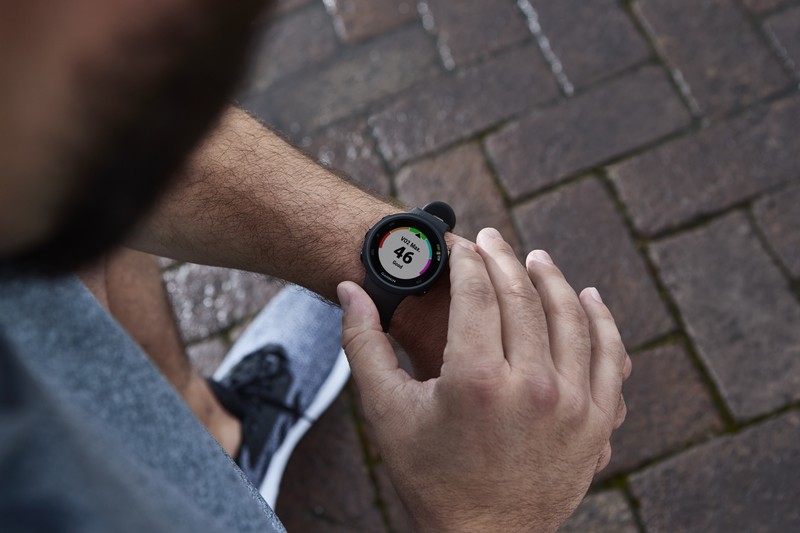
Not sure which Garmin to buy for running? The right choice mostly depends on how you run, and especially on your longest run of the year. The Forerunner 70 or 170 is all you need to start and improve on the road. The Forerunner 570 suits runners training seriously, and the Forerunner 970 is built for long trail runs and ultras.
If you mainly want an everyday smartwatch that can also track your runs, look at the Vivoactive 6 or the Venu 4 instead.
The short answer
- You’re starting out or you run on the road: Forerunner 70 ($249.99 / £219.99).
- You also run on trails or want to pay with your watch: Forerunner 170 ($299.99 / £259.99, or $349.99 / £299.99 for the Music version).
- You’re training for a marathon or half marathon with a time goal: Forerunner 570 ($549.99 / £429.99).
- You run long trails or ultras and need maps: Forerunner 970 ($749.99 / £629.99).
- You run ultras lasting more than 24 hours: Enduro 4 ($899.99 / £799.99).
- You mainly want an everyday watch: Vivoactive 6 or Venu 4.
Contents
- What to look at before buying a Garmin running watch
- Which Garmin watch for your running profile?
- Garmin Forerunner 70: the entry-level watch for beginners
- Garmin Forerunner 170 and 170 Music: the best value
- Garmin Forerunner 570: for structured training with a time goal
- Garmin Forerunner 970: for trail running and ultras
- Vivoactive 6 and Venu 4: everyday watches that can run too
- What about the fenix, Enduro or Instinct?
- Garmin running watch comparison 2026
- Mistakes to avoid when choosing your Garmin
- Following your RunMotion Coach sessions on your Garmin watch
- Frequently asked questions
Prices are Garmin’s official list prices in the US and the UK. You’ll often find them cheaper at retailers.
What to look at before buying a Garmin running watch
- The screen: the whole running range now uses bright, easy-to-read AMOLED displays.
- GPS accuracy: multi-band GPS (Forerunner 570, Forerunner 970, Venu 4) is more reliable between tall buildings and in dense forest.
- The barometric altimeter: essential for accurate elevation on trails. The Forerunner 70 doesn’t have one.
- Battery life: look at GPS hours if you’re preparing long runs.
- Music: to run without your phone, you need a Music or high-end model.
- Maps: in the Forerunner range, only the Forerunner 970 offers topographic maps with navigation.
Which Garmin watch for your running profile?
Before comparing spec sheets, start from how you run. One question often settles it: what is your longest run of the year, and on what terrain? That run sets the GPS battery life, altimeter and maps you need. The rest is comfort.
You’re new to running or getting back into it
You need a watch that measures your distance, pace and heart rate accurately, and tells you when to ease off. The Forerunner 70 does all of that for $249.99 / £219.99, with a bright AMOLED screen and just 40 g on your wrist. Its 23 hours of GPS cover weeks of 30 to 60-minute runs between charges.
Don’t jump straight to a $500 model: advanced metrics only start to make sense once you’ve been running regularly for a few months. If you’re still finding your rhythm, our guide on how to start running will help you more than a pricier watch.
You run regularly, from 10K to half marathon
Three to five runs a week, some trails, a few interval sessions: the Forerunner 170 ($299.99 / £259.99) is the sweet spot. It adds a barometric altimeter, a compass and Garmin Pay to the 70. The Music version ($349.99 / £299.99) is only worth it if you often run without your phone.
For this profile, the most useful feature is following structured workouts on your wrist: target pace, recoveries, number of reps. Every Forerunner does it.
You’re training for a marathon with a time goal
For a marathon, two things matter most: a reliable pace reading and enough battery for your long runs and race day without stress. The Forerunner 570 ($549.99 / £429.99) ticks both boxes. Its multi-band GPS keeps your instant pace steadier in cities, between tall buildings, where standard GPS makes your displayed pace jump around more. Its 18 hours of GPS leave plenty of margin, even for a 5-hour marathon.
Keep in mind that your watch doesn’t set your race pace: it displays it. To decide how fast to start, rely on your training plan and our article on marathon pacing strategy.
You run trails, short or long
Once elevation comes into play, a barometric altimeter becomes essential, which rules out the Forerunner 70. On marked trails up to 30 or 40 km, the Forerunner 170 is enough. If you run unfamiliar routes or go beyond 5 to 6 hours, go for the Forerunner 970 ($749.99 / £629.99): topographic maps, GPX course navigation, a built-in flashlight and 26 hours of GPS. To go further, our guide to the best Garmin trail running watch compares the models by race format.
You run ultras or efforts longer than 24 hours
Beyond 20 to 24 hours, battery life becomes the first criterion, ahead of the screen. Without solar charging, Garmin rates the Enduro 4 ($899.99 / £799.99) at up to 80 hours in normal activity mode, 120 hours in extended battery mode and 60 hours in max accuracy mode; with its solar lens in full sun, extended battery mode reaches up to 320 hours. Its MIP screen is less striking than AMOLED but uses very little power. The fenix 9 (from $999.99 / £859.99) is more for trail runners who want one premium watch for the mountains, everyday life and other sports.
For a 100K or a 100-miler, check the battery mode you’ll actually use: the figures in max accuracy or multi-band mode are much lower. Our guide to choosing a GPS watch for ultra-trail running covers this in detail.
You do triathlon
The Forerunner 970 is the most complete multisport watch in the running range: pool and open-water swim profiles, transitions between sports, cycling dynamics. On a tighter budget, the Forerunner 570 also offers triathlon, duathlon, brick and swimrun profiles with automatic transitions; it mainly lacks maps and a few hours of battery life.
You mainly want an everyday watch
If running is just one of your activities, look at the Vivoactive 6 or the Venu 4, covered further down. They track a run very well, but they’re less suited to structured training.
Garmin Forerunner 70: the entry-level watch for beginners
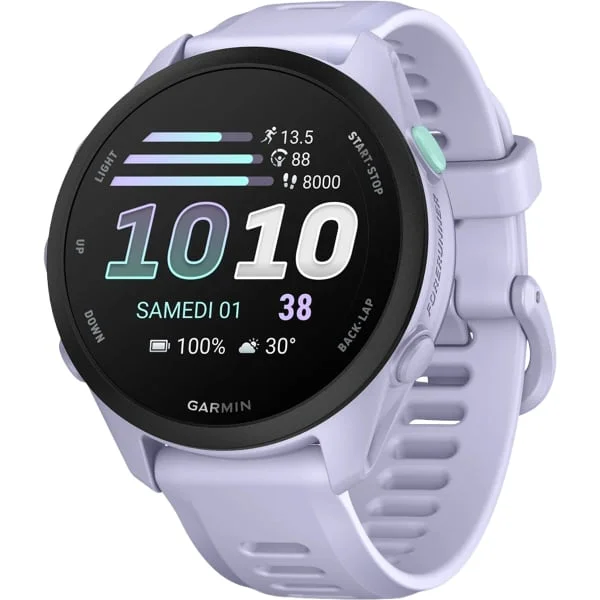
Announced in May 2026, the Forerunner 70 replaces the Forerunner 55. It has a 1.2-inch AMOLED touchscreen and weighs 40 g. It brings tools that used to be reserved for pricier models, such as training status and wrist-based running power.
Garmin quotes up to 13 days of battery life in smartwatch mode and 23 hours in GPS-only mode.
Its limits: no barometric altimeter or compass, no contactless payments, and swimming is pool-only. It’s perfect on the road, less so as soon as the route gets hilly.
Who is it for? You’re new to running, or you’re preparing your first 10K or half marathon.
Garmin Forerunner 170 and 170 Music: the best value
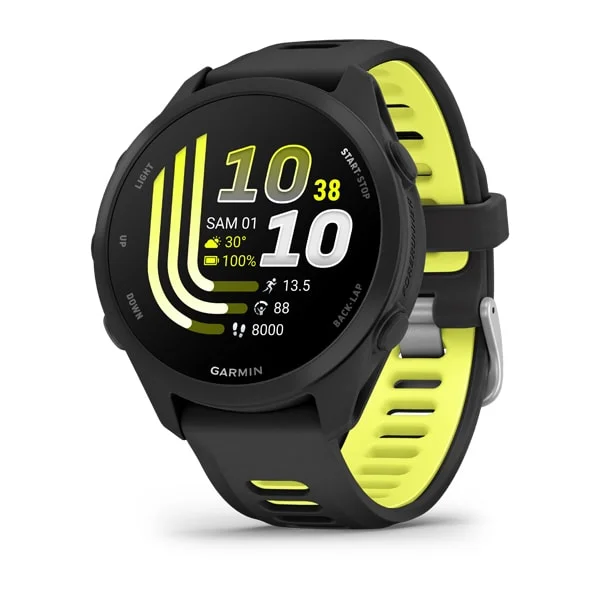
The Forerunner 170 succeeds the Forerunner 165. It keeps the size and screen of the Forerunner 70 and adds a barometric altimeter, a compass, Garmin Pay and an open-water swim profile.
Garmin quotes up to 10 days in smartwatch mode and 20 hours in GPS-only mode. The Music version lets you store your music and sync playlists from Spotify, Deezer, Amazon Music or YouTube Music, so you can run without your phone.
Its limit: no multi-band GPS.
Who is it for? You run regularly and mix road and trails.
Garmin Forerunner 570: for structured training with a time goal
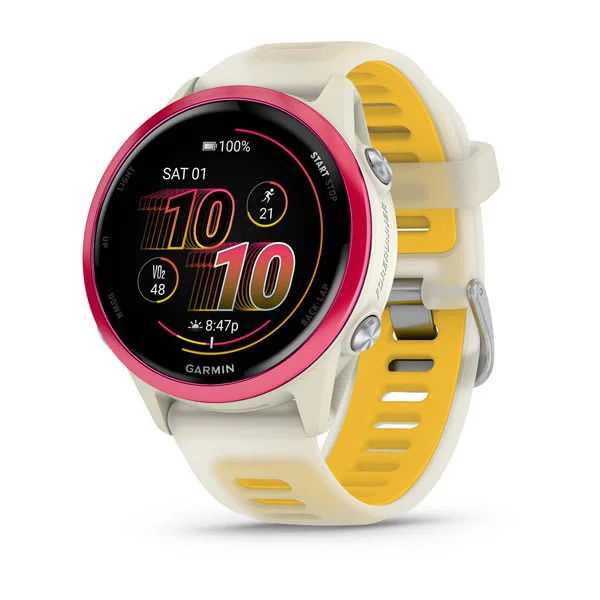
Released in 2025, the Forerunner 570 succeeds the Forerunner 265. It comes in 42 mm and 47 mm with a very bright AMOLED screen. It adds multi-band GPS, music, and a speaker and microphone so you can take calls during your run.
Garmin quotes up to 11 days in smartwatch mode. For training, you get Garmin Coach plans and an evening report that sums up your day.
Who is it for? You’re preparing a half marathon or a marathon with a time goal.
A watch measures, a plan makes you progress. RunMotion Coach builds a personalized training plan based on your level and your goal, and your sessions can be exported to your Garmin watch. Try RunMotion Coach free for 7 days.
Garmin Forerunner 970: for trail running and ultras
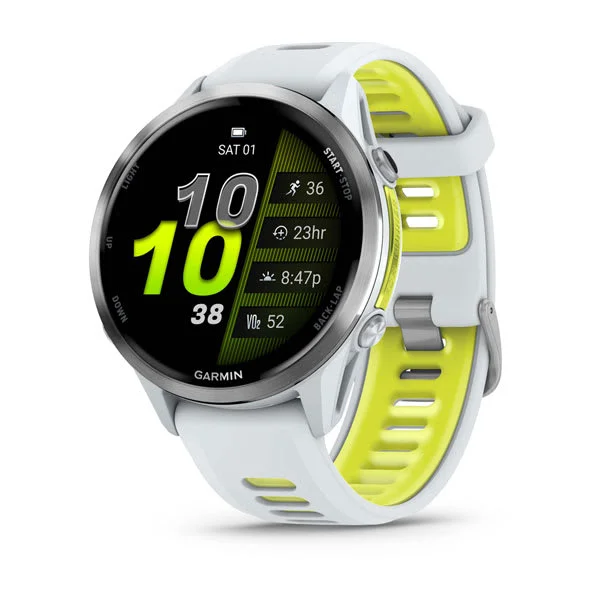
The Forerunner 970 is the most complete model in the range. 47 mm case, 1.4-inch AMOLED screen, sapphire glass and titanium finishes. It adds a built-in LED flashlight, topographic maps with navigation and an ECG.
Garmin quotes up to 15 days in smartwatch mode. It also offers advanced metrics: running economy, step speed loss and running tolerance.
Who is it for? You run long trails or ultras, or often run routes you don’t know. Remember to upload your race GPX file to follow the course.
Vivoactive 6 and Venu 4: everyday watches that can run too
If running is just one of your activities, these two models are designed to be worn every day.
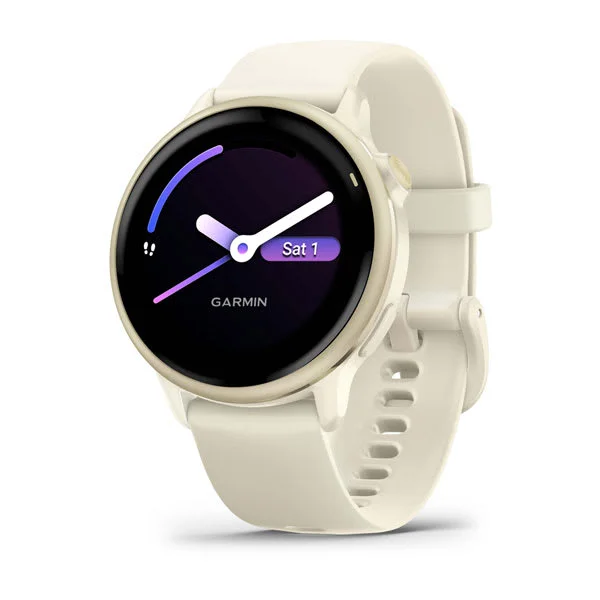
The Vivoactive 6 ($299.99 / £269.99) has an AMOLED screen, up to 11 days of battery life and stores your music. It offers more than 50 sports, Garmin Coach plans, PacePro, recovery time and heart rate variability tracking.
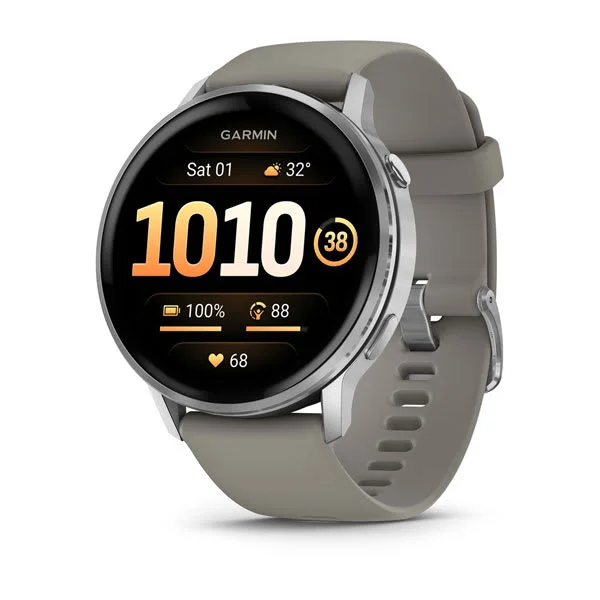
The Venu 4 (from $549.99 / £439.99, in 41 mm or 45 mm) goes further: multi-band GPS, barometric altimeter, built-in flashlight, speaker and microphone, ECG and up to 12 days of battery life.
What about the fenix, Enduro or Instinct?
These are Garmin’s outdoor watches: tougher cases, longer battery life, more advanced maps and navigation. They share the training tools of the high-end Forerunners, but what you’re really paying for is battery endurance and toughness. For most road runners, a Forerunner is more than enough.
Enduro 4: built for ultra-endurance
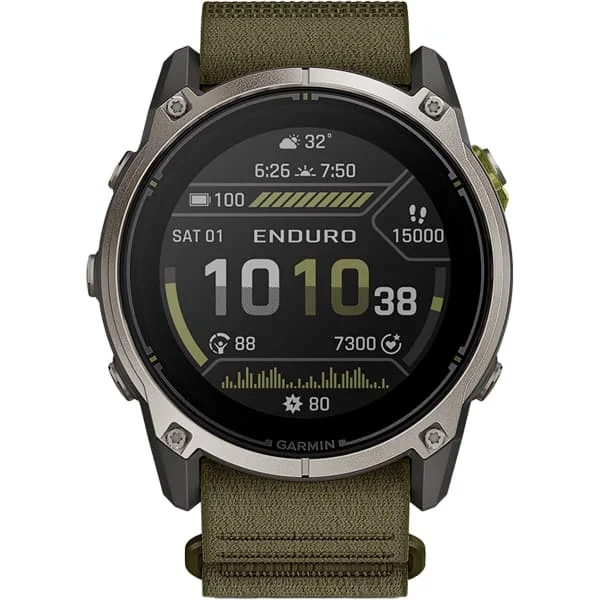
Released in October 2026 at $899.99 / £799.99, the Enduro 4 keeps the Enduro 3 recipe: a 51 mm case, a 1.4-inch MIP screen and a solar lens. Without solar charging, Garmin rates it at up to 80 hours in normal activity mode, 120 hours in extended battery mode and 60 hours in max accuracy mode; the solar lens pushes extended battery mode up to 320 hours in full sun. It weighs 66 g. It adds grade-adjusted pace, useful for managing your effort on climbs, and power modes ranging from max accuracy to max battery.
Who is it for? You run ultras of more than 24 hours, multi-day events or backyard ultras, and you don’t want to think about charging.
fenix 9: the premium all-rounder
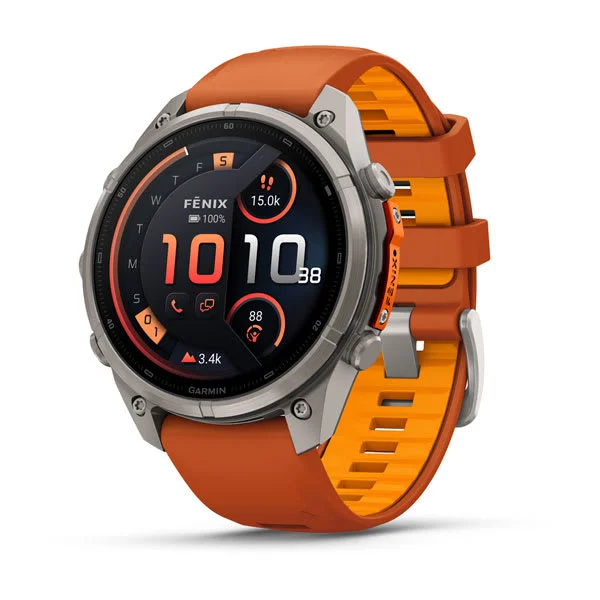
Available since late August 2026, the fenix 9 starts at $999.99 / £859.99 in 43, 47 and 51 mm sizes, with an AMOLED screen and 64 GB of storage for maps. For the 47 mm model, Garmin rates it at up to 32 hours in normal activity mode, for 78 g. The Pro version moves to a titanium case, with inReach satellite connectivity now available as a paid option.
Who is it for? You want one watch for trails, mountains, cycling and everyday life, and budget isn’t your main concern.
Instinct 3: rugged on a budget
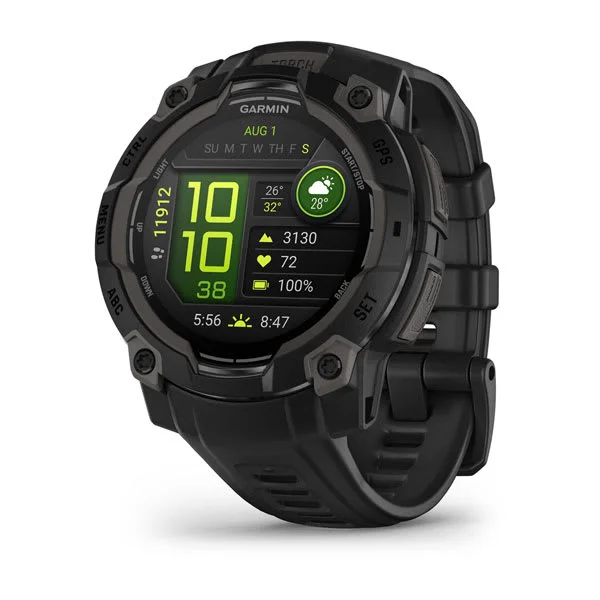
From $249.99 / £219.99, the Instinct 3 is for runners who want a very tough outdoor watch without going up to a fenix. It comes in AMOLED or Solar versions (monochrome screen and solar lens), with a barometric altimeter, multi-band GPS, running power and training readiness. Garmin rates it at up to 40 hours of GPS-only use for the AMOLED and 60 hours for the Solar without sun. There are no topographic maps, though.
Who is it for? You run on trails, you’re hard on your gear and you value toughness over the screen.
Garmin running watch comparison 2026
| Model | List price (US / UK) | Profile | GPS battery (standard mode) | Multi-band GPS | Barometric altimeter | Maps | Weight |
|---|---|---|---|---|---|---|---|
| Forerunner 70 | $249.99 / £219.99 | Beginner, road | 23 h | No | No | No | 40 g |
| Forerunner 170 | $299.99 / £259.99 (Music: $349.99 / £299.99) | Regular runner, road and trails | 20 h | No | Yes | No | 41 g |
| Forerunner 570 | $549.99 / £429.99 | Marathon, time goal | 18 h | Yes | Yes | No | 42 g (42 mm) / 50 g (47 mm) |
| Forerunner 970 | $749.99 / £629.99 | Long trails, triathlon | 26 h | Yes | Yes | Yes | 56 g |
| Enduro 4 | $899.99 / £799.99 | Ultra-trail | 80 h (120 h in extended battery mode, up to 320 h with solar) | Yes | Yes | Yes | 66 g |
| fenix 9 (47 mm) | from $999.99 / £859.99 | Mountains, multisport, everyday | 32 h | Yes | Yes | Yes | 78 g |
Battery life as rated by Garmin in standard GPS mode: it drops with multi-band GPS, music or an always-on screen.
Full specifications are on Garmin’s official website.
Mistakes to avoid when choosing your Garmin
Buying for your dream race instead of your everyday running. An Enduro for an ultra you might run in three years means paying several hundred more for a watch you wear every day. Choose for the next 12 months of running; a Forerunner 970 already covers most trail races up to around 20 hours.
Reading battery life in the wrong mode. The headline figure is often for GPS-only mode, or even with solar charging. With multi-band GPS, music or an always-on screen, it can be cut in half. For a long trail race, check the mode you’ll actually use and keep at least a 20% margin.
Paying for multi-band GPS you don’t need. It improves your track in cities and dense forest. If you mostly run on open roads and trails, standard GPS will give you very similar distances.
Thinking metrics replace a training plan. Estimated VO2max, training load and race predictions are useful benchmarks, not a program. They tell you where you stand; they don’t tell you what to do week after week to reach your goal.
Overlooking comfort. A watch weighing nearly 80 g feels very different from a 40 g one on a slim wrist, especially at night if you track your sleep. If you can, try it on in a store before buying.
Following your RunMotion Coach sessions on your Garmin watch
RunMotion Coach works with Garmin Connect. Once both apps are linked, your activities sync automatically to the app. The other way round, you can export the sessions from your plan to your watch and follow them during your run, without having to remember paces or durations.
Here’s how: sync your activities with RunMotion Coach.
Frequently asked questions
Which Garmin watch is best for beginner runners?
The Forerunner 70 is the best fit: simple, light and complete for road running. If you also run on trails, the Forerunner 170 adds a barometric altimeter for $50 / £40 more.
Do you need multi-band GPS?
No. It improves accuracy between tall buildings and in dense forest. On open routes, standard GPS is enough for most runners.
Which Garmin watch is best for trail running?
Choose at least a model with a barometric altimeter, like the Forerunner 170. For ultras or unfamiliar routes, the Forerunner 970 adds maps, a flashlight and more battery life.
Can you follow a RunMotion Coach plan on a Garmin watch?
Yes. Your plan’s sessions can be exported to your Garmin watch through Garmin Connect. Here’s how.
Which Garmin watch is best for a marathon?
The Forerunner 570 is the best fit: multi-band GPS for a steady pace in cities and 18 hours of GPS, plenty for long runs and race day. The Forerunner 170 is enough if your goal is mainly to finish and you run on open courses. To structure your preparation, choose a marathon training plan that matches your goal.
Forerunner 570 or Forerunner 970: which one should you choose?
If you mostly run on the road, the 570 covers the essentials for $200 / £200 less. The 970 is worth it if you need maps, a flashlight, more battery life (26 h vs 18 h of GPS) or a bigger screen for long trails and triathlon.
Enduro 4 or fenix 9 for ultra-trail running?
The Enduro 4 if battery life comes first: up to 80 hours in normal activity mode without sun, versus 32 hours for the 47 mm fenix 9. The fenix 9 if you want an AMOLED screen, more storage for maps and a watch you’ll also wear every day.
Should you buy an older Forerunner on sale?
It’s a good option if the price gap is significant. The Forerunner 265, still sold by Garmin, remains very capable for training, with an AMOLED screen and multi-band GPS. Just check it has what you need (altimeter, multi-band GPS, maps) and compare it with the price of its successor, which is often close once discounts apply.
Ready to give your new watch a real goal? Try RunMotion Coach free for 7 days and get your personalized plan. You can also predict your 10K, half marathon or marathon time.
Article updated on November 10, 2026. List prices from Garmin’s US and UK websites, subject to change.