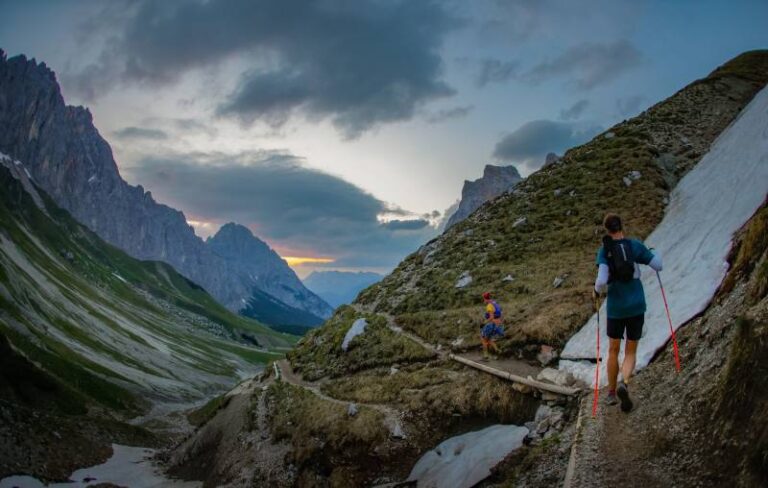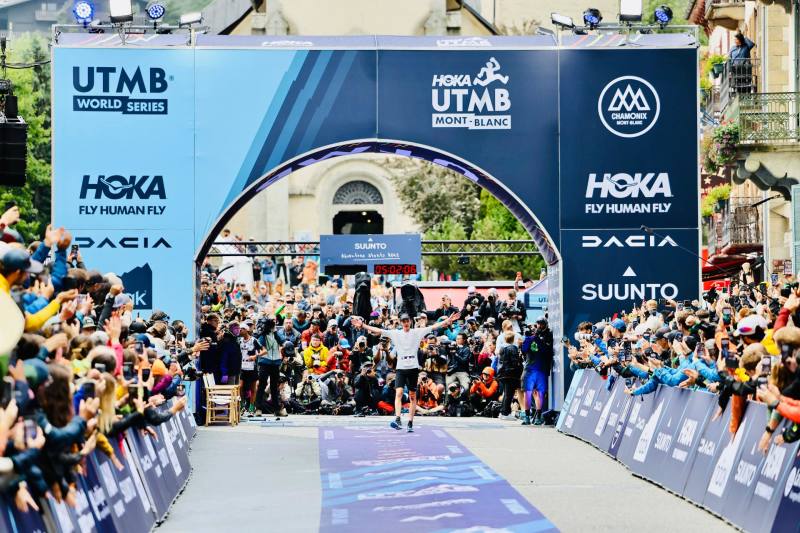
An OCC training plan needs to prepare you for 60 km and 3500 m of elevation gain from Orsières, in Switzerland, to the finish arch in Chamonix. The OCC is the 50K Final of the UTMB World Series: shorter than its big sisters, but raced fast, with steep climbs and a final section that punishes any pacing mistake. Here is how to train for the OCC and which sessions to prioritise.
The short answer
- Plan 4 to 6 months of specific training if you have already raced 30 to 40 km in the mountains; longer if the OCC is your first race of this size.
- At peak, intermediate runners often train 6 to 9 hours a week with 1500 to 2500 m of weekly elevation gain. Adjust to your history.
- Key sessions: threshold hill repeats, 3 to 5 hour mountain long runs, fast downhill repeats, climb-and-descend efforts on tired legs.
- The defining challenge: a fast race on mountain terrain, with several passes to link and a 14 h 30 time limit.
Contents
OCC distance and elevation gain
| Race | Distance | Elevation gain | Profile / notes |
|---|---|---|---|
| OCC® | 60 km | 3500 m | UTMB World Series 50K Final. Starts in Orsières (Switzerland), finishes in Chamonix. High point: Tête de Balme (2321 m). Time limit: 14 h 30. |
The OCC starts in Orsières, in the Val d’Entremont in Valais, and follows the eastern spurs of the Mont-Blanc massif. The route passes Champex-Lac and Trient, crosses into France at the Col de Balme, climbs to the Tête de Balme, the course’s new high point, then drops to Vallorcine and Le Tour before reaching Chamonix via the Col des Posettes. It takes place in late August, in the middle of UTMB week. Official details are on the OCC race page.
The other races of HOKA UTMB Mont-Blanc week:
| Race | Distance | Elevation gain | Category |
|---|---|---|---|
| UTMB® | 174 km | 9700 m | 100M Final |
| TDS® | 145 km | 9500 m | 4 Running Stones |
| CCC® | 108 km | 6200 m | 100K Final |
| MCC® | 40 km | 2350 m | 2 Running Stones |
| ETC® | 15 km | 1200 m | 1 Running Stone |
| YCC® | 15 km | 1200 m | Youth race, 1 Running Stone |
| PTL® | 300 km | 25000 m | Teams of 2 or 3, no ranking |
What makes the OCC demanding
With close to 60 m of climbing per kilometre on average, the OCC is a proper mountain race, not a runnable 50K. Climbs come one after another, and the final section, from the Col de Balme over the Tête de Balme to the Col des Posettes, arrives just as your reserves start to fade. That is often where positions and comfortable finishes are decided.
The format also sets a pacing trap: because the distance feels manageable, many runners go out at short-trail pace. Over 60 km with this much climbing, effort control on the early climbs, regular fueling and the ability to run the descents well matter more than pure speed. For mid-pack runners, the 14 h 30 limit also means no lingering at aid stations.
How long should you train for the OCC?
If you have already raced 30 to 40 km in the mountains, 4 to 6 months of specific training is a good benchmark. Coming from road running or short trails, allow 8 to 12 months, with an intermediate race of around 30 km in spring. Our article on planning your trail running season helps you place that stepping-stone race. The CCC, TDS and UTMB require much longer preparation and more experience; the MCC calls for slightly less than the OCC.
The phases of your OCC training plan
Base phase. Build endurance with regular easy runs plus one or two quality sessions a week. Because the OCC is raced fast, keeping some VO2max work (short, hard intervals) and threshold work makes sense: it lets you run the faster sections without redlining. Start strength training here too.
Specific phase. Over the 8 to 10 weeks before your taper, gradually increase elevation and time on feet, with a lighter week every three or four weeks. Run in the mountains, test your poles, vest and fueling. A 25 to 40 km race about six weeks out is a great dress rehearsal.
Taper. Two weeks of reduced volume with a few short bursts of intensity, so you reach Orsières fresh.
Key sessions for the OCC
Threshold hill repeats. For example 4 to 6 × 6 to 8 minutes uphill at threshold, jogging down. They make you more efficient on the steep climbs.
Mountain long run. Three to five hours depending on your level, with significant climbing. Practise switching between running and power hiking, and eat exactly as you will on race day.
Fast downhill repeats. Three to five minute descents at a strong but controlled pace, then longer descents at the end of long runs, to prepare your quads for the final drops to Vallorcine and Chamonix.
Climb and descend on tired legs. Finish a long run with one last strong climb followed by a descent: exactly what the end of the OCC asks of you. Scale the number of reps to your level, and if pain appears, reduce the load and see a health professional.
For a plan that adjusts every week to your completed sessions, level and availability, the RunMotion Coach app, the official online coach of the UTMB World Series, factors in elevation, strength and recovery. Try it free for 7 days.
Plan your race with Race Strategy
In a race this intense, knowing how hard to climb and when to eat changes everything. Race Strategy by RunMotion builds your plan kilometre by kilometre, with pace adjusted for elevation, altitude and terrain technicality, estimated split times at key points and a section-by-section fueling and hydration plan (carbs, water, sodium). Import the official OCC GPX, then adjust the plan to race-day weather.
Running Stones and the UTMB World Series
The OCC is open to runners holding at least one Running Stone, and to elites who qualify directly through UTMB World Series races. To build your season around this final, see our training guide for UTMB World Series races and our UTMB Mont-Blanc guide.
FAQ
Should you use poles on the OCC?
They are not essential, but many runners like them on the steep climbs. Note that the regulations penalise using poles that were not carried from the start, or discarding them during the race. Decide before the start and train with them.
What level do you need for the OCC?
You need at least one Running Stone to enter. Fitness-wise, ideally you have raced 30 to 40 km in the mountains and can keep moving for around ten hours to finish comfortably within the limit.
How many hours a week should you train for the OCC?
At peak, 6 to 9 hours a week is a common range for intermediate runners, with regular recovery weeks. If you are new to this distance, stay at the lower end.
Final thoughts
The OCC is won on the climbs and lost on the final descents: train both, with a tested fueling strategy, and you will enjoy every kilometre. RunMotion’s founders, twin brothers Guillaume and Romain Adam, come from the Alps and Chamonix is their playground; that terrain shapes our trail plans. To prepare for the OCC with a plan that adapts to you, start your 7-day free trial.
Article updated by the RunMotion Coach team.
Sources
- HOKA UTMB Mont-Blanc – OCC®
- HOKA UTMB Mont-Blanc – Races
- HOKA UTMB Mont-Blanc – Regulations
- Official UTMB®, CCC®, TDS®, MCC®, ETC®, YCC® and PTL® pages on montblanc.utmb.world