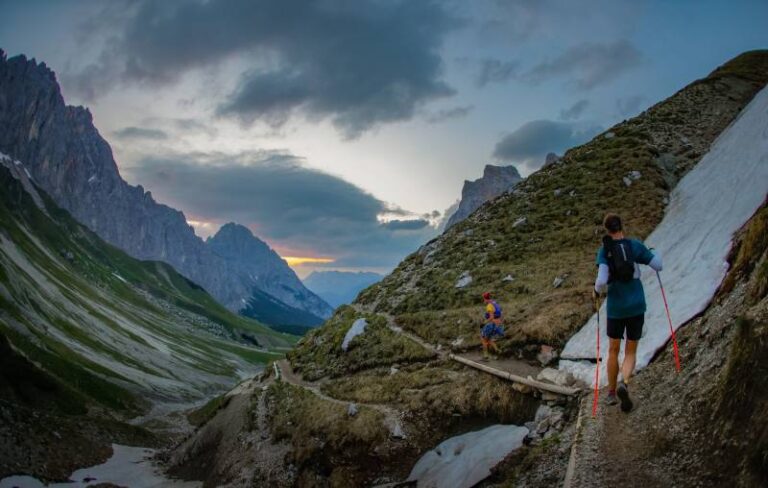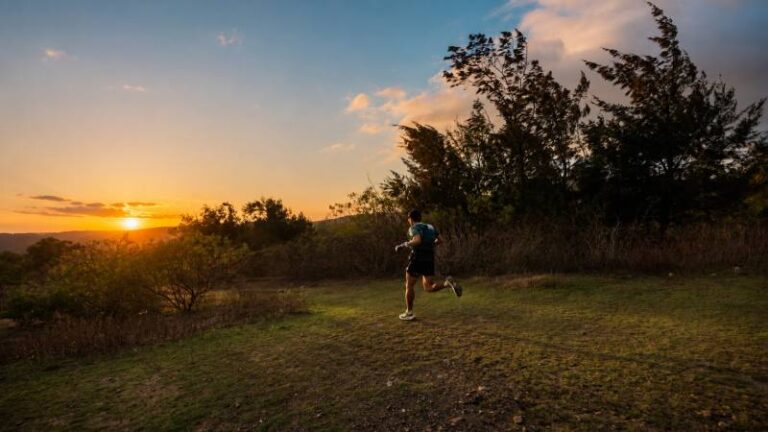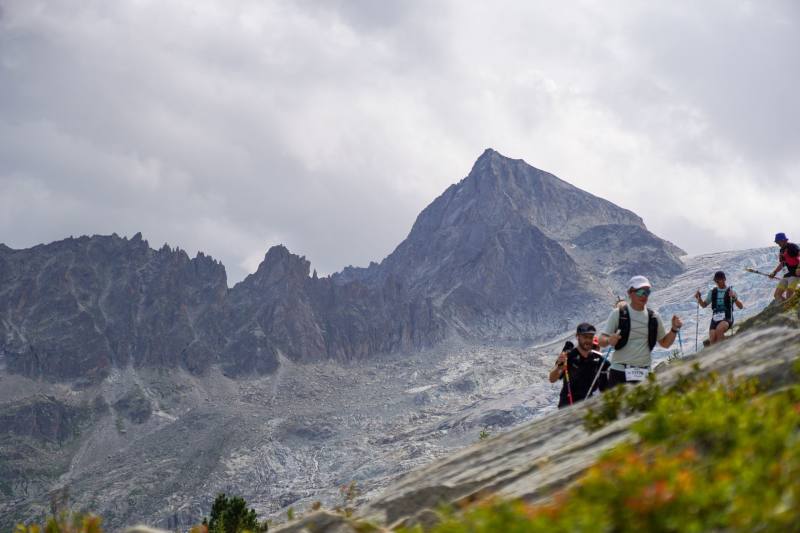
An MCC training plan should prepare you for 40 km and 2350 m of elevation gain from Martigny-Combe, in Switzerland, to the upper Chamonix valley. The MCC opens HOKA UTMB Mont-Blanc week with a unique format: bibs are reserved mainly for local residents and event volunteers. Here is how to prepare for its two big climbs, even if it is your first mountain race of this size.
The short answer
- Plan 3 to 5 months of specific training if you already run 20 to 30 km trail races; 6 to 9 months if you come from road running or shorter trails.
- At peak, intermediate runners often train 4 to 7 hours a week with 1000 to 2000 m of weekly elevation gain. Adjust to your level.
- Key sessions: threshold hill repeats, 3 to 4 hour mountain long runs, power hiking with poles, downhill work.
- The defining challenge: two long climbs, the Col de la Forclaz then the Col de Balme, within 40 km and a 10-hour time limit.
Contents
MCC distance and elevation gain
| Race | Distance | Elevation gain | Profile / notes |
|---|---|---|---|
| MCC® | 40 km | 2350 m | 2 Running Stones. Starts in Martigny-Combe (Switzerland) early in UTMB week. Col de la Forclaz then Col de Balme. Time limit: 10 h. The official description rounds the climb to 2300 m. |
From Martigny-Combe, you climb the Col de la Forclaz, then continue to the iconic Col de Balme on the French-Swiss border. The final kilometres run through the hamlets of the upper Chamonix valley to the finish arch. The race takes place in late August: it can be warm at the valley start and cooler on the ridges. Official details are on the MCC race page.
The other races of HOKA UTMB Mont-Blanc week:
| Race | Distance | Elevation gain | Category |
|---|---|---|---|
| UTMB® | 174 km | 9700 m | 100M Final |
| TDS® | 145 km | 9500 m | 4 Running Stones |
| CCC® | 108 km | 6200 m | 100K Final |
| OCC® | 60 km | 3500 m | 50K Final |
| ETC® | 15 km | 1200 m | 1 Running Stone |
| YCC® | 15 km | 1200 m | Youth race, 1 Running Stone |
| PTL® | 300 km | 25000 m | Teams of 2 or 3, no ranking |
What makes the MCC demanding
With close to 60 m of climbing per kilometre on average, the MCC is far more mountainous than a typical 40 km trail race. Most of the elevation is packed into two long climbs: you need to hold a steady rhythm for a long time, often hiking, without blowing up on the first one. The descents that follow hit the quads hard, especially if you rarely train in the mountains.
The field is unusual too: locals, volunteers and partners with very different levels. For many, it is their first mountain race of this scale. The 10-hour limit leaves some margin, but still calls for serious preparation if you hike most of the climbs.
How long should you train for the MCC?
If you already run 20 to 30 km trail races with some climbing, 3 to 5 months of specific preparation is often enough. Coming from road running or brand new to trails, allow 6 to 9 months with a short trail race in spring. Our guide to planning your trail season helps you fit that in. The OCC is the natural next step, while the CCC, TDS and UTMB require a real ultra background.
The phases of your MCC training plan
Base phase. Run regularly, three to four times a week, mostly easy, with one quality session and strength training. Consistency is what will let you absorb the climbing later.
Specific phase. Over the 8 weeks before your taper, gradually increase elevation and long-run duration, with a lighter week every three or four weeks. Do your long runs in the mountains, learn to hike fast uphill, descend relaxed and eat on the move.
Taper. Ten to fifteen days of reduced volume with a few short efforts, so you reach Martigny-Combe rested.
Key sessions for the MCC
Threshold hill repeats. For example 4 to 5 × 5 to 8 minutes uphill at threshold, a hard effort you could sustain for about an hour. They prepare you for the Forclaz and Balme climbs.
Mountain long run. 2 h 30 to 4 hours depending on your level, with elevation that increases week by week. Test your fueling and kit here.
Power hiking with poles. Long uphill hiking efforts, poles in hand if you plan to use them on race day.
Downhill work. Progressive descents at the end of runs to strengthen your quads and build confidence. If you have no mountains nearby, use treadmills on an incline, stairs and repeated short hills. Always scale volume to your level, and if pain appears, back off and see a health professional.
For a plan that adjusts every week to your sessions, level and schedule, the RunMotion Coach app, the official online coach of the UTMB World Series, builds in elevation, strength and recovery. Try it free for 7 days.
Plan your race with Race Strategy
Going out too fast on the Forclaz is a classic trap. Race Strategy by RunMotion builds your plan kilometre by kilometre, with pace adjusted for elevation, altitude and terrain technicality, estimated split times at key points and a section-by-section fueling and hydration plan (carbs, water, sodium). Import the official MCC GPX, then adjust the plan to race-day weather.
Running Stones and the UTMB World Series
Unusually, you do not need Running Stones or a UTMB Index to enter the MCC. Bibs are allocated to local residents (58%), event volunteers (30%), partners (10%) and journalists or influencers (2%). The race itself is listed at 2 Running Stones on the official website. If the MCC makes you want more, our UTMB World Series training plan helps you build what comes next, and our UTMB Mont-Blanc guide explains the races and qualification system.
FAQ
Who can enter the MCC?
Bibs are reserved for residents of municipalities connected to the event and surrounding areas, volunteers, partners and a small number of journalists and influencers. No Running Stones or UTMB Index are required.
Should you use poles on the MCC?
They help on the two long climbs. The regulations penalise using poles not carried from the start, or discarding them during the race, so decide beforehand and train with them.
Is the MCC suitable for a trail beginner?
Yes, if you start early. With 2350 m of climbing over 40 km, it is best to have run at least one shorter trail race first and to allow 6 to 9 months of progressive training.
Final thoughts
The MCC is a superb gateway into UTMB week: two passes, French-Swiss scenery and a finish in the heart of the valley. RunMotion’s founders, twin brothers Guillaume and Romain Adam, come from the Alps and Chamonix is their playground; mountains are home turf for us. To prepare with a plan that adapts to you, start your 7-day free trial.
Article updated by the RunMotion Coach team.
Sources
- HOKA UTMB Mont-Blanc – MCC®
- HOKA UTMB Mont-Blanc – Races
- HOKA UTMB Mont-Blanc – Regulations
- Official UTMB®, CCC®, OCC®, TDS®, ETC®, YCC® and PTL® pages on montblanc.utmb.world