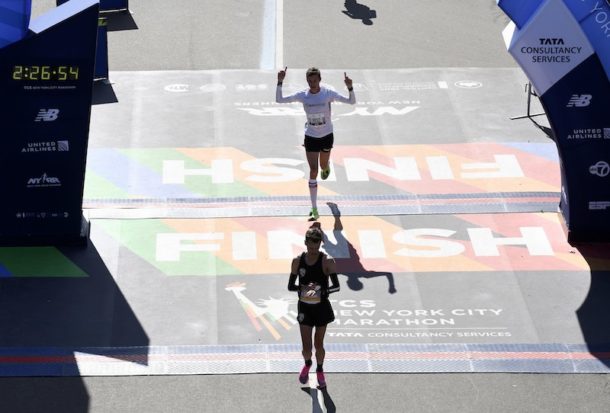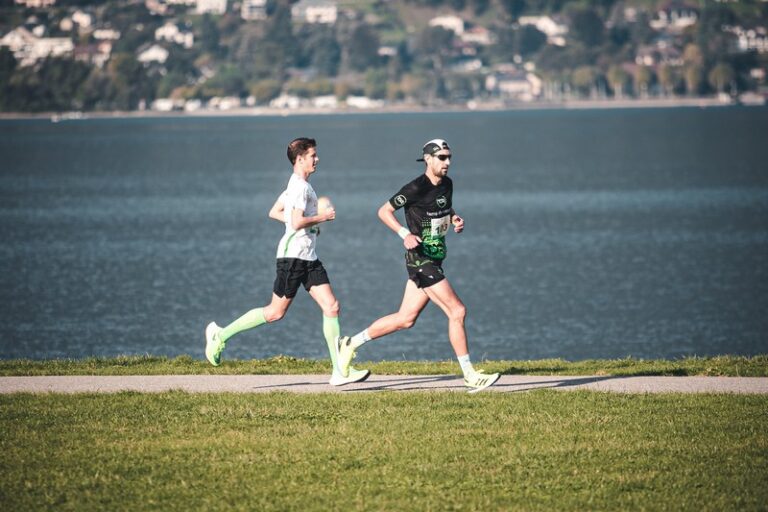
In a marathon, start at your goal pace, with no more than 5 seconds per kilometre in hand, never more. It’s the most valuable rule of your whole race: the first 10 kilometres feel easy at almost any pace, and it’s after 30 km that you pay the price for an over-ambitious start.
The short answer
- Your starting pace = your realistic marathon pace, at most 5 s/km faster.
- A small cushion helps, a big one costs you: start more than 5 s/km faster than planned and the seconds you bank early turn into minutes lost at the end.
- Hold that pace until 30 km. After that, the goal is to limit the slowdown, and only speed up if you still have something left.
- Negative splits are rare for amateur runners: losing around ten seconds per kilometre after 30 km is common, and your small cushion is there to absorb it.
- Your goal pace comes from your recent race times and your marathon-pace sessions, not from how you feel on the day.
Contents
Why starting too fast costs so much in a marathon
On race day, everything pushes you to go out fast: the taper has given you fresh legs, adrenaline masks the effort and the crowd carries you along. The result: a pace 10 or 15 seconds per kilometre too fast feels perfectly comfortable. The problem is that a marathon isn’t decided by how you feel in the first few kilometres.
The faster you run, the faster you burn through your glycogen stores, the main fuel for sustained effort. A start that’s too quick depletes them earlier, increases muscle fatigue and brings you closer to what runners call the wall: that moment, often after 30 km, when your pace collapses despite all your efforts. We cover it in detail in our article on how to avoid hitting the wall.
Race data backs this up. Analysing more than 1.7 million performances by recreational marathon runners, Barry Smyth showed that fast starts are linked to slower finishing times and more frequent late-race collapses. Another study of nearly 92,000 performances across 14 US marathons found that runners slow down markedly in the second half: by 15.6% for men and 11.7% for women on average, women pacing themselves better.
To see the imbalance, take a theoretical example. You’re aiming for 4 hours, or 5′41″/km, but you run the first 30 kilometres at 5′31″/km. You’ve “banked” 5 minutes. If you then slow to 6′15″/km over the last 12 kilometres, which is common when you hit the wall, you lose almost 7 minutes. Net result: almost 2 minutes behind your goal, and a much harder finish.
Even pacing or negative split: which strategy should you choose?
A negative split means running the second half faster than the first. At elite level, the trend is clear: an analysis of 50 years of marathon world records shows that the “classic” record holders started faster and faded after 25 km, while modern records rely on much more even pacing. The authors suggest that very steady pacing, without major speed changes, is probably the way forward.
For an amateur runner, a negative split is hard to pull off. In reality, it’s fairly common to have to drop your pace by around ten seconds per kilometre from 30 km, even after good preparation. So it’s better to build a small cushion early on, but no more than 5 seconds per kilometre.
Do the maths: 5 s/km faster over 30 km gives you a 2′30″ cushion. Slowing by 10 s/km over the last 12 kilometres costs you about 2 minutes. You still cross the line on target. Go beyond 5 s/km faster, though, and you enter the zone where a fast start triggers a much bigger slowdown.
One nuance matters: on a hilly course or in the wind, aim for an even effort rather than an even pace. Easing off a little on the climbs and letting yourself roll on the descents costs less energy than forcing the same speed everywhere.
How to work out your goal pace
Your starting pace only makes sense if your goal is realistic. The best starting point is a recent half marathon or 10 km time, run in the preceding weeks. You can enter it in our tool to predict your marathon time, which gives you a reference pace.
Then compare that estimate with your training. If you completed your marathon-pace sessions (for example several 5 to 8 km blocks, or the end of a long run at that pace) while staying in control, your goal holds up. If every specific session was a struggle, adjust it down slightly: it’s better to finish strong in 4:05 than to blow up chasing 3:50.
| Goal time | Goal pace | Max. starting pace (5 s/km faster) | 10 km split | Halfway split |
|---|---|---|---|---|
| 3h00 | 4′16″/km (6′52″/mi) | 4′11″/km | 42′40″ | 1h30′00″ |
| 3h15 | 4′37″/km (7′26″/mi) | 4′32″/km | 46′13″ | 1h37′30″ |
| 3h30 | 4′59″/km (8′01″/mi) | 4′54″/km | 49′46″ | 1h45′00″ |
| 3h45 | 5′20″/km (8′35″/mi) | 5′15″/km | 53′19″ | 1h52′30″ |
| 4h00 | 5′41″/km (9′09″/mi) | 5′36″/km | 56′53″ | 2h00′00″ |
| 4h15 | 6′03″/km (9′44″/mi) | 5′58″/km | 1h00′26″ | 2h07′30″ |
| 4h30 | 6′24″/km (10′18″/mi) | 6′19″/km | 1h03′59″ | 2h15′00″ |
| 5h00 | 7′07″/km (11′27″/mi) | 7′02″/km | 1h11′06″ | 2h30′00″ |
Split times calculated at an even pace over 42.195 km. At the maximum starting pace, you reach halfway about 1′45″ ahead, and 30 km 2′30″ ahead.
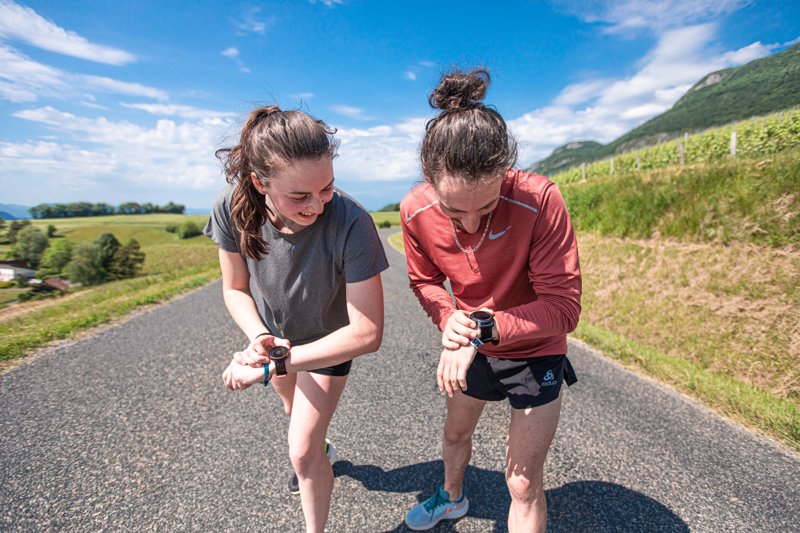
Watch out for your GPS: courses are measured along the shortest possible line, and your watch will almost always show more than 42.195 km at the finish. If you pace off your watch, you’ll fall behind your real split times. Rely on the kilometre markers instead, or keep a few seconds of margin on the pace displayed.
Your race plan, kilometre by kilometre
- Start to 5 km: don’t get carried away. Run at your goal pace, at most 5 s/km faster. If the start is crowded, accept losing a few seconds rather than weaving around: you’ll make them up gradually.
- 5 km to 21 km: settle in. Your pace should feel easy, almost frustrating. You should be able to speak a few sentences. At halfway, you’re ideally between 0 and 1′45″ ahead of your target split.
- 21 km to 30 km: stay focused. This is where attention tends to drift. Hold your pace, and keep eating and drinking according to your plan.
- 30 km to the finish: limit the slowdown. This is where many amateurs lose around ten seconds per kilometre. Your cushion is there to absorb it: focus on your stride and your rhythm. If you still feel good, pick up the pace gradually.
Your marathon pace is built during your preparation. With RunMotion Coach, your plan calculates your training paces from your level and adjusts them as your sessions go by. Try the app free for 7 days.
Pacers, heat, start pens: adjusting on race day
Pacers are a great help, as long as you know how they run. Some aim for a perfectly even pace, others keep a small margin on the target time. Find out in advance and line up behind them rather than chasing them after a blocked start.
Heat changes everything. When it’s hot, the same effort produces a slower pace, and trying to hold your usual pace will make you blow up sooner. Revise your goal downwards from the start, not at 25 km when it’s too late.
Finally, listen to your body as much as to your watch. If your goal pace already feels hard at 10 km, today isn’t the day to force it: ease off slightly straight away, and you’ll save far more time than by digging in.
Common mistakes with your starting pace
The first is starting much faster than planned, telling yourself you’re banking time for the end. Beyond 5 s/km, as we’ve seen, you lose far more time at the end than you gained at the start. The second is making up all at once the time lost in the congestion at the start: spread that deficit over 10 or 15 kilometres instead.
The trap is all the more deceptive because marathon pace feels very easy at the start. Your goal pace is 5′30″/km, but after the taper it feels so comfortable that you tell yourself you can go out at 5′15″/km. That’s a big mistake: this feeling of ease is normal in the first kilometres and says nothing about what you’ll be able to hold after 30 km. If the pace feels easy, it simply means you’re running at the right pace.
The third is following a faster group or friend because you feel good. The fourth is watching your watch’s instant pace, which constantly fluctuates; use your average pace per kilometre instead. The last is changing your goal mid-race, upwards, on the strength of a good first 10 km.
FAQ
Should you start faster than your marathon pace?
A little, yes, but never more than 5 s/km. That small cushion makes up for the slowdown of around 10 s/km that many amateurs experience after 30 km. Go beyond that and you risk triggering a much bigger slowdown.
What gap between the two halves is normal?
With the strategy described here, a second half 2 to 3 minutes slower than the first is normal for an amateur. An even or faster second half means a remarkably well-managed race. Anything more is often the sign of a start that was too fast or a goal that was too ambitious.
Should you run a marathon by pace or by heart rate?
Pace is the main guide on a flat course. Heart rate drifts naturally as the effort goes on, especially in hot weather, which makes it hard to follow over 42 km. It’s still useful early in the race to check you’re not going out too hard.
How do you know if your goal is realistic?
Compare it with a recent half marathon or 10 km time, then with your marathon-pace sessions. If both line up, go for it. If your goal is well beyond what your half marathon predicts, save it for a future build-up.
Conclusion
The right starting pace for a marathon is the one you could hold all the way to the finish, not the one your fresh legs suggest in the first kilometre. Start at your goal pace with at most 5 s/km in hand, settle in until 30 km, then use that cushion to absorb the fatigue at the end. Before race day, note down your split times and read our advice on the day before a race and on running your first marathon.
To reach the start line with the right goal pace and legs ready to hold it, follow a personalised marathon training plan with RunMotion Coach. Start your 7-day free trial.
Sources
- Smyth B. Fast starters and slow finishers: a large-scale data analysis of pacing at the beginning and end of the marathon for recreational runners. Journal of Sports Analytics, 2018. DOI: 10.3233/JSA-170205
- Deaner RO, Carter RE, Joyner MJ, Hunter SK. Men are more likely than women to slow in the marathon. Medicine & Science in Sports & Exercise, 2015;47(3):607-616. DOI: 10.1249/MSS.0000000000000432
- Díaz JJ, Fernández-Ozcorta EJ, Santos-Concejero J. The influence of pacing strategy on marathon world records. European Journal of Sport Science, 2018;18(6):781-786. DOI: 10.1080/17461391.2018.1450899
Updated: 30 October 2026.