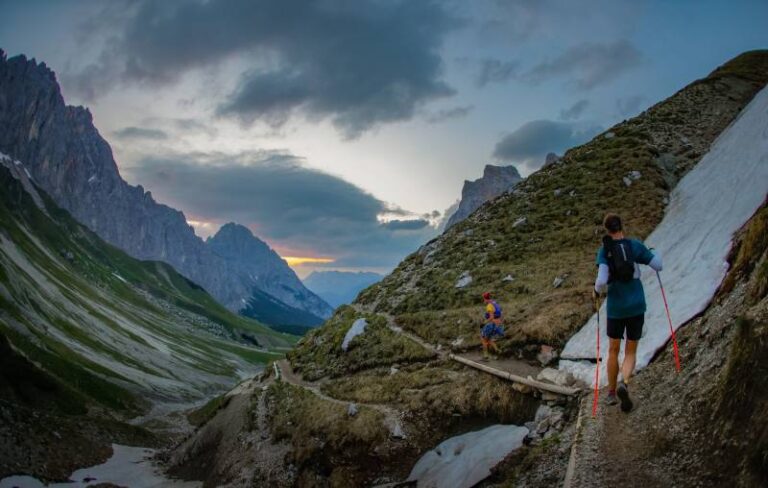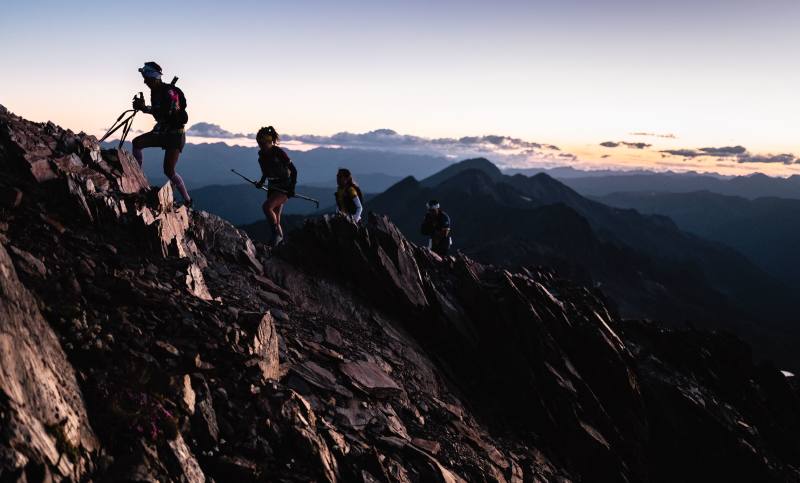
Your Trail 100 Andorra training plan needs to prepare you for high Pyrenean mountains in mid-June: steep climbs, lakes, mountain huts and long technical descents, with the Ultra starting in Ordino. From the 10K up to the Ultra 105K and its 6800 m of climbing, here are the official figures for every format, what makes the race tough and how to structure your build.
The short answer
- Allow 10 to 14 weeks for the Trail 21K, 14 to 20 for the Trail 50K, 18 to 22 for the Trail 80K and 20 to 24 for the Ultra 105K.
- Rough peak-week guide: 2500 to 4000 m of climbing for the 50K, 4000 to 6000 m for the ultras, depending on your level.
- Key sessions: long climbs with power hiking, technical descents, long mountain days, and some altitude exposure if you can.
- The defining feature: big vertical at altitude, with your specific block falling in spring when high trails may still hold snow.
Contents
Trail 100 Andorra distances and elevation
| Format | Distance | Elevation gain | Profile/notes |
|---|---|---|---|
| Ultra 105K – 100M | 105 km | 6800 m | Starts in Ordino; lakes, huts, high mountains; 100M category despite 105 km; 4 Running Stones |
| Trail 80K – 100K | 79 km | 3900 m | More progressive mountain ultra; 3 Running Stones |
| Trail 50K – 50K | 50 km | 3400 m | Very steep mountain race; 2 Running Stones |
| Trail 21K – 20K | 24.9 km | 1350 m | Short but steep; 1 Running Stone |
| Trail 10K | 10 km | 500 m | Entry-level race, no category shown |
These figures are published on the official Trail 100 Andorra by UTMB website and may change between editions. The Ultra’s race page mentions lakes, plenty of mountain huts and the Comapedrosa, the highest peak in Andorra. Expect rocky trails, steep gradients and high passes. In mid-June the weather can switch from full sun to thunderstorms within hours, and depending on the winter, snowfields may linger up high.
What makes Trail 100 Andorra demanding
The climbing ratio tells the story: 6800 m over 105 km on the Ultra, 3400 m over 50 km on the Trail 50K. You will hike a lot of the uphills, and the long, technical descents will wear your legs down. Climbing speed and quad durability matter far more than flat speed here.
Altitude adds to the cost of every effort, especially if you live near sea level. According to the official site, the Ultra starts in Ordino at 06:00 with a 34-hour limit, so many runners will spend a night in the mountains. And because of the calendar, your key training block lands in April and May, when the high mountains are not always accessible.
How long do you need to train?
For the Trail 10K, 6 to 10 weeks of consistent running is enough. For the Trail 21K (24.9 km and 1350 m), plan 10 to 14 weeks: it is short but already mountainous. Our 20 km trail training plan is a good base to which you can add vertical.
For the Trail 50K, aim for 14 to 20 weeks with a mountain trail race already completed. For the Trail 80K and the Ultra 105K, allow 18 to 24 weeks of structured training after at least one 50 km mountain race; for the Ultra, night racing experience is a real plus. Our 100 km trail training guide and our article on increasing your trail distance safely walk you through the progression.
The phases of your training plan
Base: winter
Build volume gradually at easy aerobic effort, with one quality session per week and strength work twice a week. Start with bodyweight; adding load later can help you progress. Ski touring, incline treadmill hiking and stairs are great complements.
Specific: April and May
Vertical becomes the priority. If the high mountains are still snowbound, work in the foothills, repeat climbs and accumulate time on your feet. For the ultras, add two or three back-to-back weekends and a hilly tune-up race about six weeks out.
Taper: early June
Two to three weeks of reduced volume, a few short hill efforts and plenty of sleep. If you can arrive a few days early, your body will benefit from some initial adaptation to altitude.
Key sessions for Trail 100 Andorra
Long climbs. 3 to 4 reps of 12 to 20 minutes on a steep slope, mixing running and power hiking at a strong but controlled effort. This is the cornerstone session for this kind of profile; our tips on improving uphill performance will help you pace it.
Technical descents. One weekly session on steep, rocky trail to strengthen your quads and sharpen your foot placement. Aim for flow, not speed.
Long run-hike days. 4 to 7 hours for the ultras, hiking the steep sections and running the rest. Test your fuelling and mandatory kit.
Eccentric strength. Lunges, slow squats and step-downs, twice a week in short sessions, to prepare your quads for long descents.
| Day | Sample specific week (Trail 50K, intermediate runner) |
|---|---|
| Monday | Rest |
| Tuesday | 4 × 12 minutes steep uphill |
| Wednesday | Easy 45-minute run + strength |
| Thursday | Technical downhill session, 1 hour |
| Friday | Rest |
| Saturday | Long mountain run, 4 to 5 hours |
| Sunday | Easy 1 h 30 + light strength |
If pain persists, ease off and see a health professional.
For a plan that accounts for the vertical of your race and adapts every week to your sessions and schedule, the RunMotion Coach app, the official online coach of the UTMB World Series, takes you all the way to race day. Free 7-day trial: try the app.
Build your race strategy with Race Strategy
Race Strategy by RunMotion calculates your race plan kilometre by kilometre, adjusting pace for gradient, altitude and terrain technicality, three factors that matter a lot in Andorra. You get estimated split times at key points, a fuelling and hydration plan per section (carbs, water, sodium) and a race-day weather adjustment. Import the official GPX of your race to get started.
Running Stones and the UTMB World Series
According to the official site, the Ultra 105K awards 4 Running Stones, the Trail 80K 3, the Trail 50K 2 and the Trail 21K 1. To combine Andorra with other races on the circuit, see our UTMB World Series training plan and our guide on how to plan your trail running season.
FAQ
Why is the Ultra 105K classed as a 100M race?
The official site lists it in the 100M category despite its 105 km, because World Series categories take elevation into account, not just distance. With 6800 m of climbing, the effort is much longer than the distance suggests.
What level do you need for the Trail 50K?
With 3400 m of climbing over 50 km, you should already have finished a mountain trail race of at least 30 km and feel comfortable descending.
How do you deal with altitude?
Arrive a few days early if you can, include some high-altitude outings during your build and start conservatively on race day. Easing off on the first climbs is often the smartest move.
Should you use poles in Andorra?
On slopes like these, many runners value them. Check the official rules and train with them well before race day.
Heading for the Andorran peaks
Trail 100 Andorra is built on climbing, descending and patience. RunMotion founders Guillaume and Romain Adam, twin brothers, come from the Alps: mountains, vertical and ultra distance are their home ground, and it shows in our plans. For a build tailored to you, try RunMotion Coach free for 7 days.
Article updated by the RunMotion Coach team.
Sources: