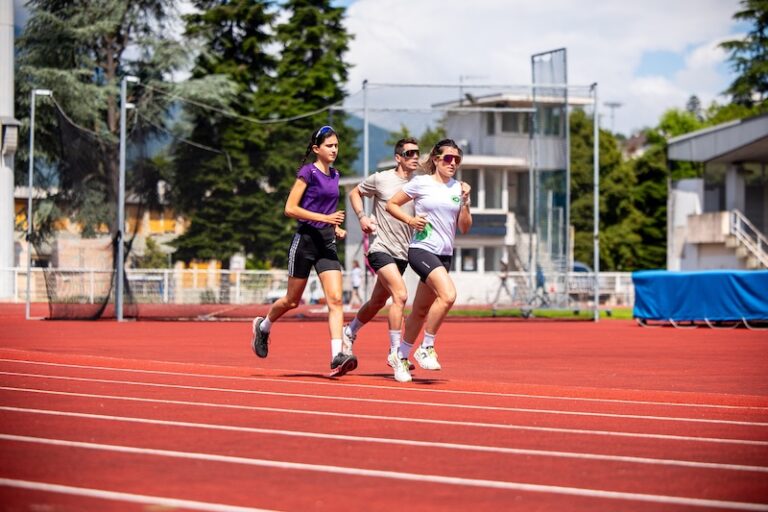
After 50, strength training is no longer a nice extra to squeeze in when you have time left over: it is one of the most effective ways to keep running for a long time, running well and staying injury-free. The reason is simple: as you age, your strength and power decline faster than your endurance, and running alone is not enough to slow that decline.
In this article, we look at why this work becomes a priority, what it concretely brings you as a runner and how to organise it without hurting your running sessions. For the big picture on training (volume, intervals, recovery), also read our guide on running after 50 and how to keep improving.
The short answer
- With age, strength and especially muscle power decline faster than muscle mass and endurance.
- Running keeps your heart in shape but places little demand on maximal strength: without strength work, that decline goes unchecked.
- Strength training helps you handle training better, reduce some injuries, protect your bones and can improve your running economy.
- Aim for 2 sessions a week, with progressive loads, a little power work and some balance work.
- Schedule them on easy days, never the day before an interval session or a long run.
Contents
- What age really changes in your muscles
- Why running isn’t enough to maintain your strength
- What strength training does for you after 50
- How many strength sessions should you do after 50?
- How to fit strength training into your running week
- Which exercises should you prioritise?
- Common mistakes to avoid
- FAQ: strength training after 50
- Strength training, your best investment for running for years to come
- Sources
What age really changes in your muscles
People often talk about “muscle wasting”, but that is not the most important thing for a runner. Muscle mass declines slowly: a review of the literature puts the loss at around 0.5 to 1% per year in 75-year-olds. Strength, on the other hand, drops much faster, by around 2.5 to 4% per year at the same age (Mitchell et al., 2012). In other words, you lose strength faster than you lose muscle. This is known as dynapenia.
Power, meaning the ability to produce force quickly, is hit even harder. It declines earlier and more steeply than strength (Reid and Fielding, 2012). And power is what you use with every stride: when you run, your foot is on the ground for a fraction of a second, and your calves, quads and tendons have to absorb and return energy very quickly.
These figures are averages, often measured in people who are older and less active than you. They don’t tell you what will happen to you at 52. But they do show an underlying trend: without specific stimulation, strength erodes, and it erodes faster than endurance.
Why running isn’t enough to maintain your strength
Running means repeating a moderate muscular effort thousands of times. It is excellent for your heart, your endurance and the efficiency of your stride, but the mechanical intensity of each stride remains far below what your muscles can produce at maximum. So your body has no reason to maintain strength it never uses.
This gap is all the more marked because runners over 50 often keep very good endurance. A study cited in our article on running after 50 found no age-related difference in running economy among competitive runners. The aerobic engine and technique hold up well; it is the “structure” (muscles, tendons, bones) that needs new attention. Strength training is the most direct way to send it the signal it needs.
What strength training does for you after 50
Handling training better and reducing some injuries
After 50, many runners find it harder to absorb increases in volume or fast sessions, and their tendons (Achilles, patellar) make themselves felt more quickly. Stronger muscles absorb part of the stress that would otherwise be passed on to tendons and joints.
The data point the same way: a meta-analysis of randomised trials across all sports showed that strength training programmes reduced injury risk to less than a third compared with control groups (Lauersen et al., 2014). These studies were not specifically about runners over 50, and no programme eliminates injury risk. But it is one of the best-supported prevention tools you have.
Running more economically
Strength training isn’t just insurance: it can also make you a better runner. A meta-analysis of well-trained middle- and long-distance runners shows that adding 2 to 3 strength sessions a week for 8 to 12 weeks clearly improves running economy, meaning the energy you spend to hold a given pace (Balsalobre-Fernández et al., 2016). The programmes studied most often combined light to moderate loads, jumps and a few short sprints.
Protecting your bones, especially after menopause
Running, with its impacts, is generally good for your bones. But it doesn’t load every area in the same way, and bone loss speeds up with age, particularly in women after menopause. In the LIFTMOR trial, women aged 65 on average with low bone density followed 8 months of heavy strength training and impact exercises, twice 30 minutes a week under supervision. Their bone density at the lumbar spine and femoral neck increased, while it fell in the control group, and their physical function improved (Watson et al., 2018).
This doesn’t mean anyone can start lifting heavy overnight: if you have known osteoporosis, ask your doctor and get supervised. But it does show that meaningful loads, built up gradually, are not just for the young.
Keeping your power and balance
Pushing up a hill, kicking in a final sprint, catching a misstep on a trail: all of this depends on your power and balance. On trails it matters even more on descents, where your quads work as brakes and a missed footing can be costly. The NSCA recommendations for older adults also stress the value of adding power work, with movements performed quickly, to traditional strength training (Fragala et al., 2019).
A health benefit that goes beyond running
Finally, strength training has health effects of its own. A meta-analysis of 16 cohort studies links 30 to 60 minutes of strength training per week with a roughly 10 to 20% lower risk of death, cardiovascular disease and cancer, and combining strength training with aerobic activity appears most beneficial (Momma et al., 2022). These are associations, not proof of cause and effect, but they are in line with WHO guidelines: at least two strength sessions a week for adults (Bull et al., 2020).
How many strength sessions should you do after 50?
Two sessions a week are a solid base for most runners. One is already better than nothing, especially when you’re starting out or in a busy training block. Three can make sense if you run little or have a specific strength goal, but you’ll need to watch your recovery.
As for duration, 20 to 40 minutes is enough if the session is well built. Four or five well-chosen exercises done with real intent beat an hour of endless circuits. A good guide: at the end of each set, you should have 2 or 3 reps “in reserve”. If you could still do ten more, increase the difficulty a little: more load, a slower tempo or switching to a single-leg exercise.
How to fit strength training into your running week
The main trap is turning up with heavy legs for a key session. To avoid it, schedule strength work on rest days or easy-run days, ideally after your run, or several hours later if you can separate the two. Avoid the day before an interval session or a long run, as well as the day after a very hard session.
In practice, with four runs a week, you can do one strength session on Monday (a non-running day) and another on Thursday after your easy run, as in the sample week for 50-year-old runners. As a race approaches, keep one session a week and lighten the loads over the last 10 days: the aim is to maintain, not to progress.
If you follow a plan with RunMotion Coach, the app’s strength sessions fit directly into your training week, with bodyweight or light-load exercises. You can try the app free for 7 days and see how your plan is organised around them.
Which exercises should you prioritise?
There’s no need to multiply exercises. For a runner over 50, an effective session covers four areas: leg strength, calves and feet, power, and balance with core work. Here is a sample session for a healthy runner who is already comfortable with the basic movements, to adapt to your level and equipment.
- Warm-up (5 to 10 min): a few minutes of light cardio, then one light set of each exercise.
- Goblet squat (dumbbell or kettlebell held against your chest): 3 sets of 6 to 8 reps.
- Romanian deadlift with dumbbells, for the hamstrings and glutes: 3 sets of 8 reps.
- Reverse lunge or step-up, one leg at a time: 2 to 3 sets of 6 to 8 reps per leg.
- Calf raises, straight leg then bent knee (to also target the soleus), on a step: 3 sets of 10 to 12 reps per leg.
- Light pogo jumps (small bounces on the balls of your feet): 2 sets of 15 to 20 contacts, staying springy and landing quietly.
- Balance and core: 3 × 30 seconds standing on one leg (eyes closed if it’s too easy) and 3 × 30 seconds of side plank on each side.
If you’re new to this, start with bodyweight or very light loads for two to three weeks while you learn the movements. Then gradually increase the load once you finish all your sets with more than 3 reps in reserve. The first strength gains often come quite quickly, largely because your nervous system learns to recruit your muscles better: it’s very motivating, but it’s no reason to rush.
Be even more careful with jumps. If you have tendon or knee pain or a history of injury, put them off until later or get help from a professional. Pain that persists or gets worse from one session to the next calls for advice from a doctor or physiotherapist.
Common mistakes to avoid
Some runners return to strength training with the enthusiasm of their 25-year-old selves and pile up muscle soreness that ruins their next runs. The first two weeks should be deliberately easy. Another classic mistake: dropping strength work as soon as race preparation gets more intense. Yet that’s exactly when one maintenance session a week protects you the most.
Finally, strength training doesn’t make up for poor recovery. Sleep and adequate protein intake matter for building and maintaining muscle; we cover this in our article on protein for running and trail running.
FAQ: strength training after 50
Is it too late to start strength training after 50?
No. Muscle can improve at any age, including in people much older than 50. Those who have never done strength training often have the most room to progress. The only condition is to start light and increase the load gradually. If you’re returning after a long break or have cardiovascular risk factors, a medical check-up is advisable before you start.
Is bodyweight enough, or do you need a gym?
Bodyweight is perfect for getting started and learning the movements, and single-leg exercises (lunges, Bulgarian split squats, single-leg calf raises) let you go quite far. But to keep building strength, you can add load: a weighted vest, a pair of dumbbells or a kettlebell at home can be enough, without necessarily joining a gym.
Will strength training make me heavier and slower?
That’s very unlikely. With two sessions a week alongside your running, muscle gain stays limited. In the study by Piacentini et al. (2013), masters marathon runners gained strength and running economy with no change in body weight or body composition.
Should you do strength training the day before a race?
No. Stop heavy sessions about ten days before your goal race and keep only a few light activation exercises (core, balance) in the final days. Your goal is to arrive fresh, not to gain strength at the last minute.
Strength training, your best investment for running for years to come
After 50, endurance often remains your strong point; what declines fastest is your strength and power. Two short strength sessions a week, with progressive loads and a little fast and balance work, are enough to make a difference: fewer niggles, a more economical stride and more enjoyment from running, today and twenty years from now.
To go further, find all our advice on adapting your running training after 50 and, if you’re already thinking ahead, on running after 60. And if you’re preparing for a race, a personalised training plan that combines running and strength work saves you from organising everything yourself: try RunMotion Coach free for 7 days.
Sources
- Balsalobre-Fernández C., Santos-Concejero J., Grivas G. V. (2016). Effects of strength training on running economy in highly trained runners: a systematic review with meta-analysis of controlled trials. Journal of Strength and Conditioning Research, 30(8), 2361–2368. DOI: 10.1519/JSC.0000000000001316
- Bull F. C. et al. (2020). World Health Organization 2020 guidelines on physical activity and sedentary behaviour. British Journal of Sports Medicine, 54(24), 1451–1462. DOI: 10.1136/bjsports-2020-102955
- Fragala M. S. et al. (2019). Resistance training for older adults: position statement from the National Strength and Conditioning Association. Journal of Strength and Conditioning Research, 33(8), 2019–2052. DOI: 10.1519/JSC.0000000000003230
- Lauersen J. B., Bertelsen D. M., Andersen L. B. (2014). The effectiveness of exercise interventions to prevent sports injuries: a systematic review and meta-analysis of randomised controlled trials. British Journal of Sports Medicine, 48(11), 871–877. DOI: 10.1136/bjsports-2013-092538
- Mitchell W. K. et al. (2012). Sarcopenia, dynapenia, and the impact of advancing age on human skeletal muscle size and strength; a quantitative review. Frontiers in Physiology, 3, 260. DOI: 10.3389/fphys.2012.00260
- Momma H. et al. (2022). Muscle-strengthening activities are associated with lower risk and mortality in major non-communicable diseases: a systematic review and meta-analysis of cohort studies. British Journal of Sports Medicine, 56(13), 755–763. DOI: 10.1136/bjsports-2021-105061
- Piacentini M. F. et al. (2013). Concurrent strength and endurance training effects on running economy in master endurance runners. Journal of Strength and Conditioning Research, 27(8), 2295–2303. DOI: 10.1519/JSC.0b013e3182794485
- Reid K. F., Fielding R. A. (2012). Skeletal muscle power: a critical determinant of physical functioning in older adults. Exercise and Sport Sciences Reviews, 40(1), 4–12. DOI: 10.1097/JES.0b013e31823b5f13
- Watson S. L. et al. (2018). High-intensity resistance and impact training improves bone mineral density and physical function in postmenopausal women with osteopenia and osteoporosis: the LIFTMOR randomized controlled trial. Journal of Bone and Mineral Research, 33(2), 211–220. DOI: 10.1002/jbmr.3284
Article updated on 8 November 2026.