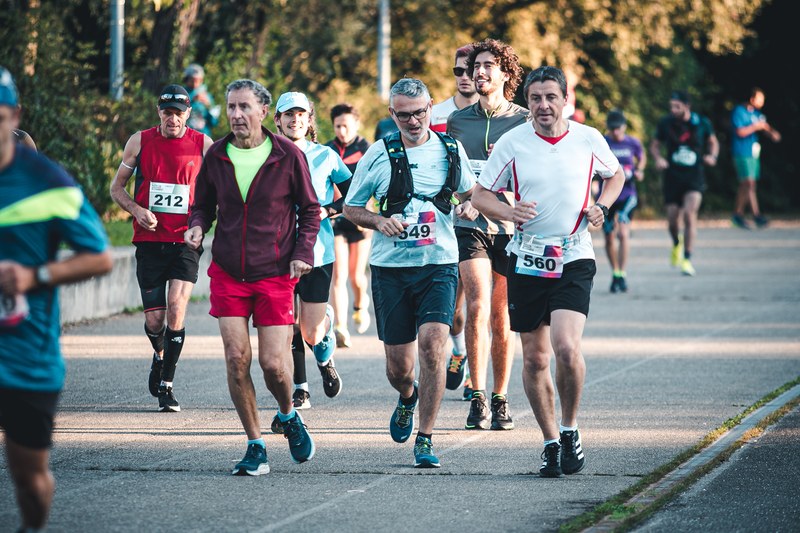
Yes, you can still improve as a runner after 50. VO2max and strength decline slowly with age, but many runners in their fifties are still a long way from their training potential. Running after 50 doesn’t mean running less: it’s mostly about dosing intensity more carefully, adding strength training and listening more closely to your recovery.
The short answer
- What declines with age: VO2max, maximum heart rate, muscle strength and power.
- What doesn’t necessarily decline: your running economy, your ability to handle volume if you’ve been running for years, and your room for progress if you started late.
- Keep one or two intensity sessions a week, well warmed up and well spaced out.
- Add two strength training sessions a week.
- Base your training load on your recovery, not on your age or on the paces you could hold at 30.
- Check your cardiovascular health with your doctor if you’re returning to running or planning hard efforts.
Contents
- Can you still improve at running after 50?
- What changes in your body after 50
- Should you run less after 50?
- Interval training after 50: keep it, but prepare better
- Strength training, your best insurance
- Recovery: the signs to watch
- The comeback trap after 50
- Sample training week for a 50-year-old runner
- Common mistakes after 50
- FAQ: running after 50
- Conclusion
- Sources
Can you still improve at running after 50?
It depends on where you’re starting from. You need to separate two things: your physiological potential, which declines slowly with age, and your actual level, which mostly depends on what you’ve already built through training.
If you started running at 40 or 45, you very likely haven’t reached your ceiling yet. The gains from training (better endurance, a more economical stride, better pacing) clearly outweigh age-related losses for several years. Setting a half marathon or marathon PB at 52 is entirely realistic.
If you were already running a 32-minute 10K at 28, things are different: you’ve already tapped a large part of your potential, and your younger PBs will be very hard to beat. What you can do is limit how much your times slow down, try a new distance or improve on the trails, where experience and effort management count for a lot.
In studies of masters athletes, endurance performance declines only moderately until around 60, then speeds up (Tanaka and Seals, 2008). Your fifties are therefore a decade when training still makes a big difference.
Age groups are a useful way to set goals. In masters athletics, runners compete in five-year age groups: M50 and W50 for ages 50 to 54, then M55 and W55 for ages 55 to 59. Many races publish results by age group, so you can compare yourself with runners your own age and maybe aim for an age-group podium.
What changes in your body after 50
Your cardiovascular engine loses a little power
Your maximum heart rate drops with age, and your heart pumps slightly less blood to your muscles at maximal effort. As a result, your VO2max, the maximum amount of oxygen your body can use, gradually declines. A figure of 5 to 10% per decade is often quoted, but the gap between a sedentary person and a regular runner is large. Training doesn’t stop this decline; it slows it down.
Your muscles mainly lose strength
People talk a lot about losing muscle mass (sarcopenia), but for a runner, it’s the loss of strength and power (dynapenia) that matters most. In a key review, strength declined two to five times faster than muscle mass (Mitchell et al., 2012). These figures concern people around 75, mostly untrained, but the process starts much earlier. On the road, it shows up as less punch on hills, a less springy stride and more strain on your tendons.
Your running economy can stay intact
Good news: a University of New Hampshire study of competitive runners found no difference in running economy between runners under 40, aged 40 to 59 and over 60 (Quinn et al., 2011, summary of the study). The older runners did, however, have a lower VO2max, maximum heart rate and strength. Those are the qualities to maintain first.
Recovery becomes more variable
Many runners notice that after 50 it takes them longer to get their legs back after a hard session. It isn’t universal: sleep, work stress, nutrition and years of running matter as much as age. A 55-year-old who has been running for twenty years often recovers better than a 30-year-old beginner.
Should you run less after 50?
Not as a rule. What matters isn’t your age but your ability to absorb your training load. If you’ve been running five times a week for years without problems, nothing forces you to drop to three sessions on your 50th birthday.
What changes is the balance. Keep most of your volume at an easy pace, the comfortable effort at which you can hold a conversation. If you want more volume, add an easy run rather than another hard session. And if your joints complain, swap a run for cycling, swimming or the elliptical: you keep your cardiovascular fitness with far less impact.
Above all, consistency beats everything else. Four sessions a week all year round are worth far more than six sessions for three weeks followed by a month off injured. If you’re short on time, our article on training with a busy schedule has some ideas.
Interval training after 50: keep it, but prepare better
It’s the most stubborn myth: after 50, you should supposedly stop hard efforts to protect your heart and joints. For a healthy runner, it’s rather the opposite. Since VO2max is the quality that declines the most, efforts close to your maximum are exactly what stimulate it best.
The evidence points the same way, even well beyond 50. In the Norwegian Generation 100 study, 1,567 people aged 70 to 77 were followed for five years. The group that did two sessions a week of 4 × 4 minutes at around 90% of maximum heart rate ended up with a slightly higher VO2max than the other groups (Stensvold et al., 2020). A meta-analysis of 44 trials in people over 60 confirms that interval training improves cardiorespiratory fitness (Liang et al., 2024). If these adaptations are possible at 70, they’re possible at 50 too.
What changes is the preparation and the dose:
- A longer warm-up. Allow 20 to 30 minutes of progressive jogging, a few running drills or mobility exercises, then 3 or 4 progressive strides before your first rep.
- One or two hard sessions a week, no more. Leave at least 48 hours between two hard sessions, more if you feel you need it.
- Varied formats. Short intervals (30 seconds to 1 minute, equal recovery) for speed and spring, 3- to 5-minute reps for VO2max, and longer blocks at half marathon or threshold pace for endurance.
- Up-to-date paces. Base your sessions on your current level: you can calculate your maximal aerobic speed (MAS) to reset your paces rather than reusing the ones from ten years ago.
On the health side, a check-up with your doctor is recommended if you’re returning after years off, aiming to race or have risk factors. It may include a resting ECG and, depending on your profile, an exercise stress test. It isn’t mandatory for everyone: the European guidelines on sports cardiology recommend an assessment tailored to each person’s risk (Pelliccia et al., 2021). And whatever the session, chest pain, feeling faint or unusual breathlessness mean you stop and see a doctor.
A plan that takes your profile into account. RunMotion Coach builds your plan from your current level, your availability and your goal, and calculates your training paces. Try the app free for 7 days.
Strength training, your best insurance
If you were to add just one thing to your training after 50, it should be this. Running maintains your endurance, but it isn’t enough to slow the loss of strength. And strength is what gives you punch on hills, stabilises your stride and protects your tendons.
Aim for two sessions of 20 to 30 minutes a week, focused on the muscles that work hardest when you run: quads, glutes, hamstrings and calves. Squats, lunges, calf raises, step-ups onto a step or bench and stiff-leg deadlifts with a light weight make an excellent base. Add some core work and a few single-leg exercises for balance.
You can start with bodyweight exercises at home. But to keep getting stronger, you need to make things gradually harder: resistance bands, dumbbells, then heavier loads with fewer reps once your technique is solid. It’s the same principle as in running: the right stimulus, increased little by little.
To get started without wondering what to do, RunMotion Coach has a complete strength training module, with bodyweight or light-weight sessions.
Recovery: the signs to watch
After 50, your recovery should steer your plan. If an interval session leaves your legs heavy for three days, that isn’t a failure: it’s information. Cut the volume of the session, lower the intensity slightly or space your hard sessions further apart.
A few signs should make you ease off: fatigue that lasts several days, performance dropping even though you’re training regularly, disrupted sleep, pain that keeps coming back in the same place, an unusual drop in motivation. If so, lighten your week and look for the cause. Persistent pain should be seen by a health professional.
Think about everything that happens outside training too. Sleep is when your body adapts to the work you’ve done. If you combine short nights and work stress, sticking to five sessions a week can become counterproductive. Also plan a lighter week every three to four weeks.
The comeback trap after 50
It’s a very common scenario. You ran a 35-minute 10K at 30, stopped for fifteen years and decide to get back into it. In your head, 4:00/km (6:26/mile) is still a “normal” pace. But your muscles, tendons and cardiovascular system are no longer prepared for those efforts.
The rule is simple: start from your current level, not the one you had twenty years ago. First rebuild a few weeks of easy running, with walk-run intervals if needed, then reintroduce intensity gradually. Our guide to getting started with running covers this phase in detail. And don’t try to make up for lost time: consistency is what will make you progress, not a few heroic sessions.
Sample training week for a 50-year-old runner
Target profile: a healthy runner who has been running regularly for several years, runs four times a week and is training for a 10K or half marathon. It’s an example to adapt, not a one-size-fits-all programme.
| Day | Session |
|---|---|
| Monday | Strength training, 30 min |
| Tuesday | 20 min warm-up + drills and 3 strides, then 10 × 1 min fast (close to your MAS) with 1 min jog, 10 min cool-down |
| Wednesday | Rest, or 1 h easy cycling |
| Thursday | 50 min easy run, then 20 min strength training |
| Friday | 20 min warm-up, then 3 × 8 min at half marathon pace with 2 min recovery, 10 min cool-down |
| Saturday | Rest |
| Sunday | Long run of 1 h 10 to 1 h 20 at easy pace |
If you don’t recover well from Tuesday’s session, turn Friday’s into an easy run. For a structured build-up over several weeks, take a look at our 10K training plan or our marathon training plan.
Common mistakes after 50
- Dropping all intensity out of fear, and watching your VO2max fall faster than it needs to.
- The opposite: stacking hard sessions without 48 hours of recovery.
- Skipping the warm-up before intervals.
- Neglecting strength training.
- Constantly comparing yourself with the runner you were at 30.
FAQ: running after 50
Can you set personal bests after 50?
Yes, if you started running late or have never trained in a structured way. If you ran at a high level when you were younger, aim instead for your best times since turning 50, or try a new distance.
How many sessions a week should you run at 50?
There’s no ideal number linked to age. Three to five sessions suit most regular runners, as long as you recover well between them and keep most of them easy.
At what age does running performance start to decline?
Some qualities, such as VO2max, decline from your thirties. In masters athletes, performance declines only moderately until around 60 before speeding up. For a runner who is still improving, training more than offsets these losses for years.
Do you need a medical certificate or heart check to run after 50?
Depending on the country and the race, you may need a medical certificate or a health questionnaire to enter. Regardless, a cardiovascular check-up with your doctor is recommended if you’re returning after a long break, planning hard efforts or have risk factors.
Conclusion
Running after 50 doesn’t mean changing everything. Stay consistent, keep one or two well-prepared intensity sessions, add two strength sessions and let your recovery tell you when to push or ease off. The goal isn’t to become the runner you were at 30 again, but the best runner you can be today.
And if you’re approaching the next milestone, read our article on running after 60.
Ready to train for your current level? RunMotion Coach adapts your plan to your profile, your goal and your progress week after week, with built-in strength training. Start your 7-day free trial.
Sources
- Tanaka H., Seals D. R. (2008). Endurance exercise performance in Masters athletes: age-associated changes and underlying physiological mechanisms. Journal of Physiology, 586(1), 55–63. DOI: 10.1113/jphysiol.2007.141879
- Mitchell W. K. et al. (2012). Sarcopenia, dynapenia, and the impact of advancing age on human skeletal muscle size and strength. Frontiers in Physiology, 3, 260. DOI: 10.3389/fphys.2012.00260
- Stensvold D. et al. (2020). Effect of exercise training for five years on all cause mortality in older adults: the Generation 100 study. BMJ, 371, m3485. DOI: 10.1136/bmj.m3485
- Liang W. et al. (2024). Effects of high-intensity interval training on the parameters related to physical fitness and health of older adults. Sports Medicine – Open, 10. DOI: 10.1186/s40798-024-00767-9
- Pelliccia A. et al. (2021). 2020 ESC Guidelines on sports cardiology and exercise in patients with cardiovascular disease. European Heart Journal, 42(1), 17–96. DOI: 10.1093/eurheartj/ehaa605
- Quinn T. J. et al. (2011), Journal of Strength and Conditioning Research: summary by the University of New Hampshire