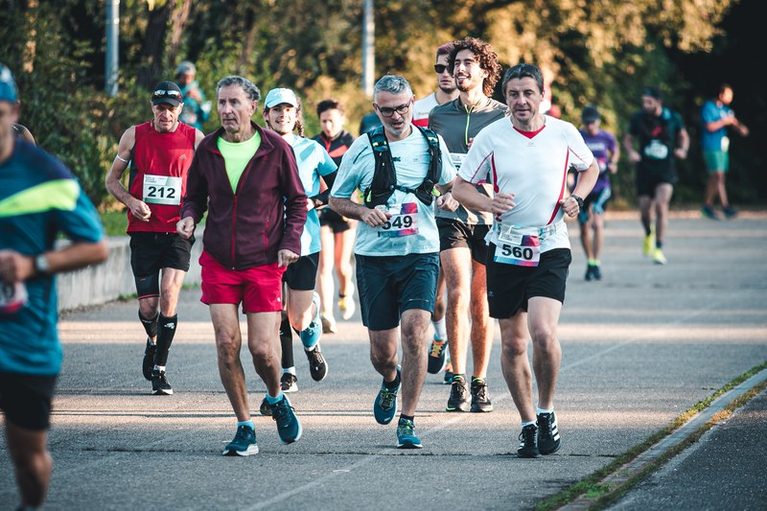
Yes, you can keep running after 60 and still improve, especially if you started late or have never followed structured training. But after 60, the decline in VO2max and strength becomes more marked, so your training needs to be well targeted. Keep some intensity, make strength and balance work a real priority, and give more room to recovery.
The short answer
- Running after 60 is still beneficial, and progress is still possible, especially if you started late.
- Interval training isn’t off-limits: well prepared, it helps maintain VO2max, even after 70.
- Strength training and balance work become as important as running itself.
- Space out your hard sessions more and plan more frequent easy weeks.
- Add cycling, swimming or the elliptical to keep your volume up with less impact.
- Check your cardiovascular health with your doctor, especially before intense training or racing.
Contents
- Can you still improve at running after 60?
- Turning 60: what really happens?
- How much should you run after 60?
- Should you stop interval training after 60?
- Strength and balance: the priority after 60
- Recovery: change the rhythm
- Sample training week for a 60-year-old runner
- Common mistakes after 60
- FAQ: running after 60
- Conclusion
- Sources
Can you still improve at running after 60?
Yes, but “improving” doesn’t mean the same thing for everyone. If you started running at 55, you still have real room to grow: your endurance, your stride and your pacing can keep improving for several years, faster than age takes its toll. Setting a 10K PB at 62 is entirely possible.
If you’ve been running for thirty years and your best times date from your mid-thirties, the goal changes. You can aim for your best times since turning 60, try trail running or a new distance, or compare your times using age grading, which measures a performance relative to your age group. In the marathon or ultras, experience also makes up for part of the losses: you start more conservatively, fuel better and handle rough patches better.
Age groups help too. In masters athletics, you compete as M60 or W60 from 60 to 64, then M65 or W65 from 65 to 69, and so on in five-year bands. And if you’re looking for inspiration, have a look at the world records by age group ratified by World Masters Athletics: they show how far training can take you at 60, 70 and well beyond.
Turning 60: what really happens?
You may have heard about the Stanford study describing two “waves” of ageing, around 44 and 60. Its authors followed 108 people aged 25 to 75 and found that many biological markers didn’t change in a linear way (Shen et al., 2024). Beware of shortcuts, though: the study didn’t measure athletic performance, and some of its analyses have since been questioned. It doesn’t say your VO2max will collapse on your 60th birthday.
In sport, studies of masters athletes do show that endurance performance generally declines faster after 60 (Tanaka and Seals, 2008). There are three main reasons:
- Your cardiovascular engine. Maximum heart rate keeps falling, the heart pumps slightly less blood to the muscles at maximal effort, and VO2max decreases.
- Strength. Around age 75, a key review reports a loss of about 0.6 to 1% of muscle mass per year, but 2.5 to 4% of strength per year (Mitchell et al., 2012). These averages concern mostly untrained people; a runner who does strength training loses much less.
- Recovery. Many runners need an extra day between two hard sessions, although the differences between individuals remain very large.
The good news: running economy, meaning the energy you use at a given pace, doesn’t seem to deteriorate with age in competitive runners (Quinn et al., 2011, summary of the study). Your stride stays efficient; it’s the engine and the strength you need to maintain.
How much should you run after 60?
There’s no maximum volume linked to age. A 63-year-old who has been running for twenty years can handle four or five sessions a week and train for a marathon. A beginner of the same age will start with three sessions, sometimes alternating walking and running. What sets your limit is your ability to recover and your injury history.
Two levers help you keep your volume without overloading your joints. The first: do most of your runs at an easy pace, one at which you can talk. The second: cross-training. A bike ride, a swim or an elliptical session maintains your cardiovascular fitness with far less impact than a run. Replacing one run in four with cycling is often a good compromise.
The WHO recommendations for people over 65 point the same way: on top of endurance activity, they advise varied activity that emphasises balance and strength, at least three days a week (Bull et al., 2020).
Should you stop interval training after 60?
No, and it’s probably the myth that costs older runners the most. If you cut out all intensity, you let your VO2max decline faster than necessary. For a healthy runner, well-dosed hard efforts remain the best way to maintain it.
The Norwegian Generation 100 study illustrates this well. For five years, 1,567 people aged 70 to 77 were split into three groups. One group did two sessions a week of 4 × 4 minutes at around 90% of maximum heart rate, after a 10-minute warm-up. After five years, this group had a slightly higher VO2max than the other two (Stensvold et al., 2020).
The study found no significant difference in mortality between the groups, but it confirms that intense training is possible and useful well after 60. A meta-analysis of 44 trials in people over 60 points the same way (Liang et al., 2024).
Whether you’re 60 or 70, intensity needs preparing:
- Warm up thoroughly. 15 to 20 minutes of very progressive jogging, some drills or mobility work, then a few strides before your first rep.
- One hard session a week is often enough. If you do two, leave at least 72 hours between them.
- Choose controlled over all-out. Reps of 3 to 4 minutes that are “hard but sustainable”, or short intervals (30 seconds to 1 minute) without all-out sprinting, are easier to absorb.
- Trust your measurements, not formulas. Maximum heart rate formulas such as “220 minus your age” are very inaccurate for individuals. Base your paces on a recent test instead: you can reset your paces from your maximal aerobic speed (MAS).
If you’re returning after a long break, first rebuild several weeks of easy running before reintroducing intensity. And before getting back into hard sessions or racing, check in with your doctor: a resting ECG, or even an exercise stress test depending on your history and risk factors.
The European guidelines on sports cardiology recommend an assessment tailored to each person’s profile (Pelliccia et al., 2021). Chest pain, feeling faint, palpitations or unusual breathlessness: stop and see a doctor.
A plan that starts from your level today. RunMotion Coach adapts the number of sessions, your paces and your progression to your profile and your goal, and adjusts your plan as you progress. Try the app free for 7 days.
Strength and balance: the priority after 60
After 60, strength training is no longer an extra: it’s part of your training. It limits the loss of strength, protects your tendons and bones, and keeps your punch on hills. And muscles can still adapt at any age: it’s never too late to start.
Aim for two strength sessions a week of 20 to 30 minutes: squats (to a chair at first if needed), lunges, step-ups, calf raises, glute bridges and core work. Start with your bodyweight, then gradually make it harder with resistance bands or dumbbells. If you have access to a gym, some coaching at the start will help you add load without getting injured.
To get started without wondering what to do, RunMotion Coach has a complete strength training module, with bodyweight or light-weight sessions.
Add a few minutes of balance work most days: stand on one leg while brushing your teeth, walk heel to toe, do single-leg exercises on a slightly unstable surface. It directly improves your stability on trails and downhills, and it’s real protection against falls. It’s also what the WHO recommends for people over 65.
Recovery: change the rhythm
After 60, recovery often becomes the limiting factor. A few adjustments make a big difference:
- Space out hard sessions. Two or three easy days between a hard session and your long run.
- Ease off more often. Many older runners feel better with a lighter week every two or three weeks rather than every four.
- Protect your sleep. Recovery is when your body adapts to training.
- Increase your load gradually. Injuries mostly come from sudden jumps in volume or intensity, for example going back to the paces you ran fifteen years ago.
Fatigue that lasts several days, performance dropping despite training, pain that keeps coming back in the same place: all signs that you should ease off. Persistent pain should be seen by a health professional.
Sample training week for a 60-year-old runner
Target profile: a healthy regular runner who runs three times a week and is training for a 10K or half marathon. It’s an example to adapt to your level and how you feel.
| Day | Session |
|---|---|
| Monday | Strength and balance, 30 min |
| Tuesday | 20 min progressive warm-up + drills and 3 strides, then 4 × 4 min at a sustained effort (hard but controlled) with 3 min jog, 10 min cool-down |
| Wednesday | 1 h easy cycling, or rest |
| Thursday | 40 min easy run + 5 relaxed strides, then 20 min strength and balance |
| Friday | Rest |
| Saturday | Rest or brisk walk |
| Sunday | Long run of 1 h to 1 h 15 at easy pace |
For a complete build-up, take a look at our half marathon training plan or our trail running training plan, and use our tool to predict your race time and set a realistic goal.
Common mistakes after 60
- Dropping all intensity out of caution.
- Only running, with no strength or balance work at all.
- Keeping the same rhythm of hard weeks as at 40.
- Going back to old paces after a long break.
- Ignoring pain that keeps coming back, hoping it will run itself out.
FAQ: running after 60
Can you start running at 60?
Yes. Start with walk-run intervals for 20 to 30 minutes, three times a week, and gradually lengthen the running sections. A medical check-up before you start is recommended, especially if you’ve been inactive. Our guide to getting started with running covers the first weeks.
Can you still run a marathon after 60?
Yes, if you have a solid endurance base and your body handles the volume well. Plan a longer build-up, more frequent easy weeks and strength training throughout.
How many times a week should you run at 60?
Three runs a week suit many runners, complemented by cycling or swimming and two strength sessions. A very experienced runner can do more if they recover well.
Should you calculate your maximum heart rate with the 220 minus age formula?
It’s a very rough guide that can be off by 10 beats or more either way. To set up your sessions, you’re better off relying on an exercise test, a field test or how you feel.
Conclusion
Running after 60 means keeping what works and adjusting the rest. Keep one well-prepared intensity session, make strength and balance a regular habit, space out your hard sessions more and add low-impact sports. Ageing is inevitable, but decline isn’t a foregone conclusion: your goal is to become the best runner you can be at your age, and to keep enjoying running for a long time.
To go back over the basics, read our article on running after 50.
Training that fits you. RunMotion Coach builds your plan around your current level, your availability and your goal, with strength training included, and adjusts it as you progress. Try it free for 7 days.
Sources
- Shen X. et al. (2024). Nonlinear dynamics of multi-omics profiles during human aging. Nature Aging, 4, 1619–1634. Link to the article
- Tanaka H., Seals D. R. (2008). Endurance exercise performance in Masters athletes. Journal of Physiology, 586(1), 55–63. DOI: 10.1113/jphysiol.2007.141879
- Mitchell W. K. et al. (2012). Sarcopenia, dynapenia, and the impact of advancing age on human skeletal muscle size and strength. Frontiers in Physiology, 3, 260. DOI: 10.3389/fphys.2012.00260
- Stensvold D. et al. (2020). Generation 100 study. BMJ, 371, m3485. DOI: 10.1136/bmj.m3485
- Liang W. et al. (2024). HIIT and physical fitness of older adults: a systematic review and meta-analysis. Sports Medicine – Open, 10. DOI: 10.1186/s40798-024-00767-9
- Bull F. C. et al. (2020). World Health Organization 2020 guidelines on physical activity and sedentary behaviour. British Journal of Sports Medicine, 54, 1451–1462. DOI: 10.1136/bjsports-2020-102955
- Pelliccia A. et al. (2021). 2020 ESC Guidelines on sports cardiology. European Heart Journal, 42(1), 17–96. DOI: 10.1093/eurheartj/ehaa605
- Quinn T. J. et al. (2011), Journal of Strength and Conditioning Research: summary by the University of New Hampshire
- World Masters Athletics: masters world records by age group