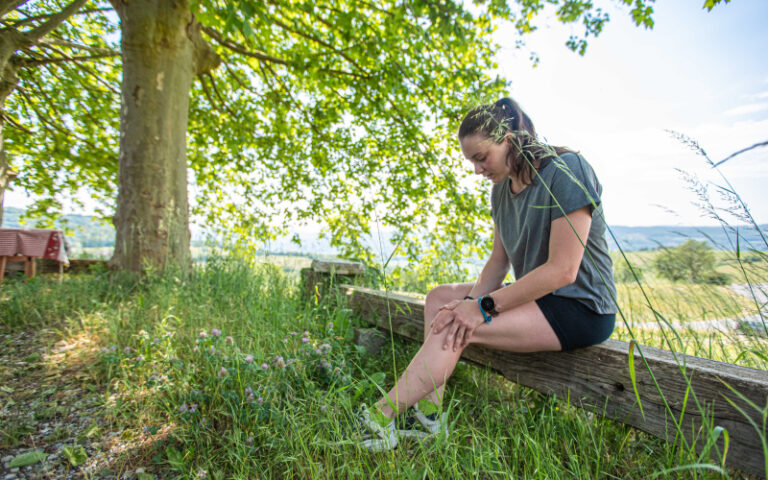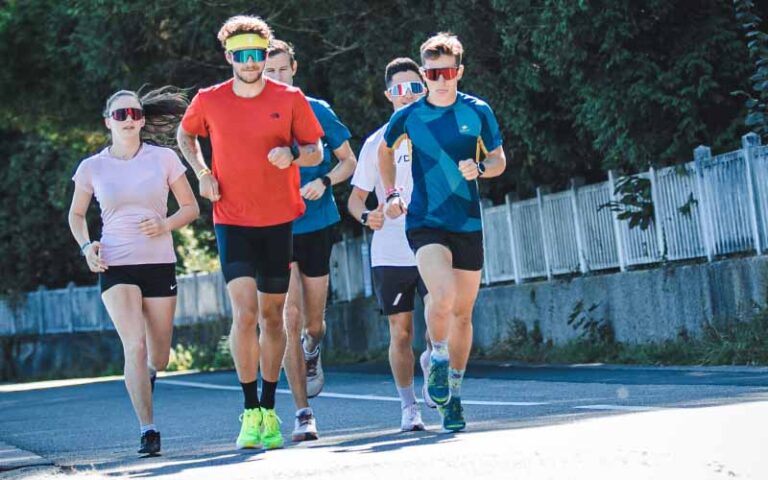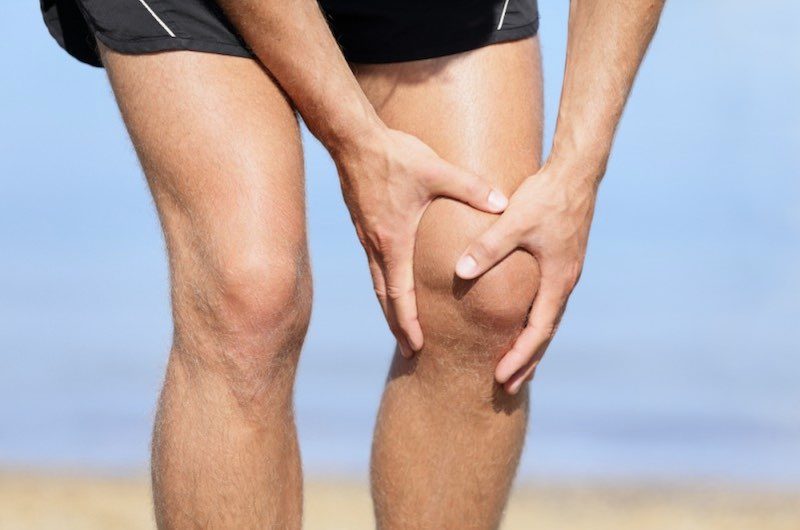
A dull ache around or behind the kneecap that flares up on downhills, on the stairs or after sitting for a long time: that’s runner’s knee, or patellofemoral pain syndrome, one of the most common causes of knee pain in runners. The good news is that you can treat it without complete rest, by adjusting your training and doing strength work. Here’s how to recognise it, treat it, get back to running and keep it from coming back.
The short answer
- Runner’s knee causes pain around or behind the kneecap, made worse by running, downhills, stairs, squats and sitting for long periods.
- It mostly comes from load increasing faster than your knee can handle: volume, downhill running, intensity.
- The best-supported treatment is strengthening the hip and thigh muscles over several weeks.
- You don’t need to stop running completely: cut back on what hurts and keep pain low during and after your runs.
- Slightly increasing your cadence (5 to 10%) reduces the load on your knee and helps a lot of runners.
Contents
- What is runner’s knee?
- How do you recognise runner’s knee?
- Why runners are prone to it
- What to do when the pain starts
- The treatment that works: strength training
- Slightly increase your cadence
- Getting back to running without a relapse
- Runner’s knee and trail running: watch the downhills
- How to prevent runner’s knee
- FAQ: runner’s knee
What is runner’s knee?
Runner’s knee, also called patellofemoral pain syndrome (PFPS) or patellofemoral pain, refers to pain at the front of the knee, around or behind the kneecap. It involves the joint between the kneecap (patella) and the thigh bone (femur), which takes significant stress every time you bend your knee under load: when you run, go downhill or squat down.
It’s one of the most common types of knee pain, in athletes and in the general population alike, especially among active teenagers and young adults (Smith et al., 2018). In runners, it’s among the most frequent injuries, along with IT band syndrome, which hurts on the outside of the knee instead.
How do you recognise runner’s knee?
Diagnosis is mainly based on symptoms (Willy et al., 2019). The main sign is pain around or behind the kneecap, triggered by activities that load the bent knee:
- running, especially downhill or on long runs;
- going down stairs, and sometimes going up them too;
- squats, lunges or jumps;
- sitting for a long time with your knees bent (at the cinema, in the car, at your desk).
The pain is often diffuse, hard to pinpoint, and can affect both knees. It usually doesn’t come with significant swelling or locking. If your knee swells noticeably, locks, gives way, or if the pain started after a fall or a twist, see someone quickly: these aren’t typical signs of runner’s knee.
Either way, a sports doctor or physiotherapist can confirm the diagnosis and rule out other causes, such as patellar tendinopathy (pain just below the kneecap) or a meniscus problem.
Why runners are prone to it
Runner’s knee isn’t caused by a “defective” kneecap. In the vast majority of cases, it shows up when the load placed on the knee increases faster than its ability to adapt. For runners, the classic triggers are:
- a sharp jump in volume or intensity, for example at the start of a training block or when coming back from a break;
- lots of downhill running, on trails or hilly roads;
- hip and quadriceps muscles that lack the strength to handle that load;
- a stride with long, infrequent steps, which increases the load on the knee with every footstrike.
That’s why managing your training load is at the heart of both treatment and prevention.
What to do when the pain starts
Complete rest is rarely necessary, and it doesn’t fix the problem: the pain often comes back as soon as you start running again if the knee hasn’t been strengthened. The idea is rather to temporarily cut back on what hurts while staying active.
- Reduce the load: cut your volume and avoid downhills and hard sessions as long as the pain is there.
- Monitor your pain: mild discomfort (around 2 or 3 out of 10) during a run is generally acceptable if it isn’t worse the next day. If it goes up or lingers, cut back further.
- Maintain your fitness with activities that don’t trigger the pain: low-resistance cycling, swimming or aqua jogging, depending on the case.
- Avoid painful positions in daily life, like sitting for a long time with your knees bent: stretch your legs out regularly.
Our article on managing a running injury explains how to stay active without making the injury worse.
The treatment that works: strength training
International guidelines are clear: exercise therapy is the go-to treatment for patellofemoral pain, reducing pain in the short, medium and long term and improving function (Collins et al., 2018). Combining hip and knee exercises gives better results than working on the knee alone (Crossley et al., 2016). Strengthening the glutes and the muscles around the hip, in particular, reduces pain and improves function (Lack et al., 2015).
It’s worth taking seriously: runner’s knee tends to drag on, and a large share of people with it still have pain 5 to 8 years after diagnosis (Lankhorst et al., 2016).
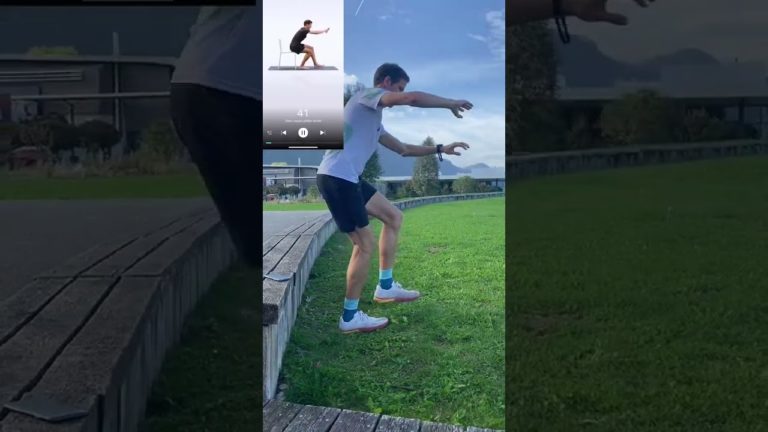
Sample program, 3 times a week
Do these exercises 2 to 3 times a week for at least 6 weeks. Start with bodyweight, using a range of motion that stays only mildly painful, then gradually make it harder: more reps, more range, then added weight if you want. Bodyweight work is already effective; adding load is a way to keep progressing, not a requirement.
- Side-lying hip abduction: with your leg straight, lift it to the side without rolling your pelvis. 3 sets of 12 to 15 on each side.
- Glute bridge: on two legs, then on one leg. 3 sets of 10 to 15.
- Banded lateral walks with the band around your knees or ankles, knees slightly bent. 3 sets of 10 to 15 steps in each direction.
- Partial squat: go down only as far as the pain stays low, then increase the range over the weeks. 3 sets of 10 to 15.
- Step-up, then a controlled step-down from a low step. 3 sets of 10 on each side.
- Knee extension seated or on a machine, through a pain-free range. 3 sets of 12 to 15.
To fit this work into your running week, our strength and conditioning workouts for runners give you more useful exercises.
What can help in the short term
Patellar taping or prefabricated foot orthoses can ease pain for a few weeks in some runners, while the strength work kicks in (Collins et al., 2018). On the other hand, knee massage or manipulation used on its own and electrotherapy devices are not recommended. These are add-ons, not a treatment in their own right.
Slightly increase your cadence
Cadence is the number of steps you take per minute. By taking slightly shorter, quicker steps at the same speed, you reduce the load your knee has to absorb with each footstrike (Heiderscheit et al., 2011). In runners with patellofemoral pain, increasing cadence by 10% reduced pain and improved function, with effects still present 3 months later (Bramah et al., 2019).
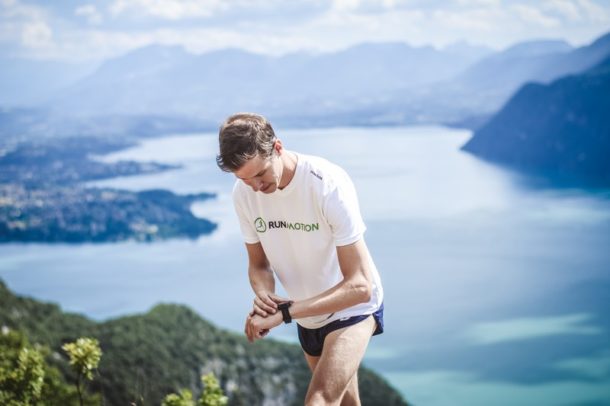
In practice, measure your usual cadence with your watch, then aim for 5 to 10% more on your easy runs. A metronome or a playlist at the right tempo helps at first. Don’t treat it as an absolute target: the point isn’t to hit a magic number, but to shorten your stride a little.
Getting back to running without a relapse
Understanding your injury and adjusting your load is already a big part of the treatment. In a trial of runners with patellofemoral pain, education on load management alone led to substantial improvements, and adding exercises or gait retraining did no better over the study period (Esculier et al., 2018). In other words: what you do with your training load matters enormously.
Restart on flat ground, at an easy pace, with short runs and pain that stays low during the run and the next day. Increase duration first, then frequency, and bring back intensity and downhills last. Our return-to-running programs give you a concrete progression. Keep up the strength work throughout your comeback, and beyond.
To get back on track with a plan that builds your load step by step and includes strength sessions, you can try RunMotion Coach free for 7 days.
Runner’s knee and trail running: watch the downhills

When you run downhill, your quads work as brakes and the joint between the kneecap and the thigh bone takes high stress. That’s often where runner’s knee flares up in trail runners, especially after a sudden increase in elevation.
- build up your downhill running gradually, just as you would your mileage;
- take short, quick steps on descents without leaning back: our tips on downhill running technique on trails will help you work on it;
- use poles on long, steep descents to take pressure off your knees;
- add targeted strength work, for example with our strength and conditioning exercises for trail running.
How to prevent runner’s knee
- Increase your load gradually, especially at the start of a training block and when coming back from a break.
- Strengthen your hips and thighs once or twice a week, all year round.
- Keep your cadence a little higher if you tend to overstride.
- Get your knees used to elevation, especially descents, before a trail race.
- Act early: pain that comes back on every run is a sign to adjust your load right away rather than grit your teeth.
To go further, check out all our tips to prevent running injuries.
FAQ: runner’s knee
Can you run with runner’s knee?
Yes, in most cases, as long as you reduce the load: less volume, no downhills or intensity at first, and pain that stays low during the run and doesn’t get worse the next day. Always pair your running with a strength program.
How long does runner’s knee last?
It varies a lot from one runner to another. With regular strength work and a well-adjusted load, pain usually eases within a few weeks, but it often takes several months to get back to full, pain-free running. Left untreated, it can last for years.
What exercises help with runner’s knee?
The most useful exercises combine the hip (side-lying hip abduction, glute bridge, banded lateral walks) and the knee (partial squat, step-up, knee extension), 2 to 3 times a week for at least 6 weeks.
How is it different from IT band syndrome?
Runner’s knee hurts around or behind the kneecap, at the front of the knee. IT band syndrome hurts on the outside of the knee, often after a fairly consistent number of kilometres.
Runner’s knee is frustrating, but it responds well to treatment when you tackle the right cause: more load than your knee can handle. Adjust your training, strengthen your hips and thighs, shorten your stride a little and build back up gradually. To train with a plan that adapts your load and includes strength work, try RunMotion Coach free for 7 days.
Updated on 9 November 2026. This advice is not a substitute for the opinion of a healthcare professional: if in doubt, get checked out.
Sources: Crossley et al., Br J Sports Med, 2016 · Collins et al., Br J Sports Med, 2018 · Willy et al., J Orthop Sports Phys Ther, 2019 · Smith et al., PLoS One, 2018 · Lack et al., Br J Sports Med, 2015 · Lankhorst et al., Br J Sports Med, 2016 · Heiderscheit et al., Med Sci Sports Exerc, 2011 · Bramah et al., Am J Sports Med, 2019 · Esculier et al., Br J Sports Med, 2018.