General strength and conditioning, often shortened to S&C, is still overlooked by a lot of runners. Yet it is a major performance driver when you want to beat your personal best on the road, from the 10K to training for a marathon (or even a 100K), while also cutting down your injury risk. There are plenty of no-equipment S&C exercises, here are a few you can start with.
Contents
Why do general strength and conditioning?
S&C helps you improve running form efficiency and get a better energy return. Your stride becomes more dynamic and more economical. Strength training is even more important over longer distances, especially the marathon, but also from the half marathon and, even more so, on a 100K, to delay muscular fatigue, avoid hitting the marathon wall or at least keep your stride efficient when it counts.
If you have not done enough strength work and enough mileage in training, your legs can start feeling heavy as early as km 15 in a half marathon, km 25 in a marathon, and even before halfway in a 100K. Pace also affects how relaxed your muscles stay. Either way, that is far too early if you want to finish your race strong.
On a 10K, S&C is also a great way to sharpen a dynamic, efficient running technique and build enough power to fight the fatigue that comes with fairly high muscle lactate levels.
These exercises help build a balanced, resilient body by training all the major muscle chains. S&C also plays a key role in injury prevention (IT band issues, runner’s knee, etc.) and in improving your marathon times, whether you’re targeting 3:45 or 4:30 for example.
What does an S&C session look like for running?
You can do an S&C session indoors or outdoors. The exercises will vary depending on the equipment you have. To keep it simple, we are sharing a no-equipment routine.
Warm-up
The ideal approach is a short warm-up, either an easy 15-minute jog beforehand or 5 minutes of jump rope. You’ll quickly notice that jump rope is demanding and warms up your legs and calves fast, plus it spikes your cardio too.
An example S&C session
The first S&C session we suggest is a circuit workout with dynamic exercises, so you also challenge your cardiovascular system.
Here is the breakdown:
– 2 upper-body exercises: push-ups and dips.
– 3 core exercises: bicycle crunches, plank with foot movement and lower-back work.
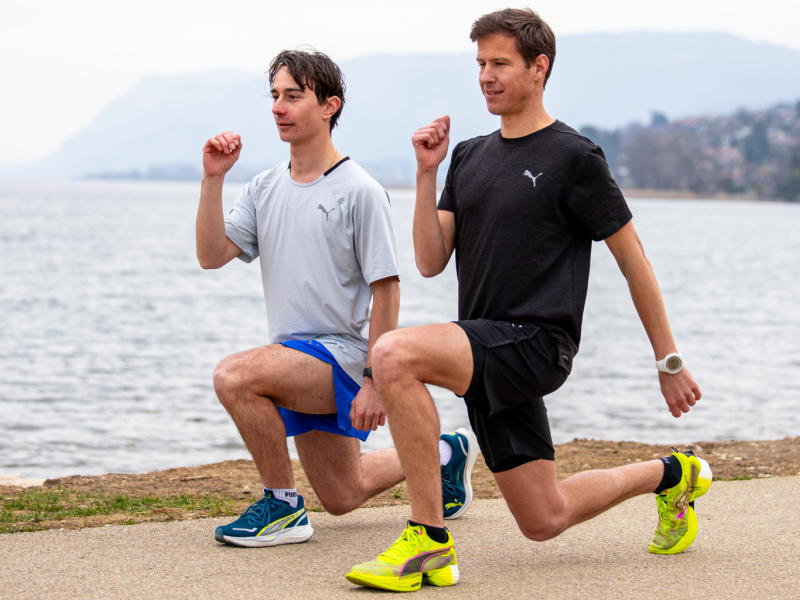
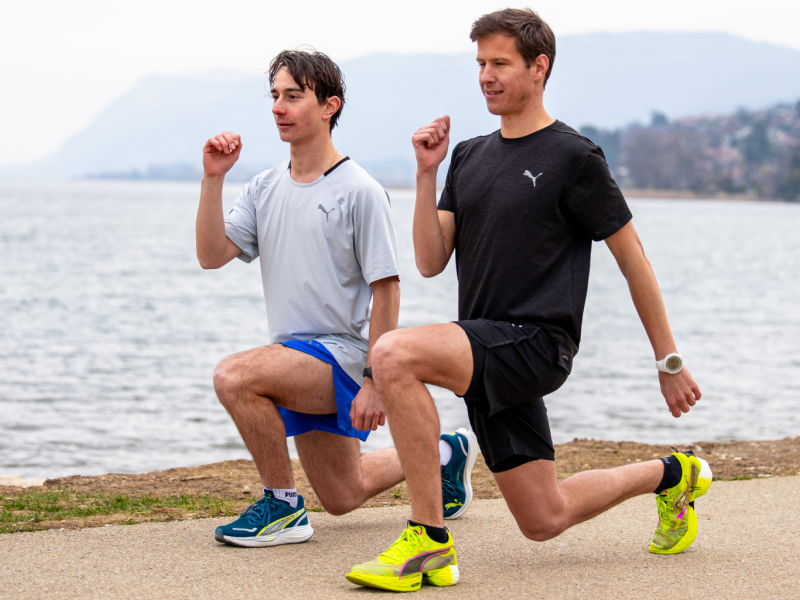
– 4 leg exercises: jump rope, squats, jumping jacks and lunges.
– 1 full-body exercise: burpees.
Specific Strength and Conditioning
You can also do sessions that are more specific with exercises tailored to your discipline. For road running, movements are usually less deep than in trail running. For example, quarter squats or half squats can be enough, without needing a full squat down very low.
At the end of these sessions, it can be useful to finish with 4 strides, progressive accelerations (not an all-out sprint) of 15 seconds, with 45 seconds of recovery. The goal is to convert the strength work and “transfer” it into your running stride.
Finally, we do not specifically recommend stretching right after the session because the muscles have already been heavily loaded. Save stretching for after an easy run instead.
Core routine: planks, abs and proprioception
Alongside S&C, we are also sharing a 10-minute routine you can add whenever you like, focused on core stability, abs and proprioception, up to 3 times per week. You can do it before or after your run workout.
If you want complete strength training exercises for road running or trail running, with a personalized circuit that’s easy to follow (a “Play” mode like Spotify), you can download the RunMotion Coach app.
With this S&C module, you no longer have to wonder which exercises to do or how long to do them for. Plus, your S&C sessions fit perfectly into your RunMotion Coach running training plan. The Strength and Conditioning module is available to Premium app subscribers.
When should you do S&C for running?
Ideally, S&C starts at the beginning of the season. In general, you work more on strength and strength endurance early in the season, then shift toward more explosive work as your main goal approaches (potentially including plyometrics).
Avoid doing an S&C session on the same day as a hard run workout, or even the day after if you struggled to recover from an intense session or a long marathon-style run. Same thing in the last 7 days before a race, you want maximum freshness, so avoid doing S&C too close to race day.
Progression matters. In S&C sessions, we sometimes suggest variations to increase or decrease difficulty. If you’re unsure, pick the easier option for the first sessions, then build up over time. Listening to how you feel is essential.
Abs, core stability and proprioception can be done all year round, up to 3 times per week.
Good luck with your next running goals, whether it’s a 5K, 10K, half marathon, marathon or even a 100K.