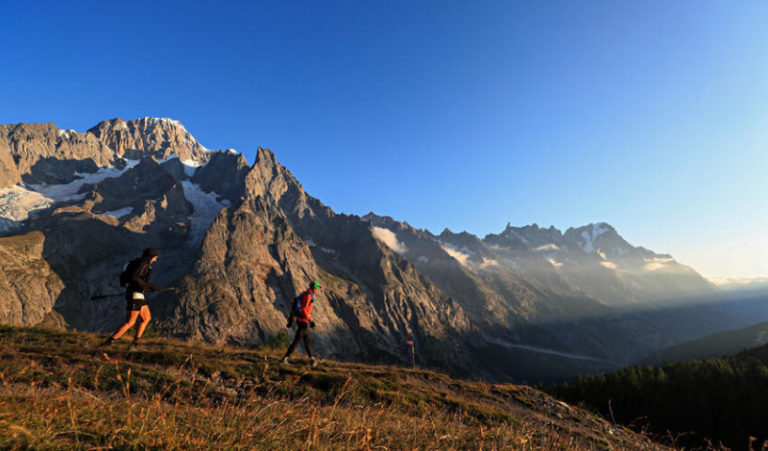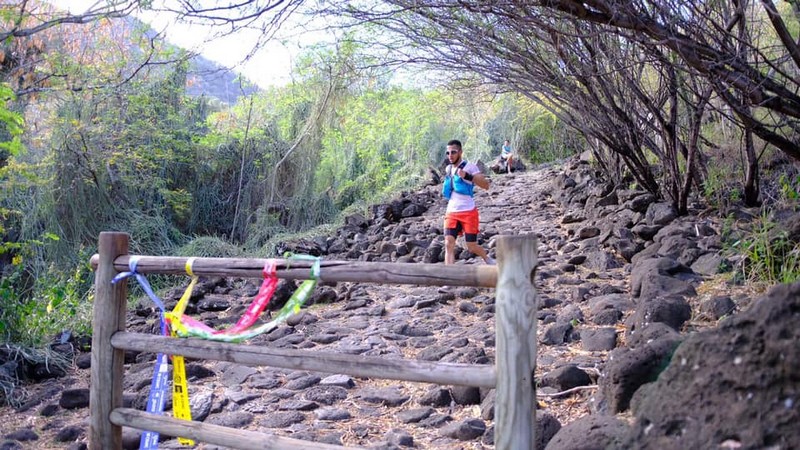
You can climb without any trouble, but as soon as the trail drops, your knee starts to ache? Knee pain when running downhill is very common in trail running: on descents, every footstrike brakes your body and your knees take far more load than on climbs or flat ground. The good news is that you can almost always get rid of it by working out where the pain comes from, adjusting your technique and gradually getting your legs used to downhill running.
The short answer
- On descents, impact forces and the stress on the kneecap joint rise sharply, and your quads work as brakes.
- Where it hurts points to the cause: front of the kneecap (runner’s knee), outside of the knee (IT band syndrome), just below the kneecap (patellar tendinopathy).
- In the moment: slow down, shorten your steps, use your poles and walk if the pain gets worse.
- To get rid of it: strengthen your thighs and hips, and build your downhill running back up gradually.
- See a professional if your knee swells, locks, gives way, or if the pain started after a fall or a twist.
Contents
- Why downhills hurt your knees
- Where does it hurt? The possible causes
- What to do if your knee hurts on a descent
- Adjust your downhill technique
- Poles: a real ally for your knees
- Strengthen your thighs and hips
- Get your knees used to downhills, gradually
- When to see a professional
- FAQ: knee pain when running downhill
Why downhills hurt your knees
When you run downhill, your legs are no longer just pushing you forward: they’re braking. Your quads lengthen while contracting (this is called eccentric work) to control how much your knee bends with each footstrike. That’s what leaves your thighs wrecked after a trail race with lots of descent.
The forces climb sharply with the gradient. On a treadmill at −9°, peak impact force rose by 54% and braking force by 73% compared with level running (Gottschall and Kram, 2005). The stress on the joint between the kneecap and the thigh bone is also higher downhill than on the flat or uphill, partly because runners hold their trunk more upright (Ho et al., 2018).
So it’s no surprise that the knee is one of the most frequently injured areas in trail running, just after the foot (Viljoen et al., 2021). And it’s the runners least used to downhill running who suffer most (Bontemps et al., 2020): the pain is often triggered by a switch from road to trail, a first mountain race or a sudden jump in elevation.
Where does it hurt? The possible causes
The exact location of the pain is the best clue to what’s going on. Here are the most common causes in trail runners.
At the front of the knee, around or behind the kneecap
This is the most common case. A diffuse ache around the kneecap that gets worse on descents, on stairs and when you sit for a long time points to runner’s knee. It responds well to hip and thigh strengthening and better-managed training load.
On the outside of the knee
A sharp pain on the outer side of the knee, which often comes on after a fairly consistent number of kilometres and sometimes forces you to walk, suggests IT band syndrome. Downhill running makes it worse because your knee is less bent when your foot hits the ground, right in the range where the band rubs the most (Orchard et al., 1996).
Just below the kneecap
Pain located on the tendon, just below the tip of the kneecap, points instead to patellar tendinopathy. It’s often worse when you start running, may ease once you’re warmed up, then comes back after the effort. As with other tendinopathies, rest alone rarely fixes it: progressive quad strengthening is the foundation of treatment.
In your thighs rather than your knee
If the pain is mostly muscular, above the knee, and shows up the day after or two days after a big descent, it’s probably muscle soreness. It’s unpleasant but goes away within a few days, and it eases considerably as you repeat this kind of effort.
Either way, if your knee swells, locks, gives way, or if the pain started after a fall or a twist, see a sports doctor or physiotherapist quickly: these signs may point to a meniscus or ligament injury.
What to do if your knee hurts on a descent
- Slow down: the faster you descend, the bigger the impacts.
- Shorten your steps and increase their frequency, so you absorb each footstrike over a shorter distance.
- Get your poles out if you have them, to take some of the load through your arms.
- Walk if the pain builds as you go down: pushing through rising pain often turns a niggle into an injury that sidelines you for weeks.
- After the run, cut back on descents while the pain is there, and keep pain low (2 or 3 out of 10 at most) and not worse the next day.
Our article on managing a running injury explains how to stay active in the meantime without making things worse.
Adjust your downhill technique
Good technique doesn’t remove the load, but it spreads it better. The basics:
- short, quick steps rather than long strides that brake hard with every footstrike;
- your trunk leaning slightly forward, in line with the slope: instinctively leaning back increases braking and the stress on your kneecap;
- soft knees, never locked, to absorb each landing;
- your eyes a few metres ahead to anticipate your footing and avoid sudden braking;
- your arms out wide to keep your balance on technical ground.
To work on all of this in detail, check out our tips on downhill running technique on trails.
Poles: a real ally for your knees

Poles let you shift part of the load to your arms. When walking down a 25° slope, they reduced ground reaction forces, knee joint moment and compressive forces in the joint by 12 to 25% (Schwameder et al., 1999). On long, steep descents, especially late in a race when your thighs are tired, they make a real difference.
Make sure you use them in training before taking them to a race: the technique takes a little getting used to. If you don’t have any yet, our selection of the best trail running poles can help you choose.
Strengthen your thighs and hips
Stronger quads handle braking better, and strong hips keep your knee well aligned on landing. Strength work is also the first-line treatment for runner’s knee and knee tendinopathies.
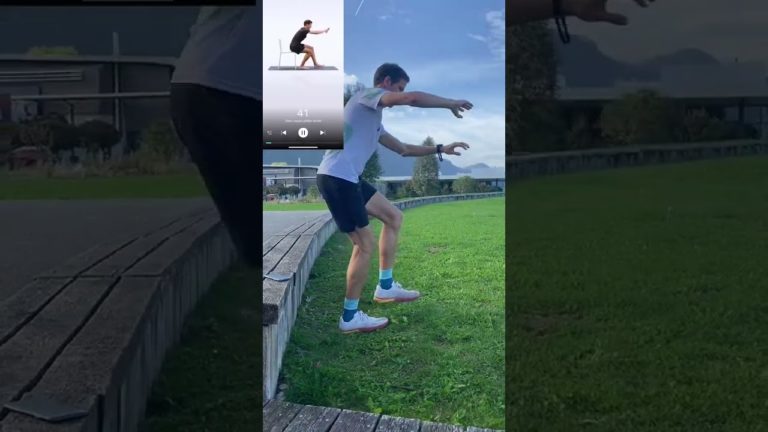
Here’s a simple session to do twice a week. Start with bodyweight, using a range of motion that stays only mildly painful, then progress: more reps, more range, then added weight if you want. Bodyweight work is already effective; adding load is how you keep progressing.
- Squat, controlling the way down (3 seconds to lower). 3 sets of 10 to 12.
- Step-down: standing on a step, slowly lower the heel of your other leg toward the floor without letting your knee cave inward. 3 sets of 8 to 10 per leg.
- Forward lunges or walking lunges. 3 sets of 8 to 10 per leg.
- Glute bridge, on two legs then on one leg. 3 sets of 10 to 15.
- Hip abduction lying on your side, or banded lateral walks. 3 sets of 12 to 15 per side.
- Wall sit, at a pain-free angle. 3 holds of 30 to 45 seconds.
Our strength and conditioning exercises for trail running give you more sessions designed for trail runners.
Get your knees used to downhills, gradually
This is the most powerful lever. After a first downhill session, your body adapts and the same descent causes much less muscle damage the next times. Research shows that gradual exposure to downhill running is the most effective strategy to tolerate it better (Bontemps et al., 2020).
- include a bit of downhill running every week, even short, rather than occasional big descents;
- increase your descent gradually, just as you would your mileage;
- start with gentle gradients and smooth trails, then move on to steeper, more technical terrain;
- if you live somewhere flat, use what you have: bridges, car parks, stairs, small hills, following our ideas to train for trail running without hills;
- save the big, fast descents for the last weeks before your race, once your legs are used to it.
Our trail running training plan builds in this progression in elevation. And if you want a plan that adjusts your load week after week and includes strength sessions, you can try RunMotion Coach free for 7 days.
When to see a professional
Discomfort that goes away within a few days and doesn’t come back is nothing to worry about. But see a sports doctor or physiotherapist if:
- your knee swells, locks or gives way;
- the pain started after a fall or a twist;
- the pain comes back on every run despite cutting your load for 2 to 3 weeks;
- it hurts at night or at rest;
- you limp when walking.
A professional can make an accurate diagnosis and give you a rehab program that fits.
FAQ: knee pain when running downhill
Why does my knee hurt going downhill but not uphill?
On descents, your legs brake with every footstrike: impact forces and the stress on the kneecap joint are higher than uphill or on the flat. Pain that only shows up downhill often points to runner’s knee or IT band syndrome.
How do you run downhill without knee pain?
Take short, quick steps, keep your trunk leaning slightly forward, your knees soft and your eyes ahead. Use poles on long, steep descents, and slow down or walk if the pain gets worse.
Should you stop running if your knee hurts on descents?
Not necessarily. Cut back on descents and intensity, keep pain low and not worse the next day, and strengthen your thighs and hips. If the pain persists or comes with swelling or locking, see a professional.
Do poles really protect your knees?
Yes, they shift part of the load to your arms. When walking downhill, they reduce ground reaction forces and the forces on the knee joint by 12 to 25%. They’re especially useful on long, steep descents.
Knee pain on descents doesn’t have to be part of trail running. First figure out where it hurts, then adjust your technique, get your poles out on big descents, strengthen your thighs and hips and get your legs used to downhill running step by step. To prepare for your next trail race with a plan that manages your load and includes strength work, try RunMotion Coach free for 7 days.
This advice is not a substitute for the opinion of a healthcare professional: if in doubt, get checked out.
Sources: Viljoen et al., Sports Med, 2021 · Gottschall and Kram, J Biomech, 2005 · Ho et al., Phys Ther Sport, 2018 · Orchard et al., Am J Sports Med, 1996 · Bontemps et al., Sports Med, 2020 · Schwameder et al., J Sports Sci, 1999.