Some marathons are run as much with your quads as with your watch. Here are the marathons with the most elevation gain, with their 2027 dates: road races first, from Athens to Sydney, then trail races, from Mont-Blanc to the Great Wall. You’ll also see how to adjust your pace when the profile gets steep.
The short answer
- On the road: Athens climbs almost non-stop from km 10 to km 31, Big Sur tackles Hurricane Point, and Sydney is the hilliest of the World Marathon Majors.
- On trail, the most climbing: the Marathon du Mont-Blanc, with 2540 m of ascent and as much descent.
- The highest: the Pikes Peak Marathon, which climbs to the 4302 m summit before coming back down.
- The Swiss classics: Jungfrau-Marathon (1953 m of climbing) and Zermatt Marathon (about 1840 m).
Contents
The road marathons with the most elevation gain
1. Athens Marathon: 21 km of climbing on the historic route
The Athens Marathon follows the historic route from the town of Marathon to the Panathenaic Stadium. Between km 10 and km 31, the course climbs almost without a break. It is one of the toughest big road marathons for pacing.
- Date: early November (8 November in 2026)
- Difficulty: a climb of more than 20 km, then a descent into Athens
- Best for: runners who want to race the original marathon route.
2. Big Sur Marathon: Hurricane Point halfway through
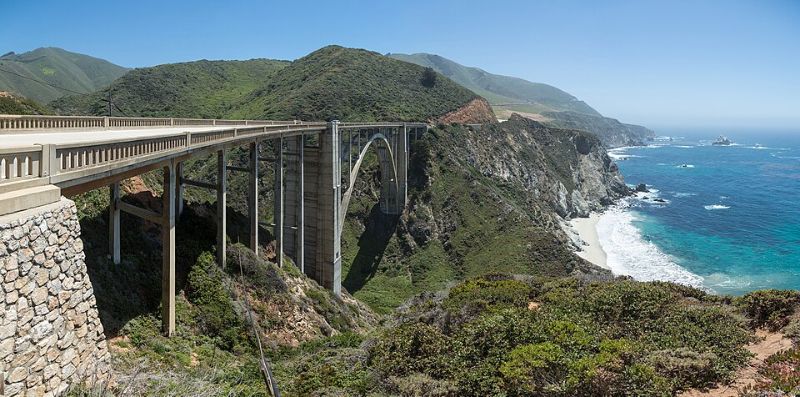
The Big Sur Marathon follows the Pacific coast on Highway 1, from Big Sur Valley to Carmel, California. Its best-known climb, Hurricane Point, rises about 130 m (427 ft) between miles 11 and 12, at about 6% on average with sections above 8%. Overall the course drops about 89 m (291 ft) from start to finish, but the rollers keep coming until the end.
- Date: April 2027
- Time limit: 6 hours
- Best for: road marathoners who want a hilly, spectacular course.
3. Sydney Marathon: the hilliest of the Majors
The Sydney Marathon crosses the Harbour Bridge and finishes in front of the Opera House. With about 313 m of elevation gain, its course is much hillier than Berlin or Chicago.
- Date: 29 August 2027
- Elevation gain: about 313 m
- Best for: Majors collectors who are happy to give up a little time.
The trail marathons with the most elevation gain
On trails, in the mountains or on the Great Wall, elevation changes scale: climbs often exceed 1800 m.
4. Marathon du Mont-Blanc: 2540 m of climbing
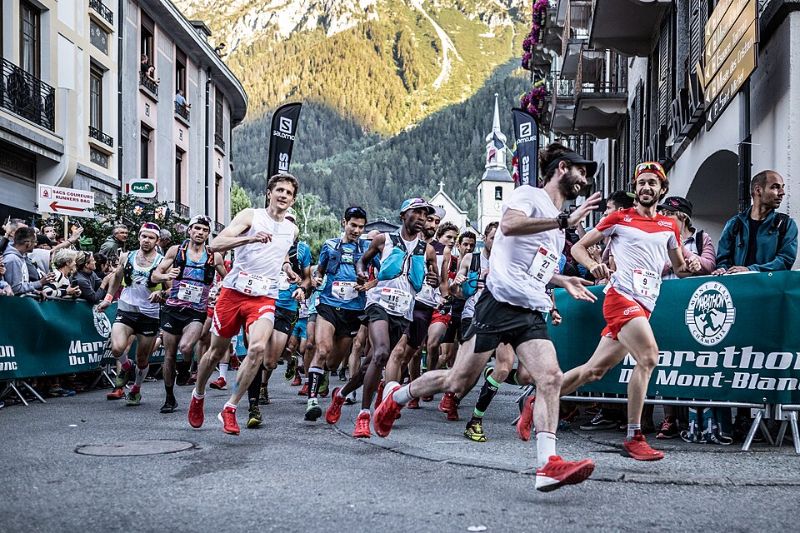
The Marathon du Mont-Blanc is run around Chamonix, France, on 42 km of mountain trails. With 2540 m of ascent and 2540 m of descent, it is a real trail race over the marathon distance, facing the Mont-Blanc massif.
- Date: 24 to 27 June 2027
- Elevation: +2540 m / -2540 m
- Best for: trail runners who want an iconic mountain marathon.
To get your bib, read our guide to Mont-Blanc Marathon 2027 registration and lottery, then prepare with our Mont-Blanc Marathon training plan, designed by the race’s official coach.
5. Pikes Peak Marathon: up to 4302 m
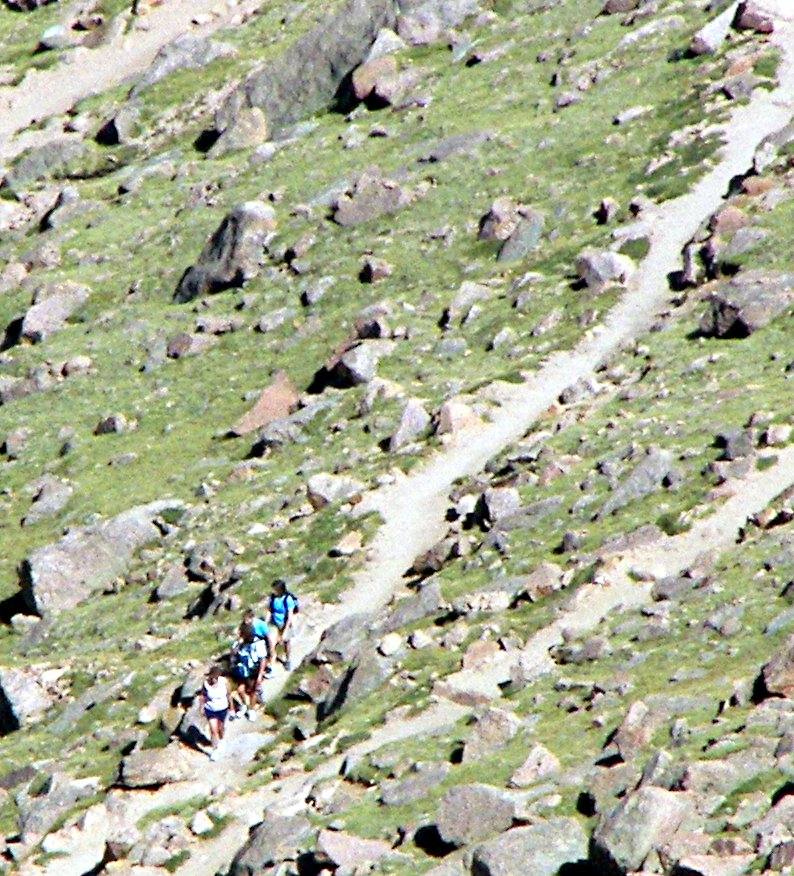
The Pikes Peak Marathon starts in Manitou Springs, Colorado, climbs to the summit of Pikes Peak on the Barr Trail, then comes back down the same way. About 2380 m of climbing, plus the altitude: the summit stands at 4302 m (14,115 ft).
- Date: weekend of 18-19 September 2027
- Elevation: about +2380 m, then as much descent
- Registration: opens on 1 March 2027, with no lottery.
- Best for: runners ready to handle altitude as much as gradient.
Planning more races in the US? Read our guide to the most beautiful trail races in the United States.
6. Jungfrau-Marathon: 1953 m of climbing below the Eiger
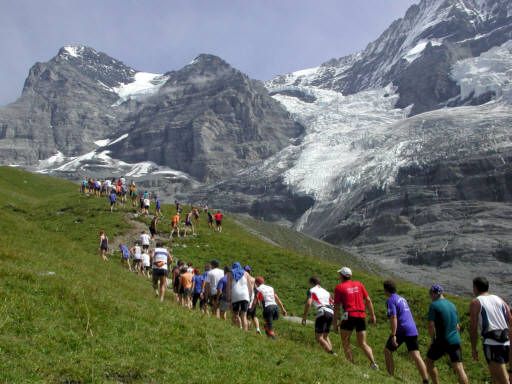
The Jungfrau-Marathon starts in Interlaken and finishes at 2320 m, at the foot of the Eiger, Mönch and Jungfrau. In between, the course gains 1953 m. The course records are 2h49′01″ for men (Jonathan Wyatt) and 3h12′56″ for women (Maude Mathys).
- Date: 11 September 2027
- Elevation gain: 1953 m
- Best for: marathoners discovering the mountains on a mixed road and trail course.
7. Zermatt Marathon: from St. Niklaus to Riffelberg
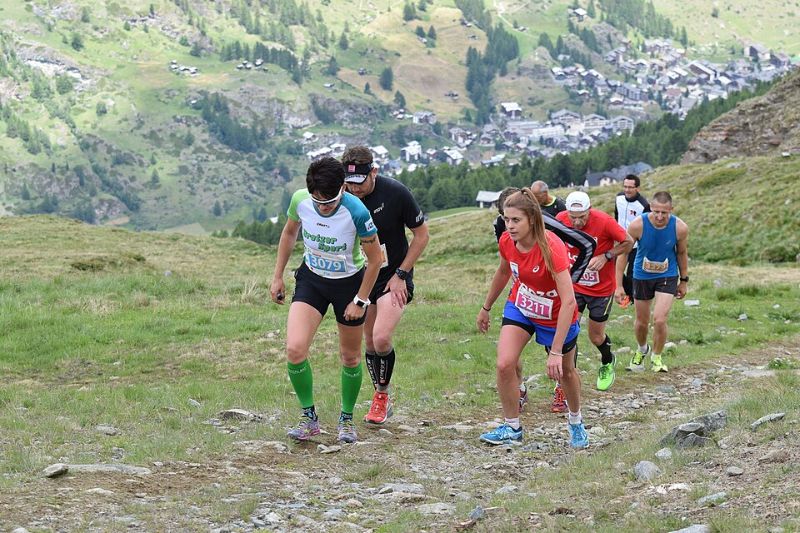
The Zermatt Marathon starts in St. Niklaus, at 1116 m, and finishes at Riffelberg, at 2585 m, facing the Matterhorn. The course gains about 1840 m and loses only 405 m.
- Date: 3 July 2027
- Elevation: about +1840 m / -405 m
- Best for: runners who prefer going up to going down.
Want more races in Switzerland? See our pick of the best marathons in Switzerland.
8. Great Wall Marathon: 5164 steps on the Great Wall
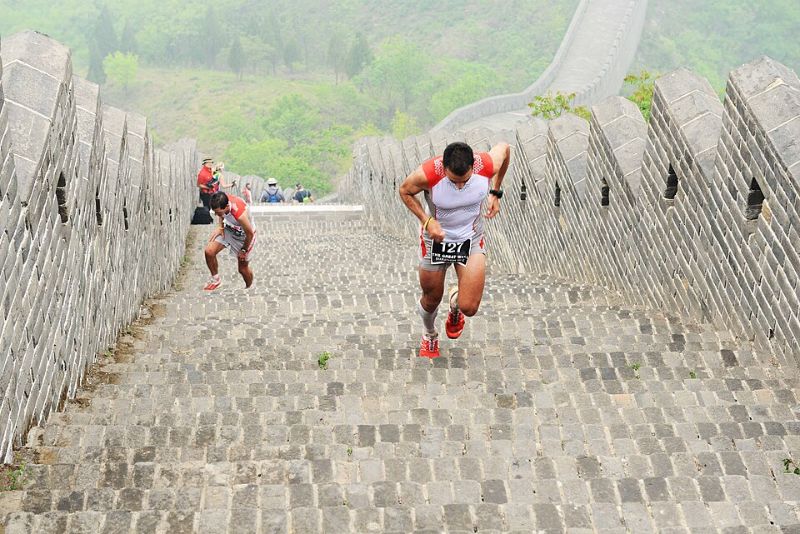
The Great Wall Marathon starts at the Huangyaguan fortress in China and runs along a section of the Great Wall. Here the climbing is counted in steps: 5164 in total, according to the organiser. Uneven stairs break your rhythm far more than a steady slope.
- Date: 15 May 2027
- Difficulty: 5164 steps, with steep ups and downs
- Best for: runners looking for an extraordinary marathon rather than a fast time.
Comparison of the marathons with the most elevation gain
| Marathon | Terrain | Country | 2027 date | Elevation | Highlight |
|---|---|---|---|---|---|
| Athens | Road | Greece | Early November | Climb from km 10 to km 31 | Historic route |
| Big Sur | Road | United States | April | Hurricane Point (about 130 m) | Coastal road |
| Sydney | Road | Australia | 29 August | About +313 m | World Marathon Major |
| Mont-Blanc | Trail | France | Late June | +2540 m / -2540 m | Mountain trail |
| Pikes Peak | Trail | United States | 18-19 September | About +2380 m | Summit at 4302 m |
| Jungfrau | Trail | Switzerland | 11 September | +1953 m | Finish at 2320 m |
| Zermatt | Trail | Switzerland | 3 July | About +1840 m / -405 m | Finish at 2585 m |
| Great Wall | Trail | China | 15 May | 5164 steps | Great Wall |
Elevation figures come from the organisers when they publish them. They can vary depending on the watch or software used: to compare your own runs, learn how to calculate your elevation gain.
Race Strategy: your pace plan, kilometre by kilometre
On a flat marathon you can aim for an even pace. With climbing, that’s impossible: running the same pace uphill and downhill means blowing up on the hills. You need to think in terms of effort and accept very different paces depending on the gradient.
Race Strategy builds that plan for you. Pick your race from the list or import the course GPX file, and the tool calculates:
- Your target pace for every kilometre, adjusted for gradient, altitude and terrain.
- A split table with cumulative ascent and descent at each checkpoint.
- Your nutrition, hydration and sodium for each section between aid stations.
- A recalculation for race-day weather.
Race Strategy covers trail, ultra and road (marathon, half marathon, 100 km). It’s free up to the half marathon. Beyond that, you pay per strategy: €12 for one race, €30 for three, €40 for five.
How to prepare for a hilly marathon
- Do hill work every week. Uphill repeats and hilly long runs get your legs used to the specific effort. No hills nearby? Here’s how to train for a trail race without hills.
- Train the downhills too. On a course that drops as much as it climbs, like Pikes Peak or Mont-Blanc, the descents are often what wrecks your quads.
- Adjust your time goal. On these courses, your flat marathon PB is no reference: set your pace section by section with our new pace prediction model.
A plan that accounts for elevation
RunMotion Coach builds your marathon training plan or trail training plan around your level, your race and its date, with sessions adapted to the climbing. Try it free for 7 days.
FAQ
Which marathon has the most elevation gain?
Among well-known marathons, the Marathon du Mont-Blanc is one of the toughest, with 2540 m of ascent and 2540 m of descent. The Pikes Peak Marathon climbs about 2380 m but reaches 4302 m of altitude.
What is the hilliest road marathon?
Among the big road marathons, Athens is known for its almost continuous climb from km 10 to km 31, and Big Sur for the Hurricane Point climb. Among the World Marathon Majors, Sydney is the hilliest, with about 313 m of elevation gain.
How do you pace a hilly marathon?
Think effort rather than pace: slow down on the climbs, recover on the flat and don’t let go too early on the descents. Race Strategy calculates a target pace for every kilometre based on gradient and altitude.
How much time should you add on a mountain marathon?
It depends on gradient, altitude and terrain, and the gap can be counted in hours on a course like Mont-Blanc. The most reliable approach is to build a plan on the actual race profile rather than apply a fixed rule.
Looking for a fast course instead? Read our top 10 fastest marathons and our guide to the most downhill marathons.
Ready to climb? Start your 7-day free trial to train for your mountain marathon, then build your race plan on Race Strategy.
Updated on 29 October 2026.