Until now, our pace recommendations were mainly based on your race performances and on a model developed from scientific research that Guillaume Adam, co-founder of RunMotion Coach, helped conduct within the joint MIT-CNRS laboratory.
This research was published in the scientific journal PLOS ONE: A minimal power model for human running performance.
The model described in this publication can estimate an individual runner’s performance across distances ranging from 800 metres to the marathon, based on principles related to metabolic power and endurance. This approach already provided a highly accurate estimate of your current fitness and training paces.
However, it could have certain limitations when your reference races were too old, completed in challenging conditions, or simply not representative of your current potential.
So, we have enhanced the model.
The new version now considers the performances you actually achieve in training to detect your progress and fine-tune your recommendations.
This improvement is based on the analysis of 1.6 million training sessions. Your racing history remains essential data, but it is now complemented by a more dynamic view of your current fitness.
Your races show what you have done. Your training shows where you are today.
And this update actually brings five new features in one.
Contents
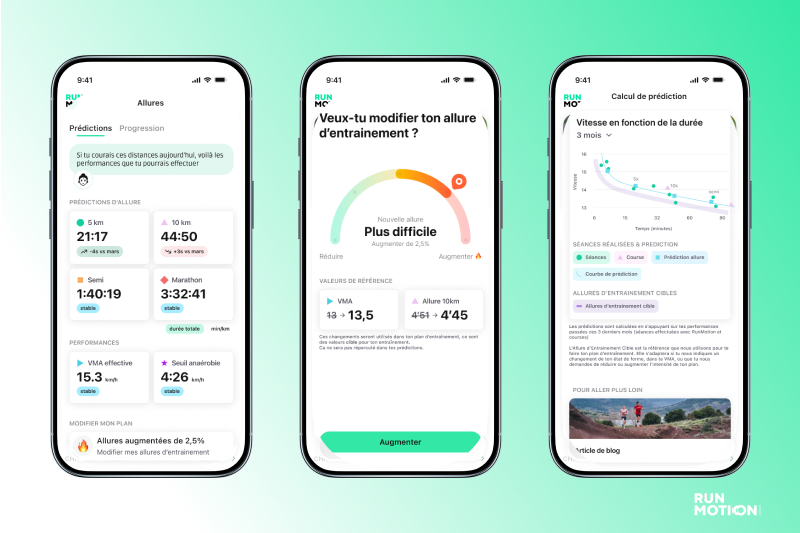
- 1. Discover your predicted paces for 5K, 10K, half marathon and marathon
- 2. Get a personalised prediction for your next race
- 3. Track your prediction trends on a graph
- 4. Follow your progress month after month
- 5. Adjust your paces based on how you feel
- What data is considered?
- How do you exclude a session from your prediction?
- A science-based model, enhanced by real-world data
- What this update changes for you
1. Discover your predicted paces for 5K, 10K, half marathon and marathon
RunMotion Coach can now estimate the paces and finish times you could target for a 5K, 10K, half marathon and marathon.
These predictions draw on both your race results and the completed, validated training sessions in the app.
The sessions considered are those that include intervals at:
- vVO2max pace;
- threshold pace;
- 10K race pace;
- half marathon race pace;
- marathon race pace.
The model analyses your actual performance during these sessions. It does not rely solely on the workout that was planned, but on what you actually ran.
The elevation gain in your training is also included in the calculation. A fast session completed on a hilly route is not interpreted in the same way as an equivalent session on flat terrain.
Thanks to this new data, an old or unrepresentative race no longer defines your recommendations on its own. After an especially successful session, your predictions can improve. During a tougher period or when returning to running, they can also adapt to your current fitness level.
Your training paces are therefore updated after every validated race and every eligible session that is analysed.
2. Get a personalised prediction for your next race
Are you training for a road race?
RunMotion Coach also gives you a race-specific pace prediction for your next goal. This estimate goes beyond distance, taking into account the planned course profile and elevation gain as well.
A perfectly flat 10K is not raced in the same way as a hilly 10K. Similarly, a fast marathon course does not place the same demands on you as a route with plenty of climbs and descents.
Your prediction is therefore tailored to the characteristics of your race, giving you a target that is more realistic and more aligned with your current fitness.
The model also considers the elevation gain from your past sessions. This helps it interpret your training performances more accurately and put them into perspective with the demands of your upcoming race.
You then have a more relevant foundation for setting your starting pace and building your race strategy.
3. Track your prediction trends on a graph
Your races and training sessions are now displayed together on the same graph.
The blue line shows the evolution of your predicted paces over time.
You can see how your estimated fitness has changed after:
- a race;
- a vVO2max session;
- a threshold session;
- a 10K-specific session;
- a half marathon-specific session;
- a marathon-specific session.
This visualisation helps you better understand the impact of your training plan and identify periods when your fitness improves, plateaus or temporarily declines. You no longer see just a predicted finish time, you understand how and why that estimate has changed.
4. Follow your progress month after month
Running progress is not always linear.
Some weeks bring major gains. Others are more about absorbing training, recovering or rebuilding consistency. By looking at your predictions over several months, you can take a step back from your training and distinguish long-term trends from short-term fluctuations.
The new graph lets you measure how far you have come, even when changes are hard to notice from one session to the next.
This view is especially useful when you have not raced for several weeks or months. Your recent training can now update your estimated fitness between races.
A more concrete way to track your progress and see that consistency pays off.
5. Adjust your paces based on how you feel
Your RunMotion Coach prediction is the reference point for personalising your sessions, but you stay in control.
You can choose slower paces than those suggested, especially if:
- you are returning to running;
- you are coming back after an injury or time off;
- fatigue is building up;
- you want to ease back in gradually;
- how you feel does not yet match your estimated fitness.
You can also select faster paces if you feel in excellent shape and the recommendations seem too cautious.
If you do not change anything, your training paces are automatically set according to the prediction calculated by RunMotion Coach.
The goal is not to impose a pace on you, but to offer the most relevant recommendation possible while letting you adapt it to your feelings and personal situation.
What data is considered?
To generate a sufficiently reliable prediction, RunMotion Coach uses at least three results from races and/or training sessions.
Two types of data can be included:
- validated races;
- analysed sessions that include intervals at vVO2max, threshold, 10K-specific, half marathon-specific or marathon-specific pace.
For these sessions, the app considers:
- the paces you actually ran;
- the different intervals within the session;
- the type of intensity worked;
- the route’s elevation gain.
This analysis enables a fairer assessment of your effort and avoids directly comparing a hilly workout with a session completed on flat terrain.
Your prediction no longer relies solely on your race times. Your specific training sessions now also contribute to evaluating your fitness level.
How do you exclude a session from your prediction?
Does a session not feel representative of your fitness?
This can happen if you ran with a friend or family member, had a GPS issue, deliberately completed a different session from the one planned, or ran in unusual conditions.
To prevent it from being included in the calculation, simply:
- do not validate the session;
- or delete its analysis.
You stay in control of the data used to personalise your predictions and training paces.
A science-based model, enhanced by real-world data
This update is not based on a generic formula or product intuition alone.
The original RunMotion Coach model is built on Guillaume Adam’s scientific research, conducted at MIT and CNRS. That scientific foundation is now enhanced by the analysis of 1.6 million training sessions.
This volume of data helps us better understand the relationship between training performance, a runner’s progress and the race times they can realistically target.
The result is a more dynamic, responsive model that better reflects your current fitness.
Science-based pace recommendations, not just a generic formula.
What this update changes for you
With this new version, you now benefit from:
- more representative finish-time predictions;
- a clearer view of your progress;
- more personalised training paces;
- more responsive recommendations;
- consideration of your races and recent training sessions;
- consideration of elevation gain in training;
- a prediction tailored to the profile of your next race;
- the option to adjust your paces manually.
Your racing history remains at the heart of the model, but it no longer tells the whole story.
Your recent sessions now count towards calculating your training paces.
More analysis. More personalisation. Paces that evolve with you, session after session.
Head to RunMotion Coach to discover your new predictions, visualise your progress and train at paces that match what you can do today.