Whether you are an experienced runner looking to improve your personal best or a first-time marathoner with an ambitious goal, this marathon training plan is designed to guide you through every stage.
If you are looking for a 3-hour marathon training plan, you are undoubtedly aiming for 2:59:59 and breaking that iconic barrier.
Contents
Why aim for a 3-hour marathon?
Running a marathon in under 3 hours is a major achievement in the running world. It takes a combination of endurance, speed and determination. This goal is realistic if you are ready to commit to structured, consistent training.
Running a 3:00:00 marathon means holding an average pace of 4:15 per km, or 14 km/h.
Fewer than 2% of marathon runners achieve this time! At the Paris Marathon, around 1,000 runners typically break 3 hours from a field of 50,000.
This target is easier to chase on fast, flat marathons, where it is easier to maintain that 4:15 per km pace.
Requirements for a 3-hour marathon
Before targeting a 3-hour marathon, you should have a solid running base. I recommend previous experience racing shorter distances and the ability to run at least 50 kilometres per week without injury.
You should be able to run 10K in under 40 minutes and have excellent endurance. Runners with less-developed endurance will need to make up for it with a faster 10K time.
Calculate your vVO2max, assess your endurance and estimate your time for your next marathon with our calculator.
A 12-week 3-hour marathon training plan
A 12-week training plan alternates between high-volume weeks and recovery weeks. Each week includes a variety of runs, including long runs, speed intervals, tempo sessions and strength training. The keys are consistency and gradual progression.
In general, runners targeting 3 hours run consistently throughout the year, so a 3-month, or 12-week, build-up, or a 4-month, 16-week, build-up is enough to arrive at the marathon in peak shape. We recommend a structure of three development weeks followed by one recovery week to create the right balance.
Long runs can build up to 2 hours 30 minutes, with marathon-pace workouts included in the plan. Your first session could be 2 x 20 minutes at marathon pace, 4:15/km in this case. Towards the end of the training block, you could progress to 15 km at marathon pace.
Three to four weeks before race day, you can also run a half marathon as part of your marathon preparation. This gives you the chance to test your gear, nutrition and hydration strategy.
Strength and conditioning (S&C) is an essential asset for staying strong in the final kilometres. Add one session per week to help prevent injuries and improve your performance.
Most runners who break 3 hours in the marathon run four to five times per week. Rather than offering you a fixed training plan, we will share our tip at the end of this article for getting personalized training with the RunMotion Coach app.
During the week before your race, reduce your training load and rest up to give yourself the best possible chance of finishing your marathon sub-3. This can include visualization exercises and short tune-up runs.
Nutrition and hydration for a 3-hour marathon
Proper nutrition is crucial to running a 3-hour marathon and it starts before race day. Focus on a balanced diet rich in complex carbohydrates, lean protein and healthy fats. Do not forget to hydrate regularly, especially during your long runs.
For a 3-hour marathon, you can use a gel-only fueling strategy. For example, take one after 50 minutes, then every 20 to 25 minutes. That gives you six to seven gels across the full marathon.
Nutripure gels, for example, are generally well tolerated. Make sure you test your fueling during your final marathon-pace long runs.
Gear and shoes
To run a marathon in 3 hours or less, carbon-plated shoes can be an excellent option. At speeds around 14 km/h, they offer strong energy return and may help delay the marathon wall or leave you with more muscular strength late in the race.
Choose technical clothing to regulate body temperature and reduce chafing, such as a singlet and shorts, to minimize the weight of your gear and stay as light as possible.
Race strategies for running a sub-3 marathon
Mental preparation matters just as much as physical training. Practice positive visualization and develop strategies to overcome difficult moments during the race. Mental resilience is your ally in reaching your 3-hour goal.
Try to run evenly, passing the half marathon in 1:30, or 1:28 to give yourself a little cushion for the second half. But do not go out too fast, or you may blow up in the closing miles.
These plans include vVO2max workouts, easy runs and long runs.
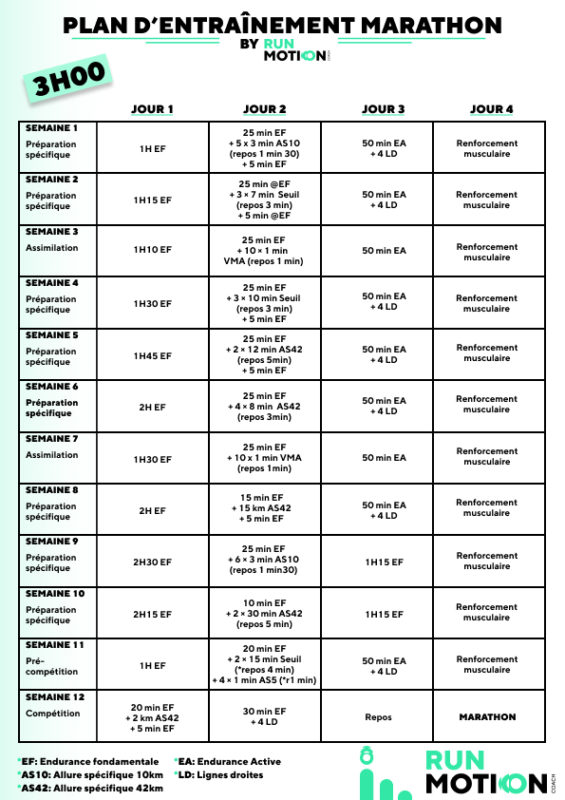
Here is an excerpt from your 12-week 3-hour marathon training plan, shown below:
Week 1, Specific preparation
Session 1: 1-hour easy run
Session 2: 25 min easy run + 5 x 3 min at 10K pace, 1 min 30 recovery + 5 min easy run
Session 3: 50 min active endurance + 4 strides
Session 4: Strength training
Week 7, Adaptation
Session 1: 1-hour 30-min easy run
Session 2: 25 min easy run + 10 x 1 min vVO2max, 1 min recovery
Session 3: 50 min active endurance
Session 4: Strength training
Week 10, Specific preparation
Session 1: 2-hour 15-min easy run
Session 2: 25 min easy run + 2 x 30 min at marathon pace, 5 min recovery
Session 3: 1-hour 15-min easy run
Session 4: Strength training
Sub-3 marathon training plan: 4 sessions over 12 weeks
Running a marathon in under 3 hours is an impressive achievement. With a dedicated training plan, the right nutrition and strong mental preparation, you can make this goal a reality. Stay motivated, be patient and, above all, enjoy every stage of this extraordinary journey.
Download the RunMotion Coach app for personalized training tailored to this goal. You can select your available days each week, add S&C sessions and receive targeted paces, including that all-important 4:15/km marathon pace.
If you want to go further and build your race strategy, we have developed a tool that lets you create a personalized race plan, including split times, paces, nutrition and hydration management. Everything you need to manage your race on the big day.
👉 Head to Race Strategy.
Good luck with your marathon training! We hope you break 3 hours, just like the hundreds of RunMotion Coach users who already have 😉
You may also be interested in these articles:
- 3:15 marathon training plan
- How to run a 3:30 marathon
- 3:45 marathon training plan: detailed guide
- How to run a 4-hour marathon
- How to run a 4:15 marathon
- 4:30 marathon training plan
FAQ: 3-hour marathon training plan
What pace do you need to hold?
To finish a marathon in 3 hours, you need to maintain an average pace of around 4:16 per kilometre over the full 42.195 km. This performance requires excellent endurance and rigorous, marathon-specific preparation.
What half marathon time allows you to target this goal?
A runner capable of completing a half marathon between 1:24 and 1:27 will generally have the fitness required to target a 3-hour marathon, provided they follow training suited to the distance.
What weekly training volume is needed for this goal?
Most runners targeting 3 hours run between 70 and 100 kilometres per week. The exact volume depends on your current fitness, experience and ability to recover.
What vVO2max do you need to run a 3-hour marathon?
Although marathon performance depends primarily on endurance, a vVO2max between 19 and 20 km/h is often seen in runners capable of completing a marathon in 3 hours.
How should you manage your pace to break 3 hours in the marathon?
The goal is to run consistently around your target pace from the start. Sensible pacing through the opening kilometres, combined with a well-rehearsed fueling strategy, gives you the best chance of crossing the finish line in under 3 hours.