An Eiger Ultra Trail training plan has one main job: getting you ready for some of the steepest terrain on the UTMB World Series. From Grindelwald, beneath the Eiger North Face, every race strings together passes, ridges and long, steep descents. Eiger Ultra Trail by UTMB offers six adult races from 15 km to 261 km, and this guide covers how to train for each of them.
The short answer
- E16 and Trail Surprise: 8 to 12 weeks of training; E35 and E51: 12 to 16 weeks; E101: 6 to 8 months; E250: at least a full season with several ultras behind you.
- Rough guide in the specific phase for the E101: 9 to 14 hours a week and 2000 to 3500 m of elevation gain, depending on your level.
- Key sessions: long steep climbs, hike-running with poles if allowed, downhill repeats, back-to-back mountain days.
- The main challenge: very high elevation per kilometre (6700 m over 101 km), which means lots of power hiking and quads that can take a beating.
Contents
Eiger Ultra Trail distances and elevation gain
Figures from the official Eiger Ultra Trail by UTMB website.
| Race | Distance | Elevation gain | Profile/notes |
|---|---|---|---|
| E250 – UNESCO Trail | 261 km | 18000 m | 100M category. Start in Grindelwald, run in teams of 2 or 3 over the whole route, 95-hour limit. |
| E101 – Ultra Trail | 101 km | 6700 m | 100K category, 3 Running Stones. 4 a.m. start in Grindelwald, 25-hour limit, partial self-support |
| E51 – Panorama Trail | 51 km | 3100 m | 50K category, 2 Running Stones. Over the Faulhorn (2680 m), 13-hour limit |
| E35 – North Face Trail | 35 km | 2500 m | 50K category, 2 Running Stones. Burglauenen to Grindelwald below the North Face, 9-hour limit |
| E16 – Pleasure Trail | 16 km | 950 m | 20K category |
| Trail Surprise | 15 km | 800 m | 20K category |
| Kids Race | not stated | not stated | Children’s race |
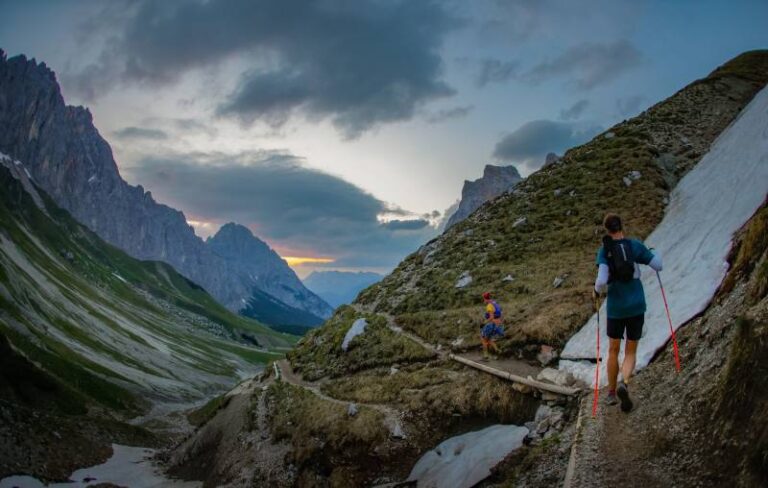
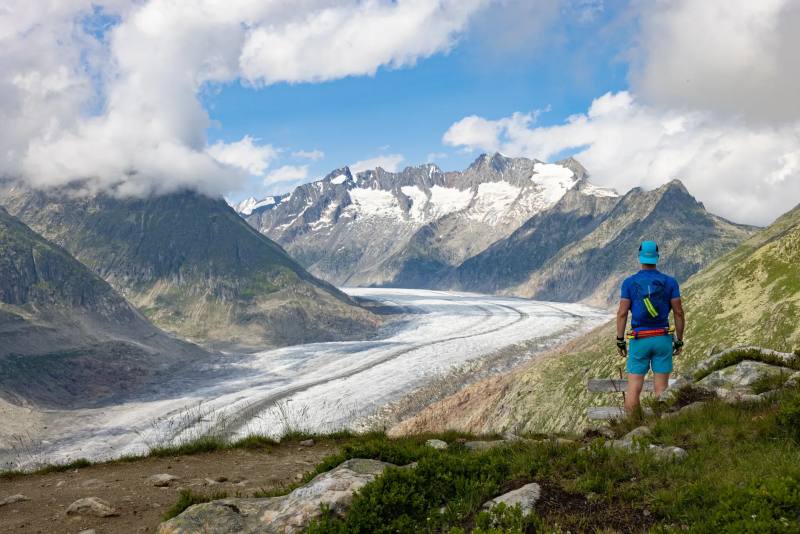
The terrain is fully alpine: mountain paths, ridges, moraine on the E35, summits such as the Faulhorn and, on the E250, a crossing of the great glacier area around the Aletsch via passes like the Hohtürli and the Grimselpass. The event takes place in mid-July, so expect big temperature differences between the valley floor and the high points.
What makes the Eiger Ultra Trail demanding
Elevation comes first. With 6700 m over 101 km on the E101 and 2500 m over 35 km on the E35, much of the climbing is done walking. Your training must build a fast, efficient power hike, not just uphill running.
Descents come next. They are long and often steep, and this is usually where the end of the race is decided, when your quads are already saturated. Eccentric strength and downhill technique belong in your plan from day one.
Self-sufficiency matters as well. The races run in partial self-support: between aid stations you carry your own food, drink and mandatory gear. On the E250 you also manage sleep over several days and race as a team, so you need to train with your teammates and find a shared rhythm.
How long do you need to train?
For the E16 and Trail Surprise, 8 to 12 weeks is enough if you run regularly and have some mountain experience. For the E35 and E51, allow 12 to 16 weeks, ideally after a first 25 to 40 km mountain race: short in kilometres, long in hours.
For the E101, plan 6 to 8 months including 12 to 16 specific weeks, with at least one 50 to 80 km mountain race already completed. Our guide to increasing your trail distance explains how to step up safely.
The E250 is a project of its own: several days, 18000 m of climbing, in a team. Prepare over at least a full season after several successful long ultras, ideally a 100-miler. Our 100-mile training plan is a logical step before considering it.
The phases of your training plan
Base building
Aerobic volume at easy effort, strength work twice a week (lunges, step-ups, core, eccentric quad work) and one quality uphill session. In winter, ski touring and incline treadmill sessions are good ways to gain elevation without impact.
Specific phase
In the last 10 to 12 weeks, increase weekly elevation gain and long-run duration step by step, on terrain close to the course. Validate your gear, nutrition and pole technique, and for the E250 train together as a team as often as possible.
Taper
Two to three weeks of reduced volume (30 to 50 %), with a few short uphill efforts. Arrive fresh: on this kind of profile, leftover fatigue shows on the very first climb.
Key workouts for the Eiger Ultra Trail
Steep power-hiking repeats: 4 to 6 climbs of 10 to 15 minutes on a steep slope, mixing running and fast hiking, with or without poles. This is the session closest to race conditions.
Long mountain days: 4 to 7 hours with 1500 to 2500 m of climbing depending on your race and level, eating as you would on race day.
Downhill repeats: on technical trail, 4 to 8 descents of 5 to 10 minutes, focusing on flow rather than raw speed.
Back-to-back days: two long consecutive days, essential for the E101 and E250, to learn to keep moving on tired legs.
The RunMotion Coach app builds and adjusts this kind of plan every week based on the sessions you complete, your level and your schedule, with elevation, strength and recovery built in. RunMotion Coach is the official online coach of the UTMB World Series, and its founders, twin brothers Guillaume and Romain Adam, come from the Alps: steep climbs and ultras are their home ground. Try the app free for 7 days.
Plan your race strategy with Race Strategy
On a profile this broken, even pacing makes no sense. Race Strategy by RunMotion calculates your race plan kilometre by kilometre, with pace adjusted for elevation, altitude and technical terrain, estimated split times at key points and a fuelling and hydration plan per section (carbohydrates, water, sodium). Import the official course GPX from the race website, then adjust the plan to race-day weather.
Running Stones and the UTMB World Series
The Eiger Ultra Trail is part of the UTMB World Series. According to the official site, the E101 earns 3 Running Stones, while the E51 and E35 earn 2 each, improving your chances in the lottery for the Finals in Chamonix. To build a season around the circuit, read our UTMB World Series training plan guide and our article on preparing for UTMB with a personalised plan.
FAQ
Are poles allowed at the Eiger Ultra Trail?
Check the official race regulations. On profiles above 60 m of climbing per kilometre, poles help a lot on the way up, provided you have trained with them.
What level do you need for the E101?
Having finished at least one 50 to 80 km mountain race is a sensible prerequisite. The 25-hour limit leaves some margin, but the climbing demands real confidence both uphill and downhill.
How many hours a week to train for the E51?
In the specific phase, 6 to 9 hours a week with 1500 to 2500 m of climbing is a common benchmark, adjusted to your level and progression.
Conclusion
The Eiger Ultra Trail rewards runners who hike fast, descend cleanly and manage their own supplies. Choose your race according to your experience, build your base patiently and give yourself clear benchmarks with a plan that adapts. Start your free RunMotion Coach trial.
Article updated by the RunMotion Coach team.
Sources: