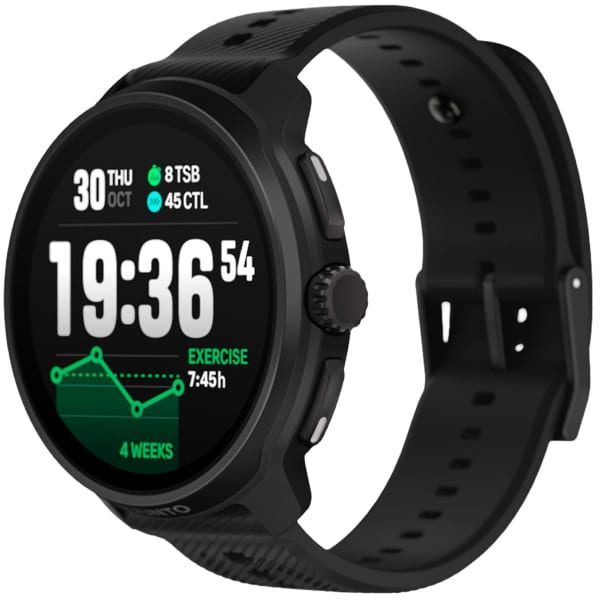
Trying to decide which Suunto watch to run with? For most road runners, the Suunto Run 2 is all you need. The Race 3S and Race 2 make sense if you want more battery life or run trails, while the Vertical 2 is built mainly for ultras and the mountains. Here’s how to choose the right Suunto running watch for your training, your budget and the way you like to train.
The short answer
- Road running, 5K to marathon, tight budget: Suunto Run 2 (from €299), light and accurate.
- Road + trail, light all-rounder: Suunto Race 3S (€499).
- Long trail runs, triathlon, big screen: Suunto Race 2 (from €499).
- Ultra trail and mountains: Suunto Vertical 2 (from €599), the longest battery life, with a built-in flashlight.
- Following a RunMotion Coach plan and want your workouts on your wrist: choose a Race or Vertical. The Run and Run 2 don’t support SuuntoPlus, which you need to receive your workouts.
Contents
Suunto’s running watch lineup in 2026
Suunto has refreshed most of its lineup over the past few months. The Run 2 launched in September 2026, the Race 3S in October 2026, and the Race 2 and Vertical 2 in 2025. The good news: they all now have a bright AMOLED screen, dual-band GPS and offline maps. So the real differences are less about accuracy and more about battery life, weight, screen size and advanced features.
The table below sums up the four current models that matter most for runners. Prices are European launch prices; they often drop during sales.
| Model | Launch price | Dual-band GPS battery | Weight | Best for |
|---|---|---|---|---|
| Suunto Run 2 | €299 (4 GB) / €349 (64 GB) | 24 h | ≈ 50 g | Road runners, 5K to marathon |
| Suunto Race 3S | €499 (titanium) | 38 h | 56 g | Road + trail all-rounders |
| Suunto Race 2 | €499 (steel) / €599 (titanium) | 55 h | 76 g (steel) | Long trail runs, triathlon, big-screen fans |
| Suunto Vertical 2 | €599 (steel) / €699 (titanium) | 65 h | 87 g (steel) | Ultra trail, mountains, long adventures |
The original Suunto Run (2025) is still on sale, often around €250. It has been replaced by the Run 2, which notably fixes the heart rate sensor’s reliability. The Race S has made way for the Race 3S. As for the Suunto 7 (2020), Suunto’s only Wear OS watch, it never got a direct successor: if you own one, the Race models and the Run 2 offer the same kind of AMOLED screen with far better battery life.
The 4 criteria that really matter for runners
Before comparing spec sheets, ask yourself one simple question: what is your longest run or race of the year, and on what terrain? The answer already rules out half the lineup.
Battery life: base it on your longest race
For a marathon, even a 5-hour one, the Run 2’s 24 hours are more than enough. A 100 km ultra is another story: with dual-band GPS, an always-on display and navigation, battery drains fast. Keep a margin of at least 30 to 50% over your expected finish time. That’s where the Race 2 (55 h) and Vertical 2 (65 h) pull ahead.
Weight and size: an underrated factor
Between the Run 2 (about 50 g) and the Vertical 2 (87 g in steel), you’ll feel the difference on your wrist, especially during interval sessions and at night if you wear your watch for sleep tracking. If you have a slim wrist, the Run 2 or Race 3S will be more comfortable day to day.
Maps and navigation: essential on trails
The whole current lineup offers offline maps. But for trail running, Climb Guidance, which shows the profile and remaining elevation gain of each climb, changes how you manage your race. It’s available on the Race 3S, Race 2 and Vertical 2, but not on the Run 2. If you run marked courses or on the road, you won’t miss it. If you’re training for a mountain trail race, it really helps you pace your effort. And to follow a course, you can upload the GPX file of your race to your watch.
GPS and heart rate accuracy
Dual-band GPS is now standard at Suunto, which clearly improves tracks in cities and forests. For wrist-based heart rate, keep in mind a limitation that applies to every brand: during short, intense efforts, the optical sensor lags behind. If you do a lot of heart rate–based training, a chest strap is still the gold standard.
Which Suunto watch is right for you?
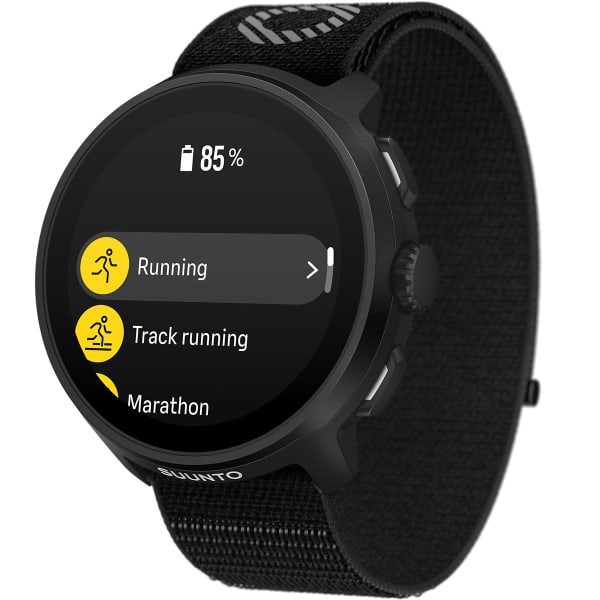
You run on the road, from 5K to marathon: Suunto Run 2
The Run 2 is the most relevant Suunto for most runners. Light, with a great AMOLED screen and dual-band GPS, it gives you everything you need to run a pace session or a marathon. It also has road-focused features such as a marathon time estimate and “Ghost Runner” to race against a target pace. The 64 GB version adds room for offline music.
Its limits: no Climb Guidance, no SuuntoPlus support (so no export of your RunMotion workouts, see below) and shorter battery life than the Race models. If you’re aiming for a trail race longer than 6 to 8 hours, look at the Race 3S instead. Just starting out and wondering whether you need such a complete watch? Our guide to choosing a GPS running watch as a beginner will help you decide.
You mix road and trail: Suunto Race 3S
The Race 3S, launched in October 2026, packs most of the Race 2 into a more compact design: 56 g, titanium bezel, sapphire glass, maps, Climb Guidance and 38 hours of dual-band GPS. It’s the right compromise if you want a single watch for weekday road runs and weekend trails. It does cost as much as the steel Race 2, though, with noticeably shorter battery life.
You run long trails or do triathlons: Suunto Race 2
The Suunto Race 2 has the biggest screen in the lineup (1.5 inches), ideal for reading a map on the move, and 55 hours of dual-band GPS. It also has the most complete multisport features, with automatic transitions for triathlon. The trade-off: it weighs 76 g in steel, more than 50% heavier than the Run 2.
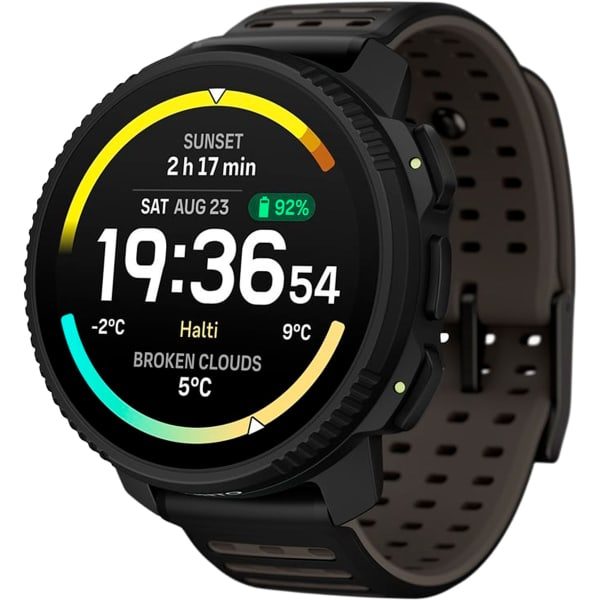
You’re training for an ultra or run in the mountains: Suunto Vertical 2
The Suunto Vertical 2 has the longest battery life: 65 hours of dual-band GPS and up to 250 hours in power-saving mode. It adds a built-in LED flashlight, handy for a night section or a 4 a.m. start. It’s the watch for races over 24 hours and long days in the mountains. For road running, it’s oversized and heavy (87 g in steel).
Following a training plan with a Suunto watch
A watch measures; it doesn’t coach. What makes you improve is a plan that balances easy running, threshold sessions and VO2max intervals, and adapts to your fatigue. So the real question is: can your Suunto display your plan’s workouts while you run?
With the RunMotion Coach app, there are two things to tell apart. First, importing your activities: every Suunto watch connected to your Suunto account automatically syncs its runs to the app, which matches them with your scheduled sessions. Second, exporting workouts to the watch: this goes through SuuntoPlus Guides, so the day’s workout shows up right on your wrist, with target paces for each block. One essential requirement: your watch must support SuuntoPlus, the platform that lets it receive Guides from partner apps like RunMotion Coach. That’s the case for the Suunto Race and Vertical (all versions), as well as the Suunto 9, 5, 3 and Ocean. It isn’t the case for the Suunto Run or the Run 2: without SuuntoPlus, they can’t receive your RunMotion workouts. That limitation comes from Suunto.
If following your interval sessions on your wrist matters to you, that’s a buying criterion in its own right. Setup is explained step by step in our help article on how to export a session to your Suunto watch.
Got your Suunto but no plan yet? RunMotion Coach builds a personalized program based on your goal, level and availability, and adjusts it using the activities your watch records. Try the app free for 7 days.
Mistakes to avoid when buying
The most common one is buying for the race you might run someday. A Vertical 2 for three 45-minute road runs a week means €300 and nearly 40 g too much compared with a Run 2. Choose for your current running and your goal for the next 12 months.
Another trap: trusting the maximum battery life on the box. The 250 hours of the Vertical 2 or the 200 hours of the Race 2 are for a heavily reduced power-saving mode. To compare, always look at dual-band GPS battery life, which is what you’ll use on race day.
Finally, don’t let the watch dictate all your training. Checking your pace on every run often pushes you to go too fast on easy days. A few simple settings make a big difference, as we explain in our tips on getting the most out of your running watch.
FAQ: choosing a Suunto watch for running
What is the best Suunto watch for a marathon?
For a road marathon, the Suunto Run 2 ticks every box: light, accurate and with more than enough battery life. If you want your RunMotion workouts on your wrist, go for a Race, which supports SuuntoPlus. When it comes to preparation, a structured plan matters more than the watch, for example our 4:15 marathon training plan.
What’s the difference between the Suunto Run 2 and the Race 3S?
The Race 3S adds Climb Guidance, SuuntoPlus apps, a titanium case with sapphire glass and longer battery life (38 h vs 24 h in dual-band). The Run 2 is lighter and costs €150 to €200 less.
Do Suunto watches work with Strava and RunMotion Coach?
Yes. Every Suunto watch syncs its activities to Strava and RunMotion Coach through the Suunto app. Exporting your plan’s workouts to the watch, however, depends on the model (see above).
Do you need a Suunto watch with maps for trail running?
On a marked trail it isn’t essential, but it’s reassuring if you take a wrong turn. All recent Suunto watches have maps. To manage your effort on climbs, Climb Guidance (Race 3S, Race 2, Vertical 2) is more useful day to day than the map itself.
Bottom line
To choose your Suunto, start from your longest race and your terrain. On the road, the Run 2 is enough. To mix road and trail, the Race 3S is the most balanced. For long trails and triathlon, the Race 2 offers the best battery life for the money, and the Vertical 2 is made for ultras. If you follow a plan, also check that your watch can receive your workouts.
Your watch records; RunMotion Coach tells you what to run and at what pace, based on your level and goal. Start your personalized plan with a 7-day free trial.
Updated November 9, 2026.