A Wildstrubel training plan has to get you ready for high Swiss mountains: between the Valais and the Bernese Oberland, the courses cross passes and climb to 2800 m at the Wildstrubel hut before converging on Crans-Montana. Wildstrubel by UTMB offers seven adult races, from 10 km to the Wild 110. Here is how to train for Wildstrubel by UTMB, with the official figures for each race.
The short answer
- Wild 10 and Wild 25: 8 to 12 weeks; Wild Glacier Marathon and Wild 55: 12 to 16 weeks; Wild 70 and Wild 110: 5 to 8 months on a solid ultra base.
- Rough guide in the specific phase for the Wild 110: 9 to 14 hours a week and 2000 to 3500 m of elevation gain, depending on your level.
- Key sessions: long hill repeats, long days at altitude, technical descents, back-to-back weekends.
- The main challenge: altitude, with a high point of 2800 m on the Wild 110 and Wild 55, on point-to-point and traverse courses that take you far from where you started.
Contents
Wildstrubel by UTMB distances and elevation gain
Figures from the official Wildstrubel by UTMB website.
| Race | Distance | Elevation gain | Profile/notes |
|---|---|---|---|
| Wild 110 Crans-Montana | 113 km | 6600 m | 4 Running Stones. 11 p.m. start, 30-hour limit, high point 2800 m, Gemmi (2268 m) and Rawyl (2427 m) passes |
| Wild 70 Kandersteg | 72 km | 4600 m | 3 Running Stones. Kandersteg to Crans-Montana, 17 h 30 limit |
| Wild 55 Adelboden | 55 km | 3300 m | 2 Running Stones. Adelboden to Crans-Montana, high point 2800 m, 14-hour limit |
| Wild Glacier Marathon Lenk | 42 km | 2700 m | 50K category, 2 Running Stones. Lenk to Crans-Montana via the Schnidejoch, 10 h 30 limit |
| Wild 25 Leukerbad | 26 km | 1200 m | 20K category, 1 Running Stone. Leukerbad to Crans-Montana, 6-hour limit |
| Wild 10 Crans-Montana | 10 km | 500 m | Short race |
| Wild NextGen Crans-Montana | 10 km | 500 m | Youth race |
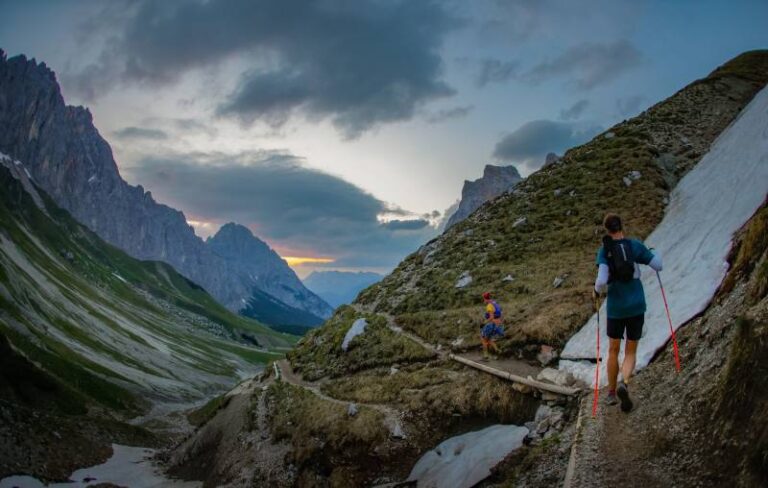
There are also kids’ races, an adaptive run and a joëlette challenge. The terrain alternates well-kept alpine pastures, mountain paths, pass crossings and more runnable sections along the bisses, the old irrigation channels of the Valais. The Wild Glacier Marathon offers views of several glaciers from the Schnidejoch. The event takes place in September, so your specific training happens in summer, when high trails are easier to access.
What makes Wildstrubel demanding
Altitude comes first. Climbing to 2800 m after hours of effort affects your breathing and appetite, especially if you live at low elevation. A few outings above 2000 m during your build show you how your body reacts.
The traverses come next. The Wild 70, Wild 55, Glacier Marathon and Wild 25 start in another valley (Kandersteg, Adelboden, Lenk, Leukerbad) and finish in Crans-Montana, while the Wild 110 starts in Crans-Montana, crosses into the canton of Bern via the Gemmi and returns to the Valais over the Rawyl. Every pass means a long, sometimes technical descent.
Night and weather matter too. The Wild 110 starts at 11 p.m., so the first passes are crossed in the dark. In September at altitude, nights can be cold and weather changeable, so test your gear thoroughly in training.
How long do you need to train?
For the Wild 10 and Wild 25, 8 to 12 weeks is enough if you run regularly. The Wild 25 includes a varied descent with technical sections, so practise it.
For the Wild Glacier Marathon and Wild 55, allow 12 to 16 weeks. The Glacier Marathon is very steep (2700 m over 42 km), so a first 25 to 30 km mountain race is a sensible prerequisite.
For the Wild 70 and Wild 110, plan 5 to 8 months including 12 to 16 specific weeks, after at least one 50 km mountain race. Our guide to increasing your trail distance explains how to progress. These durations are benchmarks.
The phases of your training plan
Base building (spring)
Easy aerobic volume, strength work twice a week and one quality hill session. With a September race, you have time to build a solid base without rushing elevation.
Specific phase (summer)
Over the last 10 to 12 weeks, use the summer to go high: long runs above 2000 m, pass crossings and long descents. For the Wild 110, add two or three night runs with your headlamp.
Taper
Two to three weeks of reduced volume (30 to 50 %) with a few short efforts. Avoid very long altitude days in the last ten days.
Key workouts for Wildstrubel
Long hill repeats: 3 to 5 climbs of 12 to 15 minutes, running or hiking fast depending on the gradient.
Long days at altitude: 4 to 7 hours with 1500 to 2500 m of climbing, ideally crossing a pass above 2000 m. This is the most race-specific session.
Long descents: a single descent of 800 to 1200 m at controlled pace, so your quads get used to what follows every pass.
Back-to-back days: two long consecutive mountain days, useful for the Wild 70 and Wild 110.
The RunMotion Coach app builds and adjusts your plan every week based on completed sessions, level and availability, including elevation, strength and recovery. RunMotion Coach is the official online coach of the UTMB World Series, and its founders, twin brothers Guillaume and Romain Adam, come from the Alps: mountains and ultras are their home ground. Try the app free for 7 days.
Plan your race strategy with Race Strategy
Race Strategy by RunMotion calculates your race plan kilometre by kilometre, with pace adjusted for elevation, altitude and technical terrain. On a course reaching 2800 m, accounting for altitude really changes the estimates. You also get estimated split times at key points and a fuelling and hydration plan per section (carbohydrates, water, sodium). Import the official course GPX from the race website, then adjust for race-day weather.
Running Stones and the UTMB World Series
Wildstrubel by UTMB is part of the UTMB World Series. The official site lists 4 Running Stones for the Wild 110, 3 for the Wild 70 and 2 for the Wild 55 and Wild Glacier Marathon, improving your chances in the lottery for the Finals in Chamonix. For season planning, see our UTMB World Series training plan guide and how to plan your trail running season.
FAQ
Are poles allowed at Wildstrubel?
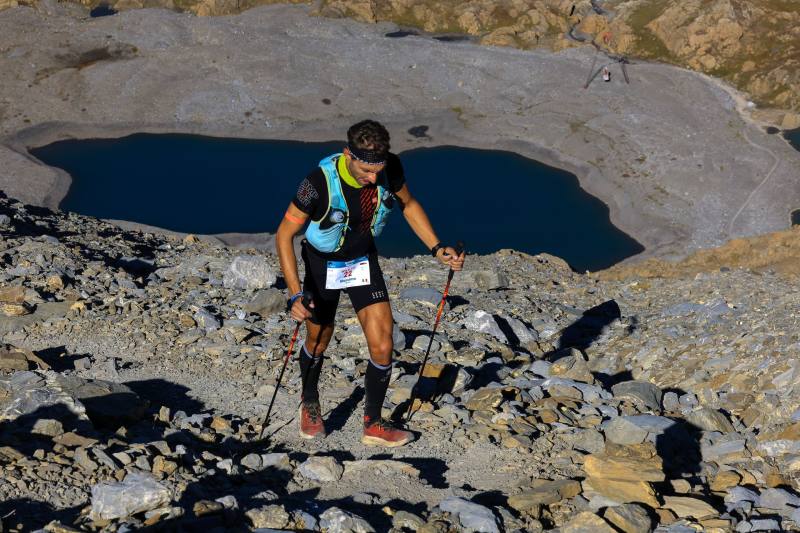
Check the official race regulations. On the long races and the very steep Glacier Marathon, poles help on the climbs if you have trained with them.
What level do you need for the Wild 110?
Having finished at least one 50 to 80 km mountain race is a sensible prerequisite, ideally with some night and altitude experience.
Can I train for Wildstrubel if I live far from the mountains?
Yes, with incline treadmill sessions, stairs and strength work for the base, but plan at least a few weekends in the mountains during the summer to practise altitude and long descents.
Conclusion
Wildstrubel by UTMB calls for comfort at altitude, strong quads and good management of long traverses. Choose your race according to your experience and make the most of summer to train in the mountains. Start your free RunMotion Coach trial.
Article updated by the RunMotion Coach team.
Sources: