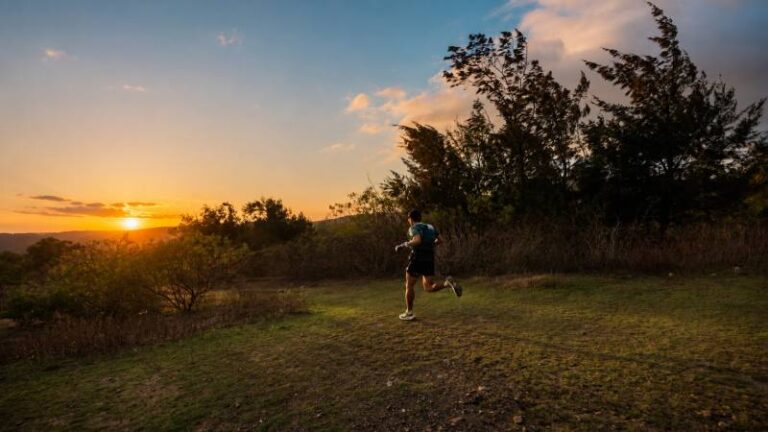
A good Vietnam Highlands Trail training plan gets you ready for relentless climbing on the highland trails around Da Lat, in Lam Dong province, through pine forest, primary jungle and summits such as Langbiang. There are four races, from 10K to 100K, and the 100K packs more than 5500 m of elevation gain. Here is how to train for each of them.
The short answer
- Indicative build-up: 8 to 10 weeks for the 10K, 10 to 12 weeks for the 20K, 16 to 20 weeks for the 50K, 6 to 9 months for the 100K.
- Peak weekly climbing as a rough guide: about 1000 to 1500 m for the 20K, 2000 to 3000 m for the 50K, 3000 to 4500 m for the 100K.
- Key sessions: hill repeats, technical forest descents, long hike-run days, early-morning head-torch runs for the 100K.
- The defining feature: dense climbing (over 50 m per km on the 50K and 100K) on sometimes technical jungle trails.
Contents
Vietnam Highlands Trail distances and elevation
Figures come from each race page on the official Vietnam Highlands Trail by UTMB website.
| Race | Distance | Elevation gain | Profile / notes |
|---|---|---|---|
| 100K Langbiang (100K category) | 101.5 km | 5570 m | Pre-dawn start at Lam Vien Square, Langbiang Peak (2167 m), technical jungle trails in the national park; 29 h cut-off |
| 50K Elephant (50K category) | 56.4 km | 2946 m | Wild Elephant Mountain massif (1815 m), shifting terrain and technical sections |
| 20K Pinhatt (20K category) | 24.1 km | 1113 m | Pine and primary forest, high point at Pinhatt Peak (1600 m) |
| 10K Tuyen Lam (no category listed) | 11.3 km | 486 m | Runnable course, a good introduction to trail running |
The races take place in Vietnam’s Central Highlands, around four iconic peaks: Bidoup, Langbiang, Elephant and Pinhatt. The organisers describe open ridgelines, pine forests and old-growth forest, with runnable dirt tracks and technical sections under the trees. The event is held in January, and the 50K page mentions changing weather, so pack layers suited to altitude and an early start.
What makes the Vietnam Highlands Trail hard
The climbing density is the first challenge. The 100K averages about 55 m of gain per kilometre, and the 50K Elephant is in the same range. You rarely get a long flat stretch to recover, which wears you down more than a profile built on a few big climbs.
The second is the mix of surfaces. The 100K starts on paved roads in Da Lat, moves onto rolling dirt tracks, then drops into technical jungle trails in Bidoup–Nui Ba National Park. You need to run efficiently when the ground allows it and stay sharp on your footing when it gets rough.
Finally, the 100K starts at 3 a.m., so the first hours are run by head torch after a short night. Managing sleep and pre-race fuelling is part of the job.
How long do you need to prepare?
10K and 20K: the Tuyen Lam 10K suits a regular runner discovering trails, with 8 to 10 weeks of preparation. The Pinhatt 20K, with over 1100 m of gain, needs 10 to 12 weeks and some hill experience.
50K: allow 16 to 20 weeks. With nearly 3000 m of gain, it is a genuine mountain 50K, ideally tackled after a 30 to 40 km trail race.
100K: plan 6 to 9 months after one or two seasons of trail running, with at least one mountain 50K completed. These are guidelines; your history and available time come first.
The phases of your training plan
Base: easy aerobic running, regular strength work, one short speed session a week, and climbing that increases gradually, with a lighter week every three or four weeks.
Specific: over the last 8 to 12 weeks, target the saw-tooth highland profile with more hill work, forest descents and long runs on mixed trails, testing your food and kit. For the 100K, add a couple of very early starts by head torch.
Taper: two to three weeks with volume down 30 to 50%, a few short efforts, and sleep as a priority, especially if you have a long trip to reach Da Lat.
Key sessions to train for the Vietnam Highlands Trail
Medium hill repeats. Six to ten climbs of 3 to 6 minutes with a jog back down. They match a course made of many climbs rather than one long ascent.
Technical forest descents. Find trails with roots and loose soil and link descents together while staying relaxed. This is what pays off in the jungle sections.
Long rolling runs. Three to six hours depending on your race, mixing runnable tracks and technical trail, to practise power hiking, getting back into rhythm on the flat, and your fuelling plan.
Early start, for the 100K. Once or twice in the specific phase, head out before dawn for a long run by head torch to test breakfast timing, lighting and night footwork.
To fit these sessions into a plan that matches your level and schedule, RunMotion Coach, the official online coach of the UTMB World Series, adjusts your training every week based on what you actually completed. Try it free for 7 days.
Build your race plan with Race Strategy
On a course this rolling, it is easy to go out too hard on the first climbs. Race Strategy by RunMotion calculates your strategy kilometre by kilometre, adjusting pace for gradient, altitude and terrain technicality. You get estimated split times at key points, a section-by-section fuelling and hydration plan (carbs, water, sodium) and a race-day weather adjustment. Just import the official GPX of your race.
Running Stones and the UTMB World Series
The Vietnam Highlands Trail by UTMB is part of the UTMB World Series: the 20K, 50K and 100K category races earn Running Stones, which improve your odds in the draw for the Chamonix finals. Check each race page for the exact allocation. To build a full season around the circuit, read our UTMB World Series training plan guide and our advice on planning your trail running season.
FAQ
Are poles allowed at the Vietnam Highlands Trail?
Check the official rules and mandatory gear list. If they are allowed, they can help on the 100K, provided you have trained with them.
What level do I need for the 100K Langbiang?
With 101.5 km, 5570 m of gain and a 29 h cut-off, it is for trail runners who have already finished at least one mountain 50K. Our guide to increasing your distance explains how to step up safely.
Is the Tuyen Lam 10K suitable for beginners?
The organisers present it as an accessible introduction with gentle climbing (486 m). If you already run two or three times a week, it is a good first trail race.
Final word
The Vietnam Highlands Trail rewards runners who can handle climb after climb without fading and stay precise on jungle trails. At RunMotion, mountains and vertical gain are home ground: our founders, twin brothers Guillaume and Romain Adam, come from the Alps. For a plan built around your race, start your free 7-day RunMotion Coach trial.
Article updated by the RunMotion Coach team.
Sources