An Ultra Trail Whistler training plan has to prepare you for genuine mountain running: 5,100 m of climbing on the 100K, with ascents of both of the resort’s signature mountains, Whistler and Blackcomb. Held in late June in British Columbia, the first Canadian event of the UTMB World Series offers four races from 10K to 100K. Here are the official numbers and how to build your preparation.
The short answer
- Typical build: 6 to 10 weeks for the 10K, 3 to 4 months for the 25K, 4 to 6 months for the 50K, 6 to 9 months for the 100K.
- Specific-phase volume: roughly 3 to 5 hours a week (10K) up to 9 to 14 hours (100K), with a large share of climbing.
- Key sessions: long power-hiking climbs, technical descents on tired legs, mountain back-to-backs for the 50K and 100K.
- The defining feature: a high climbing ratio (over 50 m per km on the 100K) with two big alpine ascents in one day.
Contents
Ultra Trail Whistler distances and elevation
The official name is Ultra Trail Whistler by UTMB (not to be confused with other local races in the resort). Figures come from the official race pages, which note that courses remain subject to permitting and land access approvals.
| Race | Distance | Elevation gain | Profile / notes |
|---|---|---|---|
| 100K (100K category) | 100 km (62.1 mi) | 5,100 m (16,732 ft) | 5 a.m. start at Creekside, climbs Whistler Mountain and Blackcomb, high alpine and river trails, finish at Spruce Grove Park; 24-hour limit; 3 Running Stones |
| 50K (50K category) | 50 km (31.1 mi) | 2,942 m (9,652 ft) | Whistler Mountain climb, descent to the Village, Blackcomb climb; 12 h 30 min limit; 2 Running Stones |
| 25K (20K category) | 26 km (16.2 mi) | 1,500 m (4,921 ft) | Lost Lake trails then Blackcomb climb; 8-hour limit; 1 Running Stone |
| 10K | 12 km (7.5 mi) | 550 m (1,804 ft) | Billed as a beginner-level course, Lost Lake and Blackcomb, steep climb then steady descent; 6-hour limit; no Running Stones listed |
The two longest races start at Creekside, at the foot of Whistler Mountain, and link both mountains before finishing at Spruce Grove Park; the 100K adds valley river trails. The 25K and 10K start and finish at Spruce Grove Park, running the Lost Lake trails before climbing Blackcomb on flowing singletrack. Course details are on the official website.
What makes Ultra Trail Whistler hard
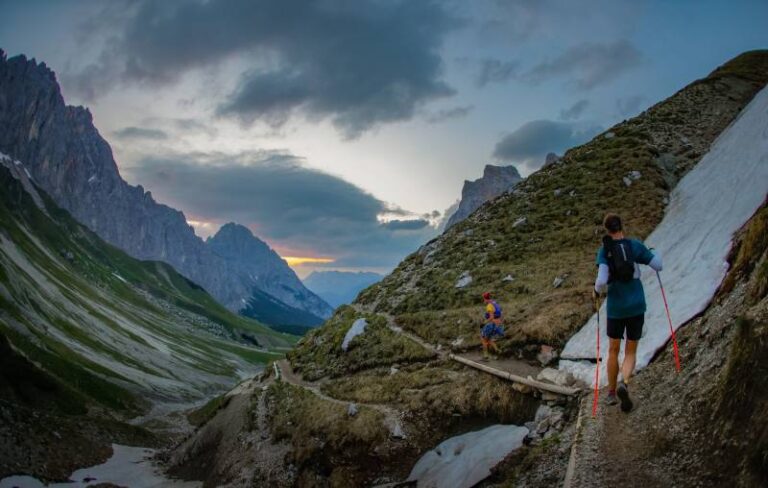
The numbers tell the story: over 50 m of gain per kilometre on the 100K, close to 60 m on the 50K and 25K. That is an alpine profile, with long climbs from valley floor to alpine terrain and long descents back to the village. You face two big ascents, and the second arrives after your quads have already absorbed the first descent.
On the 100K, a 5 a.m. start and a 24-hour limit mean many runners will finish in the evening or after dark, so plan lighting and fuelling accordingly. In early summer, conditions up high can be very different from the village. Read the mandatory gear list carefully.
How long to train for each distance
The 10K is billed as beginner-friendly: 6 to 10 weeks is enough if you already run regularly, with some climbing work. The 25K, with 1,500 m of gain, asks more: a first 15 to 20 km mountain race and 3 to 4 months of preparation. The 50K suits runners with a 30 to 40 km race and at least 1,500 to 2,000 m of gain behind them, over 4 to 6 months. The 100K ideally follows one or more 50 to 60 km mountain races, over 6 to 9 months; see our 100 km trail training plan and our guide to increasing distance. These benchmarks depend on your history and access to mountains.
The phases of your training plan
For a late-June race, the base phase falls in winter, when mountain access is often limited. Grow easy volume, keep one quality session a week and add two strength sessions; treadmill incline, stairs or ski touring are useful complements. The specific phase runs through spring, over 8 to 12 weeks: long runs with lots of vertical, technical descents and, for the 50K and 100K, mountain back-to-backs. Take a lighter week every three or four. The taper lasts one to two weeks for the shorter races and two to three weeks for the 100K.
Key workouts for Ultra Trail Whistler
The long climb. A continuous ascent of 30 to 90 minutes depending on your race, alternating running and power-hiking with the gradient. The best preparation for Whistler and Blackcomb.
The double ascent. In one session, link two long climbs separated by a descent. You rehearse the course logic and learn to climb again on quads already worked by the downhill.
Technical descents. Late in a session, on varied terrain: work on foot placement, vision and staying relaxed.
Mountain back-to-backs (50K and 100K). Long on Saturday, shorter on Sunday, to train on fatigue without one oversized run.
Want a plan that adjusts every week to what you actually ran, your level and your schedule? The RunMotion Coach app, official online coach of the UTMB World Series, factors in elevation, strength and recovery. Try it free for 7 days.
Plan your race with Race Strategy
On a course of big climbs and long descents, average pace means nothing. Race Strategy by RunMotion builds a kilometre-by-kilometre plan with pace adjusted for gradient, altitude and terrain, estimates your splits at key points, and gives you a per-section nutrition and hydration plan (carbs, water, sodium) adjusted to race-day weather. Import the official GPX for your race.
Running Stones and the UTMB World Series
Ultra Trail Whistler earns 3 Running Stones on the 100K, 2 on the 50K and 1 on the 25K; none are listed for the 10K. To build a season around several events, see our UTMB World Series training plan hub and how to plan your trail running season. RunMotion’s founders, twin brothers Guillaume and Romain Adam, come from the Alps: mountains, vertical and ultra distance are home turf.
FAQ
Should I use poles at Ultra Trail Whistler?
With climbs this long they can help on the 50K and 100K, as long as you have trained with them. Check whether they are allowed and any restrictions in the regulations.
What experience do I need for the Whistler 100K?
At least one 50 to 60 km trail race with significant climbing. With 5,100 m of gain, this 100K is close to an alpine ultra.
Is the 25K suitable for a first mountain race?
It is demanding for its length, with 1,500 m of gain over 26 km. If it is your first mountain race, the 10K, billed as a beginner course, is a better entry point.
Ultra Trail Whistler rewards runners who can climb for a long time, descend cleanly and handle two big ascents in one day. Build in winter, specialise in spring and arrive fresh. For a plan that adapts to you, start your free 7-day RunMotion Coach trial.
Article updated by the RunMotion Coach team.
Sources