An Ultra-Trail Shudao training plan prepares you to race on the ancient Shu Roads between Jiange and Zhaohua, in northern Sichuan, China. Flagstones polished over centuries, bamboo forest and the ridges of Jianmen’s Seventy-Two Peaks make for very distinctive terrain. Here are the four official races, from 20K to 100K, and how to train for them.
The short answer
- Indicative build-up: 10 to 12 weeks for the 20K, 14 to 18 weeks for the 50K (42 km), 5 to 7 months for the 70K, 6 to 8 months for the 100K.
- Peak weekly climbing as a rough guide: 800 to 1200 m for the 20K, 1500 to 2000 m for the 50K, 2500 to 3500 m for the 70K and 100K.
- Key sessions: medium running climbs, footwork on steps and paving, running long runs, a night run for the 100K.
- The defining feature: paved, flagstoned ground that can be slippery and uneven, rather than altitude (the 100K tops out at 1073 m).
Contents
Ultra-Trail Shudao distances and elevation
Figures come from each race page on the official Ultra-Trail Shudao by UTMB website. Note that the 70K sits in the 100K category.
| Race | Distance | Elevation gain | Profile / notes |
|---|---|---|---|
| DSD 100K (100K category) | 104 km | 3800 m | Jiange to Zhaohua, 9 p.m. start, Daping Mountain summit (1073 m), Qin-era flagstone post roads and bamboo forest; 26 h cut-off |
| CSD 70K (100K category) | 70.5 km | 3100 m | Starts in Zhaohua Ancient Town, polished flagstones; 19 h cut-off |
| MSD 50K (50K category) | 42 km | 1900 m | Technical traverse on the Shu Roads; 14 h cut-off |
| ESD 20K (20K category) | 21.5 km | 900 m | From the ridges of Jianmen’s Seventy-Two Peaks to Zhaohua Ancient Town; 7 h cut-off |
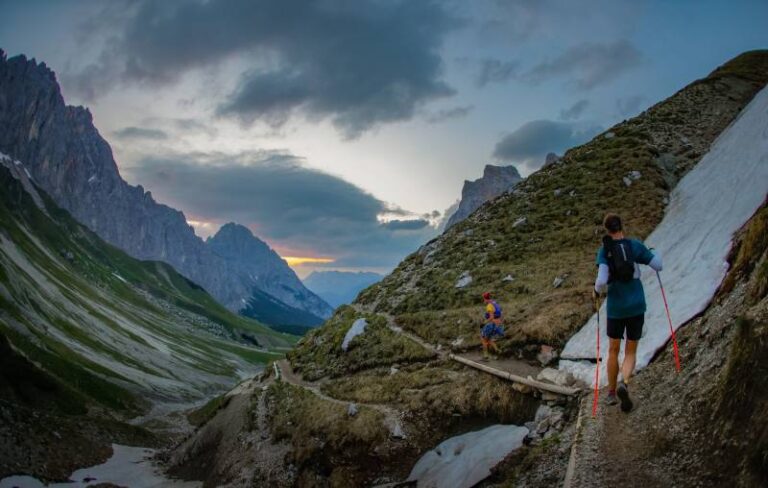
The Shu Roads are a network of ancient routes that linked Sichuan to Shaanxi across the mountains. The course runs from Jiange to Zhaohua on old flagstone post roads, bamboo forest trails and the steep ridges around Jianmen. Altitude stays moderate, with a high point of 1073 m on the 100K. The event is held in early November; the race pages give no weather data, so check the forecast before you go.
What makes Ultra-Trail Shudao hard
The ground is the main challenge. The race pages describe flagstones polished smooth by a thousand years of feet and hooves, and moss-covered paved roads. These surfaces are hard on your joints and can turn slippery when wet. You need secure footing and a short stride for hours, uphill and down.
The climbing is evenly spread, at around 36 to 45 m per kilometre depending on the race, which leaves plenty of runnable ground and calls for real running endurance. The 100K starts at 9 p.m., so the first half is run by head torch on these demanding surfaces.
How long do you need to prepare?
20K: with 21.5 km and 900 m of gain, the ESD needs 10 to 12 weeks if you already run regularly.
50K: the MSD is 42 km; allow 14 to 18 weeks, ideally after a first 20 to 30 km trail race.
70K and 100K: plan 5 to 7 months for the CSD and 6 to 8 months for the DSD, after at least one 40 to 50 km trail race. These are guidelines; your history and available time come first.
The phases of your training plan
Base: aerobic volume, strength work and one short speed session a week, with extra attention to ankle strength and balance for uneven flagstones.
Specific: over the last 8 to 12 weeks, add climbs and descents on stairs or paved paths, long runs where you run most of the time and, for the 100K, one or two night runs.
Taper: two to three weeks with 30 to 50% less volume and a few short efforts.
Key sessions to train for Ultra-Trail Shudao
Medium running climbs. Six to ten climbs of 3 to 5 minutes at a strong running effort, to handle the many moderate gradients.
Steps and paving. Once a week in the specific phase, run up and down stairs or paved paths with short, precise steps. Build up carefully: descending on hard surfaces is very demanding.
The running long run. Three to five hours on rolling terrain, running everything runnable. It is the best match for a course with steady climbing.
Night run, for the 100K. Several hours by head torch on trails to train your eyes and focus on uneven ground in the dark.
To bring these sessions together in a coherent plan, RunMotion Coach, the official online coach of the UTMB World Series, builds a personalised trail or ultra plan that adjusts every week to the sessions you complete and the time you have. Try it free for 7 days.
Build your race plan with Race Strategy
On flagstoned roads, terrain slows you down more than the elevation profile suggests. Race Strategy by RunMotion calculates your strategy kilometre by kilometre, adjusting pace for gradient, altitude and terrain technicality. You get estimated split times at key points, a section-by-section fuelling and hydration plan (carbs, water, sodium) and a race-day weather adjustment. Just import the official GPX of your race.
Running Stones and the UTMB World Series
Ultra-Trail Shudao is part of the UTMB World Series. According to the race pages, the 100K and 70K each earn 3 Running Stones, the 50K 2 and the 20K 1, improving your odds in the draw for the Chamonix finals. To plan your season, see our UTMB World Series training plan guide and our advice on planning your trail running season.
FAQ
Are poles allowed at Ultra-Trail Shudao?
Check the official mandatory gear list. On a fairly runnable, paved course, they matter less than on an alpine ultra.
Does the Shudao 70K count as a 100K?
Yes. According to its race page, the CSD is in the 100K category and earns 3 Running Stones, like the DSD.
What level do I need for the 100K?
With 104 km, 3800 m of gain and a 26 h cut-off, the DSD suits trail runners who have finished a 40 to 50 km race and want to step up to ultra distance. Our guide to increasing your distance explains how.
Final word
Ultra-Trail Shudao rewards enduring runners with precise footwork who can run for hours on demanding surfaces. At RunMotion, vertical gain and ultras are home ground: our founders, twin brothers Guillaume and Romain Adam, come from the Alps. For a plan built around your race, start your free 7-day RunMotion Coach trial.
Article updated by the RunMotion Coach team.
Sources