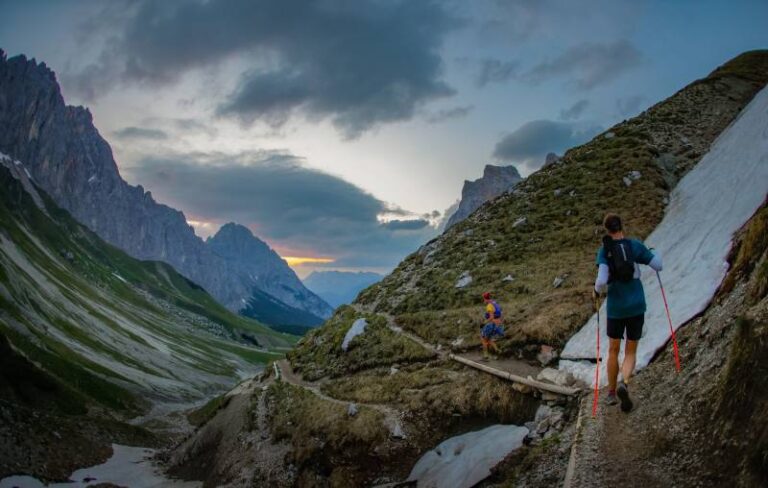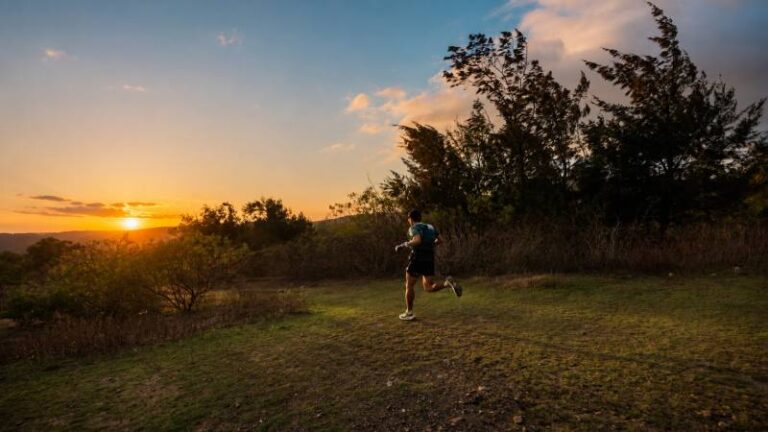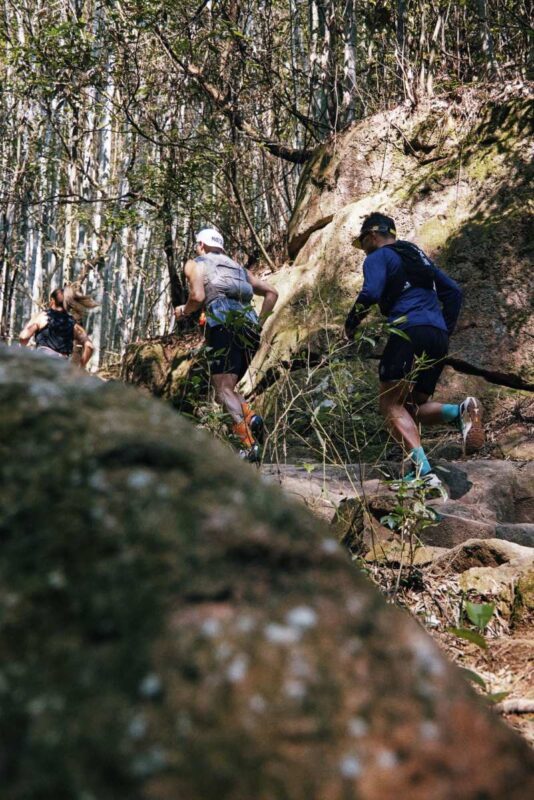
Your Ultra-Trail Mogan training plan needs to prepare you for the bamboo forests and mountain paths of Moganshan, near Huzhou in China. The event offers four races from 20K to 100M, several of them starting at night. Below you will find the official figures and how to structure your training for each distance.
The short answer
- Indicative build-up: 10 to 12 weeks for the 20K, 16 to 20 weeks for the 50K, 5 to 7 months for the 100K (81 km), 6 to 9 months for the 100M (114 km).
- Peak weekly climbing as a rough guide: 1500 to 2500 m for the 50K, 2500 to 4500 m for the 100K and 100M.
- Key sessions: hill repeats, stair work, relaxed descents, long night runs.
- The defining feature: a constantly rolling profile (about 57 m of gain per km on the 100M and 100K) and night starts on the 100K and 50K.
Contents
Ultra-Trail Mogan distances and elevation
All races are listed on the official Ultra-Trail Mogan by UTMB website. Note that the Running Stones category does not always match the actual distance: the 100M race is 114 km.
| Race | Distance | Elevation gain | Profile / notes |
|---|---|---|---|
| DMG (100M category) | 114 km | 6600 m | Loop from the Moganshan International Tourism Resort, 11 aid stations, bamboo forest and ridges; 32 h cut-off |
| CMG (100K category) | 81 km | 4600 m | 9 p.m. start, forest paths and open ridges; 22 h cut-off |
| MMG (50K category) | 52 km | 2900 m | 10 p.m. start, dirt roads, stone steps and forest paths; 15 h cut-off |
| EMG (20K category) | 25 km | 1200 m | Clear course presented as suitable for trail newcomers; 7 h cut-off |
Moganshan sits in Deqing County, Huzhou, in Zhejiang province, and the organisers call it the “first mountain south of the Yangtze River.” The race theme, tracking through bamboo seas, sums up the setting: long shaded sections in bamboo forest, technical mountain paths and open ridges. The event takes place in April.
What makes Ultra-Trail Mogan hard
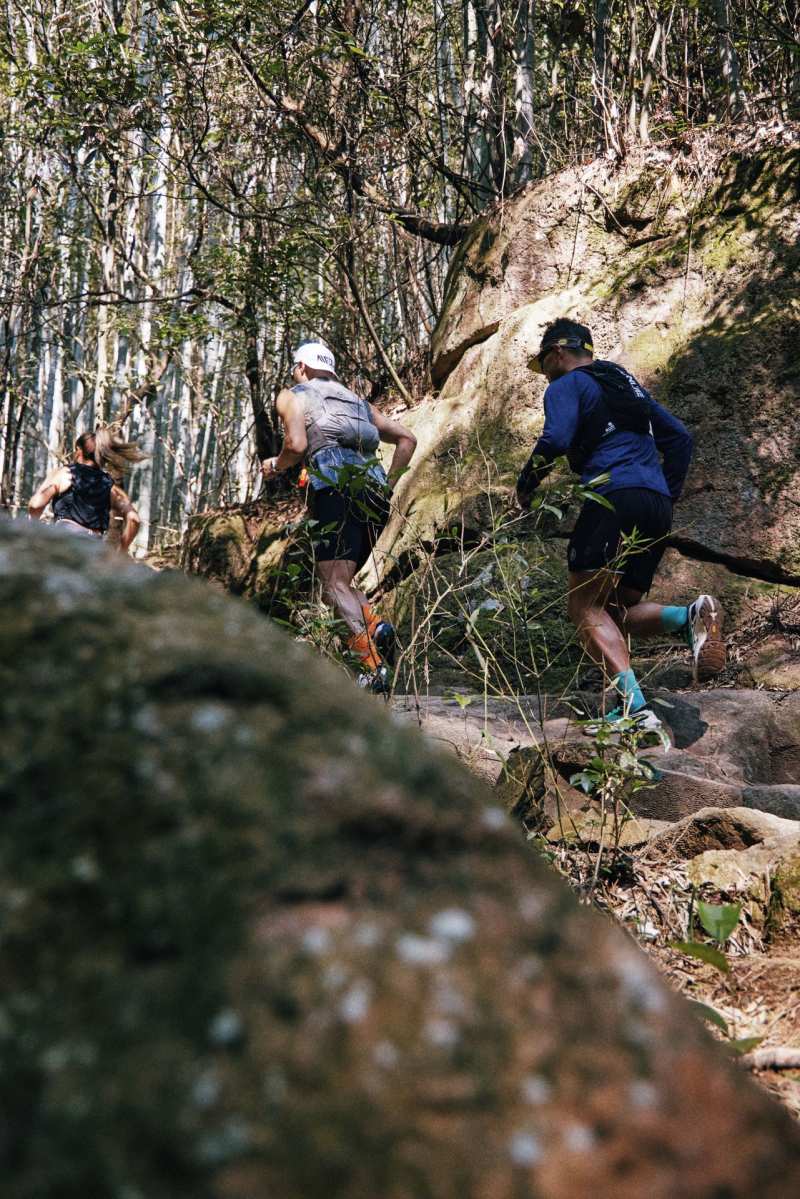
The climbing comes in countless short ups and downs rather than a few big ascents. Both the DMG and CMG average close to 57 m of gain per kilometre, which constantly breaks your rhythm. Switching smoothly between running and power hiking saves a lot of time.
The ground mixes dirt roads, stone steps and forest trails. Steps load your quads on the way down and your calves on the way up, and they force an unnatural stride.
Several races start at night: 9 p.m. for the CMG and 10 p.m. for the MMG. You will race most of the distance after a day of waiting and without proper sleep, which changes how you handle food, lighting and alertness.
How long do you need to prepare?
20K: with 25 km and 1200 m of gain, the EMG needs 10 to 12 weeks of specific training if you already run regularly.
50K: allow 16 to 20 weeks, ideally after a first 25 to 35 km trail race. The night start means some head-torch runs belong in your plan.
100K and 100M: plan 5 to 7 months for the CMG and 6 to 9 months for the DMG, after one or two mountain ultras. Adjust these guidelines to your history, recovery and available time.
The phases of your training plan
Base: easy aerobic volume, strength work for quads, glutes, calves and core, one short speed session a week, and gradually increasing climbing with a lighter week every three or four weeks.
Specific: in the last 8 to 12 weeks, recreate the Moganshan profile with lots of short climbs, stairs, relaxed descents and long runs on mixed terrain. If your race starts at night, schedule one or two long evening runs.
Taper: two to three weeks with 30 to 50% less volume and a few short efforts. For night starts, bank sleep in the final days.
Key sessions to train for Ultra-Trail Mogan
Hill repeats. Eight to twelve climbs of 2 to 4 minutes with a jog back down. They match a course full of short climbs and train you to get back into rhythm after each top.
Stairs. One stair session a week during the specific phase, both up and down, prepares your legs for stone steps. Start small: descending stairs is very hard on the quads.
Relaxed descents. Five to ten minute trail descents with a high cadence and light footing.
Long night runs. For the CMG and MMG, head out in the evening for three to five hours of hike-running by head torch, testing your light, food and focus as fatigue builds.
Want a plan that organises all this for you? RunMotion Coach, the official online coach of the UTMB World Series, builds a personalised trail or ultra plan and adapts it every week to the sessions you complete and the time you have. Try it free for 7 days.
Build your race plan with Race Strategy
On a saw-tooth course, pace changes constantly and split times are hard to predict. Race Strategy by RunMotion calculates your strategy kilometre by kilometre, adjusting pace for gradient, altitude and terrain technicality. It gives you estimated split times at key points, a section-by-section fuelling and hydration plan (carbs, water, sodium) and a race-day weather adjustment. Import the official GPX of your race: on the DMG and its 11 aid stations, you will know exactly what to carry between each one.
Running Stones and the UTMB World Series
Ultra-Trail Mogan is part of the UTMB World Series. Each finish earns Running Stones, which improve your odds in the draw for the Chamonix finals: the DMG page, in the 100M category, lists 4. To plan your season on the circuit, see our UTMB World Series training plan guide and our advice on how to plan your trail running season.
FAQ
Is the Mogan 100M really 100 miles?
No. The DMG sits in the UTMB World Series 100M category but is 114 km long with 6600 m of gain. Its difficulty comes from climbing density, not distance.
Are poles allowed at Ultra-Trail Mogan?
Check the official race rules. If they are allowed, they help on repeated climbs, as long as you have trained with them.
How do I step up from the 50K to the 100K?
Increase your long runs and weekly climbing gradually over several months, and add back-to-back weekends. Our guide to increasing distance as a trail runner explains the process.
Final word
Ultra-Trail Mogan calls for strong legs to absorb the climbs and steps, and smart management of night starts. At RunMotion, vertical gain and ultras are home ground: our founders, twin brothers Guillaume and Romain Adam, come from the Alps. For a plan built around your race, start your free 7-day RunMotion Coach trial.
Article updated by the RunMotion Coach team.
Sources