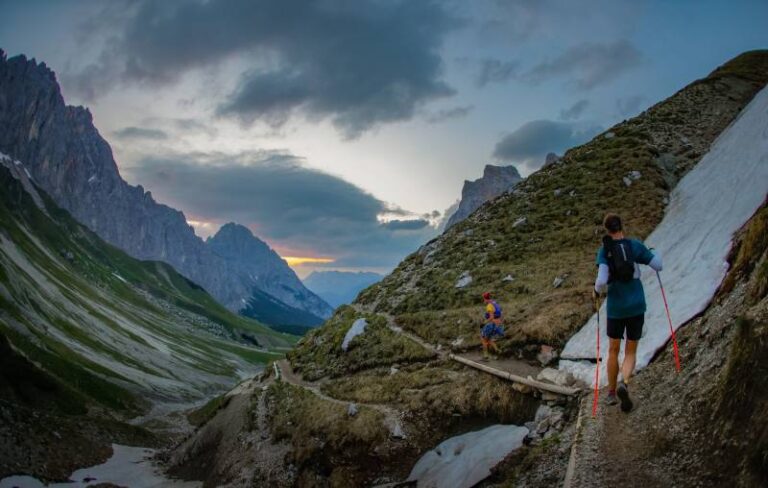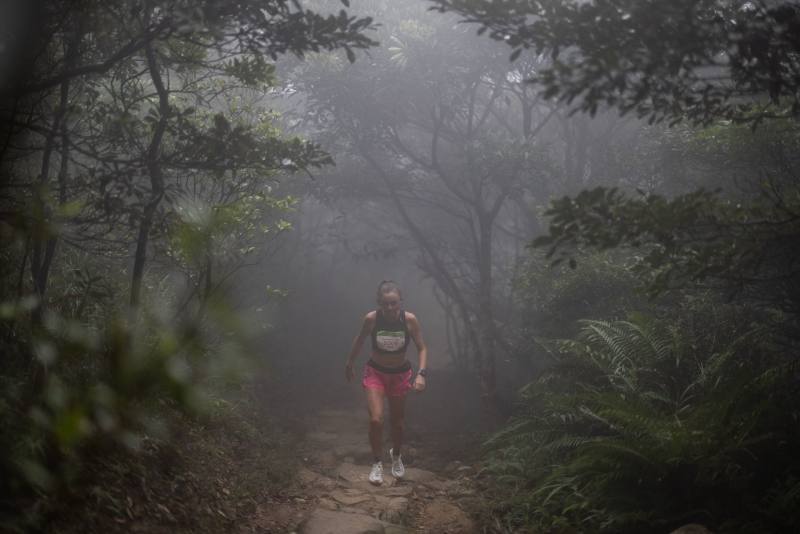
A TransLantau by UTMB training plan has to prepare you for short, brutal climbs and steep descents on Lantau, the largest of Hong Kong’s islands. The event offers four races from 15 to 104 km, and this page gives you the official figures for each one plus a realistic approach to how to train for TransLantau.
The short answer
- Allow 8 to 10 weeks for TransLantau15, 10 to 12 for TransLantau25, 12 to 16 for TransLantau50 and 20 to 24 for TransLantau100.
- Indicative peak weeks: 40 to 60 km and 1500 to 2500 m of climbing for the 50, 60 to 90 km and 2500 to 4000 m for the 100.
- Key sessions: steep hill repeats, technical descents, a long night run and eccentric quad strength.
- The defining feature: the 100 starts in the evening, so much of it is run by headlamp on steep ground.
Contents
TransLantau distances and elevation gain
TransLantau takes place over three days in mid-November. Figures below come from the official TransLantau website.
| Race | Distance | Elevation gain | Profile / notes |
|---|---|---|---|
| TransLantau100 | 104 km | 4500 m | 100K category, 3 Running Stones; evening start in Mui Wo, 27 h limit |
| TransLantau50 | 45 km | 2500 m | 50K category, 2 Running Stones; over 55 m of gain per km |
| TransLantau25 | 27 km | 1100 m | 20K category, 1 Running Stone |
| TransLantau15 | 15 km | 500 m | 20K category, 1 Running Stone; entry-level format |
The high point of TransLantau100 is Fung Wong Shan (Lantau Peak), at 934 m, Hong Kong’s second-highest summit. Starting from sea level means honest climbs and equally direct descents; the organisers describe challenging trails with steep ascents and descents. By November the summer heat has usually eased, but humidity can linger and the ridges can be windy.
What makes TransLantau demanding
With 4500 m of gain over 104 km and 2500 m over 45 km, there is little respite. The climbs are short by alpine standards but steep and relentless, often on steps or rocky paths. Your quads work hard both ways, and they usually decide how the final hours go.
On the 100, the evening start changes everything: fresh legs, but long hours of sleep management and technical running by headlamp. The rules require two working lights. On the shorter races the trap is the opposite: going out too fast on gradients that punish early ambition.
How long should you train?
TransLantau15 and TransLantau25: 8 to 12 weeks with three runs a week, one of them on hills. The 25 already requires confident descending.
TransLantau50: 12 to 16 weeks, ideally after a first 25 to 30 km trail race.
TransLantau100: 20 to 24 weeks, with at least one 50K finish and some night-running experience. If this is a big step up, read our guide on increasing trail distance without injury.
The phases of your training plan
Base. Build easy aerobic volume, one quality session a week and two strength sessions. Prioritise squats, lunges and step-ups now: on Lantau, leg strength is a prerequisite.
Specific. For eight to ten weeks, weekly climbing goes up, long runs move to steep ground and you add regular descents. For the 100, schedule at least two evening long runs to rehearse the night start with your race nutrition. Insert a lighter week every three or four weeks. Our article on what makes a trail running plan different explains the logic.
Taper. Two weeks for the shorter races and the 50, three for the 100. Volume drops clearly, a little intensity remains, and you arrive with fresh quads.
Key workouts for TransLantau
Steep hill repeats. 6 to 10 reps of 3 to 5 minutes on a steep slope or stairs at a strong effort. They build the climbing power and economy the profile demands.
Descent practice. One session a week with several fast but controlled downhills, focusing on short, light steps.
Long night run. For the 100, head out in the evening for 3 to 5 hours with climbing, headlamp on. Test your lighting, fuelling and alertness.
Eccentric strength. Slow lunges, controlled step-downs, squats. Bodyweight work is already effective; adding load is an option to progress, not an obligation.
Prefer a plan that is built for you and adjusted every week? The RunMotion Coach app, the official online coach of the UTMB World Series, adapts your trail or ultra plan to your level, completed sessions and availability. Try it free for 7 days.
Build your race plan with Race Strategy
On a course this broken, knowing where you will be and when changes your race. Race Strategy by RunMotion builds a kilometre-by-kilometre plan with pace adjusted for gradient, altitude and technicality, and estimates split times at key points. Import the official GPX of your race to get a section-by-section fuelling and hydration plan (carbs, water, sodium), adjusted to race-day weather.
Running Stones and the UTMB World Series
TransLantau awards 3 Running Stones for the 100, 2 for the 50 and 1 each for the 25 and 15. To fit it into a bigger season, read our guide to training for UTMB World Series races and our advice on planning your trail running season.
FAQ
Are poles allowed at TransLantau?
Check the rules and gear list for your race. On gradients this steep they can help uphill, but only if you have trained with them.
What level do you need for TransLantau100?
A 50K finished in good shape, confident descending and some night-running experience are reasonable prerequisites. It is not the ideal first ultra.
How much climbing per week for TransLantau50?
At peak, 1500 to 2500 m a week is a sound guideline for many amateurs. If you live somewhere flat, use stairs, an inclined treadmill and strength work.
Final thoughts
TransLantau rewards strong legs, controlled descending and, on the 100, real comfort at night. RunMotion founders Guillaume and Romain Adam are twin brothers from the Alps: mountains, vertical gain and ultra distances are their home ground, and that know-how is built into the app. Start your free trial.
Article updated by the RunMotion Coach team.
Sources
- translantau.utmb.world (races, distances, elevation gain, Running Stones)
- TransLantau100 official page