Your training paces are only accurate at the moment they are calculated. As soon as you get fitter, take a break or your form changes, they can drift without you noticing. Here are the signs to look out for, and how to reset your paces without turning your training upside down.
The short answer
- Paces too slow: intervals feel easy, you race faster than predicted, your heart rate drops at the same pace.
- Paces too fast: you can no longer finish your sessions, easy runs stop feeling easy, fatigue builds up.
- High-risk situations: returning after a break or an injury, an outdated race time, heat, hills.
- What to do: rely on a recent race or test, look at the trend over several sessions, then adjust in small steps.
Contents
- Why your training paces stop matching your fitness
- Signs your training paces have become too slow
- Signs your training paces have become too fast
- 7. Your situation has changed: when your paces are almost certainly off
- How to check and reset your training paces
- What the new RunMotion Coach pace model changes
- FAQ
- Summary
- Sources
Why your training paces stop matching your fitness
Your paces are calculated from a snapshot of your fitness: a 10 km time, a vVO2max test, a half marathon run last spring (for the method itself, see our guide to finding your training paces). The problem is that your fitness keeps changing. A runner who trains consistently often improves during the first months of a training block. Conversely, a few weeks off are enough to lower VO2max and endurance capacity (Mujika and Padilla, 2000).
Here is a concrete example. With a vVO2max of 14 km/h, your vVO2max intervals are run at around 4′17″/km and your easy pace, at about 70% of vVO2max, sits around 6′07″/km. If your vVO2max rises to 15 km/h after a few months of training, your intervals should be run at around 4′00″/km and your easy runs at around 5′43″/km. If you stick to your old paces, every quality session loses part of its value. The opposite drift, after a break, is trickier: it pushes you to train too fast, with more fatigue and a higher risk of injury.
These gaps don’t always show up in a single session. What matters is the trend over two to three weeks.
Signs your training paces have become too slow
1. Your interval sessions feel easy
A vVO2max or threshold session should be demanding. On 8 × 400 m at vVO2max, the last reps should require real focus. If you regularly finish thinking you could have done three more, or if you have to hold yourself back from going too fast, the target pace probably no longer reflects your fitness.
A good rule of thumb: at the end of a well-calibrated quality session, you feel you have worked hard but still have a little left in the tank. If that margin is huge session after session, your paces are probably too conservative.
2. You raced faster than predicted
This is the most reliable sign. If you have just set a 10 km personal best or run a half marathon well under your prediction, your benchmark has changed. Paces calculated from your old time are now too slow, especially for threshold and race-pace sessions.
3. Your heart rate drops at the same pace
As your fitness improves, your heart works less for the same speed. If, in comparable conditions (same route, same temperature, same level of fatigue), your heart rate on easy runs is clearly lower than two months ago, that is a sign of progress. On its own, this sign is not enough, because heart rate varies with heat, sleep and stress. But combined with the two previous signs, it confirms that your paces can be raised.
Signs your training paces have become too fast
4. You can no longer hold your intervals to the end
You start at the planned pace, the first reps go fine, then everything falls apart: you lose 10 to 15 seconds per kilometre on the last reps, or you have to cut the session short. A bad session now and then happens to everyone. If it becomes the norm, your target pace is probably too ambitious for your current fitness.
5. Your easy runs no longer feel easy
Easy running should stay easy. You should be able to hold a conversation in full sentences without getting out of breath. If you have to stop talking to breathe, or if your “easy” runs leave your legs heavy the next day, the pace is too fast. It is a common mistake, and a costly one: easy runs done too fast tire you out without delivering the expected benefits, and they compromise the quality sessions that follow.
6. Fatigue builds up and your performance stalls
Constantly heavy legs, poorer sleep, dropping motivation, the feeling of running on empty: when these signals persist for several weeks, it is not always a question of volume. Paces that are too high across all your sessions push your real training load well beyond what your plan intends. If the fatigue persists despite a few lighter days, or if you feel unusual pain, ease off and see a health professional.
7. Your situation has changed: when your paces are almost certainly off
Some situations are bound to throw your paces off, even before you feel the effects.
Returning after a break or an injury is the most common case. After several weeks without running, going straight back to your old paces is the best way to get injured again. It is better to restart at slower paces and let your recent sessions gradually bring your benchmark back up.
An outdated race time causes the same problem, in either direction. A personal best set two years ago says little about your current fitness.
Heat slows everyone down. An analysis of seven major marathons showed that performance declines steadily as the heat stress index rises from 5 to 25 °C, and that slower runners are the most affected (Ely et al., 2007). In the middle of summer, running your sessions at your winter paces means training harder than planned.
Finally, hills distort your pace readings. On a hilly route, think in terms of effort or grade-adjusted pace rather than raw min/km.
How to check and reset your training paces
Before changing anything, observe for two to three weeks. One bad session after a poor night’s sleep says nothing about your fitness; three bad sessions in a row do.
Next, rely on objective, recent data. A 5 km or 10 km race run all-out remains the best benchmark. Failing that, a half-Cooper test (the longest distance you can cover in 6 minutes after a good warm-up) gives you an estimate of your vVO2max. You can then estimate your race times with our race time prediction calculator and find the matching paces in the vVO2max pace table.
Finally, adjust in small steps. It is better to change your paces by a few seconds per kilometre and reassess two weeks later than to change everything at once.
| What you notice | What it often means | What you can do |
|---|---|---|
| Easy intervals, a huge margin at the end of the session | Paces too slow | Check against a recent race or test |
| Race faster than predicted | Fitness underestimated | Update your benchmark time |
| Intervals you can’t finish several times in a row | Paces too fast | Slow down slightly and reassess |
| Breathless on easy runs | Easy pace too fast | Slow down until you can talk |
| Persistent fatigue, declining performance | Training load too high | Ease off for a few days, review your paces |
| Returning after a break or injury | Old benchmark out of date | Restart at slower paces |
What the new RunMotion Coach pace model changes
The main weakness of traditional training paces is that they depend on your last race time. If you only race once or twice a year, your paces can stay frozen for months while your fitness changes.
That is exactly what the new pace prediction model in RunMotion Coach fixes. It no longer relies on your races alone: it also analyses your interval sessions at vVO2max, threshold, 10 km, half marathon or marathon pace, taking into account the paces you actually ran, the type of intensity and the elevation. Your training paces are updated after every validated race and every eligible session analysed. In other words, most of the signs described above are picked up for you, based on what you actually do in training.
To build your prediction, the app needs at least one race, ideally two over different distances, run on the road without too much elevation. Training sessions count from the very first workout linked to a session in your plan. In both cases, the more data you add, the more reliable the prediction. Races or sessions that sit too far from the curve are automatically excluded, so that a one-off result doesn’t skew your paces.
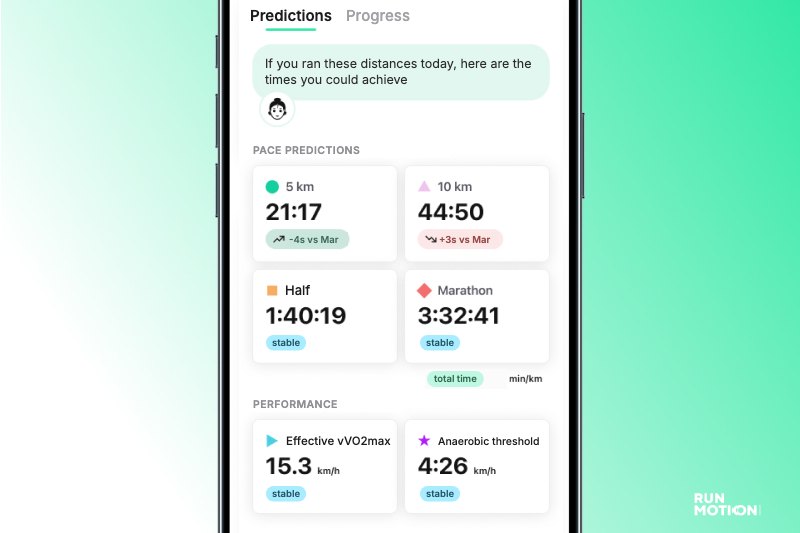
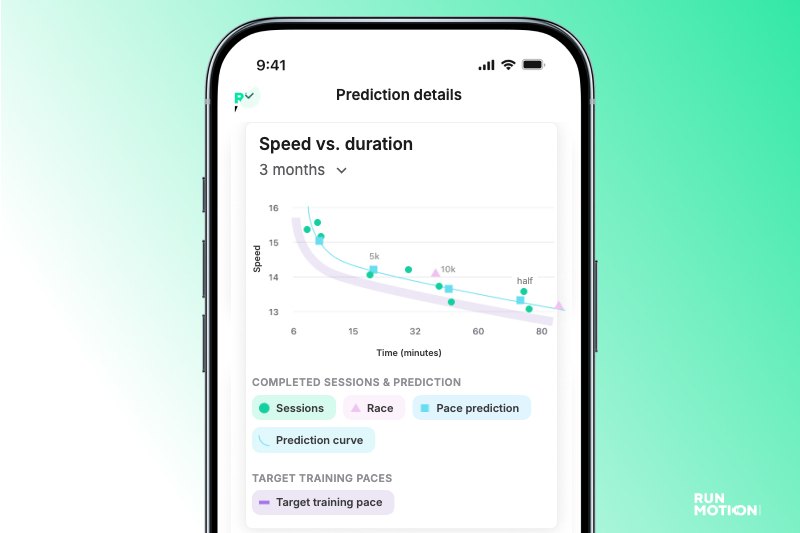
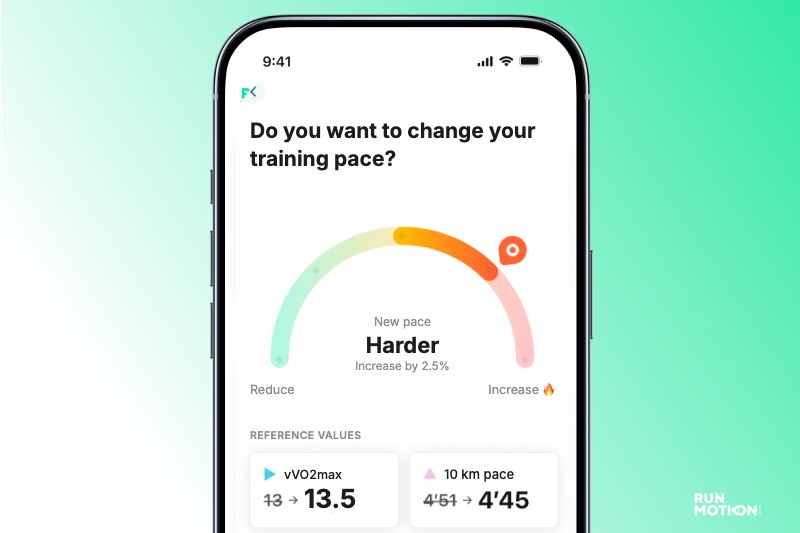
You can follow how your prediction evolves on a chart that shows both your races and your training sessions. And if the paces don’t match how you feel, you stay in control: you can choose slower paces (comeback, fatigue, injury) or faster ones if you feel in great shape. A session that doesn’t reflect your fitness, because you ran with a friend or your GPS dropped out, can be excluded from the calculation by not validating it.
The model is based on the work of Guillaume Adam, co-founder of RunMotion Coach, carried out with researchers from MIT and CNRS (Mulligan, Adam and Emig, 2018). To find out more, read how this performance model developed with MIT and CNRS researchers works.
Want training paces that keep up with your fitness? Try RunMotion Coach free for 7 days and let your sessions update your paces.
FAQ
How often should you recalculate your training paces?
There is no single rule. A practical guideline: after every race run all-out, after a vVO2max test, and after any break of more than two to three weeks. Without new data, a check every six to eight weeks of training helps avoid large gaps.
Should you trust pace or heart rate?
The two complement each other. Pace is accurate on flat ground in mild weather; heart rate helps you manage effort in hot conditions or on hills, but it lags behind on short intervals. For easy runs, the talk test remains an excellent safeguard.
My paces changed from one week to the next. Is that normal?
With a model that takes your training into account, yes. A good threshold session or a successful race can shift your paces slightly, up or down. These are small variations: if the change seems too large, check that an unusual session has not been included.
Is it bad to run your easy runs too fast?
It is not dangerous for a single run, but it is counterproductive over time. You build up fatigue, you arrive less fresh for your quality sessions and you improve less. Slowing down your easy runs is often the most worthwhile adjustment you can make.
Summary
The right training paces mean easy sessions that are truly easy and quality sessions that are demanding but achievable. If your intervals become a formality, or on the contrary a repeated struggle, your fitness has changed and your paces need to follow. Rely on recent data, look at the trend rather than a single session, and adjust in small steps.
So you no longer have to keep an eye on all this yourself, try RunMotion Coach free for 7 days: your paces update as you race and train.
Sources
- Mujika I., Padilla S. (2000). Detraining: loss of training-induced physiological and performance adaptations. Part I: short term insufficient training stimulus. Sports Medicine, 30(2), 79-87. DOI: 10.2165/00007256-200030020-00002
- Ely M. R., Cheuvront S. N., Roberts W. O., Montain S. J. (2007). Impact of weather on marathon-running performance. Medicine and Science in Sports and Exercise, 39(3), 487-493. DOI: 10.1249/mss.0b013e31802d3aba
- Mulligan M., Adam G., Emig T. (2018). A minimal power model for human running performance. PLOS ONE, 13(11). DOI: 10.1371/journal.pone.0206645
Updated: October 31, 2026