
Breaking 35 minutes for 10K is an ambitious goal that puts you at a strong regional level and marks you as a seriously fast runner. At an average pace of 3:30 per kilometer, this is no longer about simply finishing a race or shaving a few seconds off your PR. This target demands several years of consistent running, a structured training approach, and a clear understanding of what your body can actually sustain.
Plenty of dedicated amateur runners reach this level through smart, consistent training, patience, and long-term progression built season after season.
If you want to run 10K in 35 minutes, you are probably already an experienced runner. Here’s how to optimize your preparation and stack the odds in your favor.
Contents
- Running a 10K in 35 minutes: what pace do you need to hold?
- What level do you need before aiming for 35 minutes?
- The physiological demands of a sub-35 goal
- How many kilometers should you run each week?
- 10K training plan over 12 weeks
- What weekly structure should you follow?
- Mistakes that keep you from breaking 35 minutes
- How do you manage the race on the big day?
- The importance of the details
- Prepare your sub-35 goal with RunMotion Coach
- FAQ: 10K training plan for 35 minutes
Running a 10K in 35 minutes: what pace do you need to hold?
To finish a 10K in 35 minutes, you need to hold an average pace of 3:30 per kilometer. That equals an average speed above 17 km/h for the entire race.
At this speed, even small pace fluctuations can seriously affect your final time. The real goal is to develop outstanding effort control and the ability to hold a high intensity from start to finish.
What level do you need before aiming for 35 minutes?
A 35-minute goal is designed for runners who are already very well trained.
Most athletes who hit this performance typically run a 5K under 17 minutes and a half marathon around 1:15 to 1:20. They have often been training for several seasons and already handle a solid weekly mileage.
That does not mean you need some special “gift.” But you do need gradual, consistent progression. Runners who get to this level almost always build it over multiple years.
The physiological demands of a sub-35 goal
At this performance level, the margins get smaller, and every detail matters more.
Aerobic endurance remains the foundation. It lets you absorb a high training load while still recovering well between sessions.
Your lactate threshold also becomes a deciding factor. The faster you can run while limiting the buildup of metabolic fatigue, the better you will perform over 10K.
Finally, velocity at VO2max (vVO2max) plays a key role. Your race pace is often a large percentage of your vVO2max. Improving it boosts your speed reserve and makes your goal pace more economical.
How many kilometers should you run each week?
There is no universal weekly volume for running 10K in 35 minutes. That said, most runners who reach this goal typically log between 50 and 80 kilometers per week, sometimes more depending on experience. Mileage alone is not enough. How you distribute it, and the quality of that work, matters just as much. Increasing kilometers too quickly increases the risk of chronic fatigue and injury.
10K training plan over 12 weeks
Preparing for a sub-35 goal usually relies on several complementary types of sessions.
easy run sessions are non-negotiable. Even for high-performing runners, they make up a big part of weekly mileage. They help you accumulate volume while supporting recovery.
Threshold work takes a central place. Sessions built around 10 to 20-minute blocks at a strong, controlled intensity improve your ability to sustain an effort close to race pace.
Long-interval vVO2max sessions are also particularly effective. Repeats of 600 to 800 meters develop both cardiovascular fitness and resistance to fatigue.
Finally, 10K-specific sessions are the best way to prepare your body for race-day demands. Workouts like 6 x 1000 m, 4 x 2000 m, or 3 x 3000 m at target pace build confidence and the pacing cues you will need when it counts.
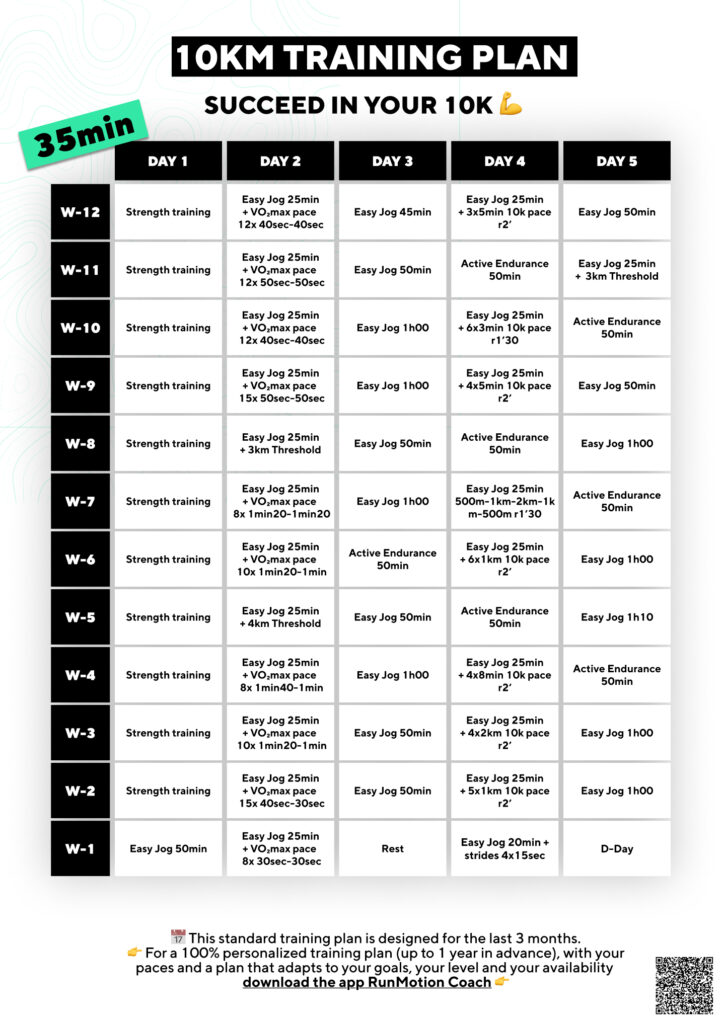
Here’s an excerpt from your 12-week training plan to run a 10K in 35 minutes (full plan below):
| DAY 1 | DAY 2 | DAY 3 | DAY 4 | DAY 5 | |
| Week 1 | Strength training | easy run 25min + vVO2max 12×40/40 sec | easy run 45 min | easy run 25 min + 3×5 min at 10K pace (rest 2 min) | easy run 50 min |
| Week 7 | Strength training | easy run 25min + vVO2max 8×1’20/1 min | easy run 50 min | easy run 25 min + 6x1km at 10K pace (rest 2 min) | easy run 1h |
| Week 10 | Strength training | easy run 25min + vVO2max 10×1’20/1 min | easy run 50 min | easy run 25 min + 4x2km at 10K pace (rest 2 min) | easy run 1h |
What weekly structure should you follow?
Most runners targeting 35 minutes for 10K train five to seven times per week. A typical week usually includes several recovery runs, one vVO2max session, one threshold session, and one 10K-specific session.
This variety helps you develop all the qualities needed for peak 10K performance at the same time.
The main challenge is finding the right balance between training load and recovery. It is not always the runner who trains the most who improves the most, it is often the runner who recovers the best.
Mistakes that keep you from breaking 35 minutes
At this level, mistakes can be less obvious but just as costly.
One of the most common is doing too many hard sessions. Many runners think they will progress by constantly increasing intensity. In reality, accumulated fatigue often reduces the quality of the key workouts.
Another mistake is skipping recovery phases. Lighter weeks help lock in physiological adaptations and keep you fresh enough to train well.
Finally, some runners place too much emphasis on short vVO2max sessions, even though 10K improvement often comes more from threshold work and race-specific pacing.
How do you manage the race on the big day?
For a 35-minute 10K goal, precision is everything. Going out just a few seconds too fast per kilometer can quickly lead to a major slowdown in the final kilometers. On the other hand, starting too cautiously can make the goal unreachable even with great fitness.
The ideal approach is to settle quickly around 3:30/km and hold that rhythm as evenly as possible. Intermediate splits are excellent reference points. Hitting 5K between 17:15 and 17:30 is often recommended to keep a small margin.
The difference is often made in the last two kilometers, when your ability to hold pace under fatigue becomes the deciding factor.
The importance of the details
When you are chasing a sub-35 time, the details matter more than ever. Sleep, nutrition, hydration, and stress management directly affect training quality and your ability to recover.
Strength training also improves running economy and fatigue resistance. A few targeted sessions each week can deliver meaningful long-term gains.
At this level, every percentage point of progress counts.
Prepare your sub-35 goal with RunMotion Coach
Running 10K in 35 minutes requires precise, individualized preparation that fits your profile. The needs of a runner chasing this goal can vary a lot depending on experience, training volume, and physiological strengths.
With RunMotion Coach, you get a personalized training plan that evolves as you progress. Sessions adapt to your level, your availability, and your goals to maximize your chances of success.
With patience, consistency, and structured training, the 35-minute barrier can become a realistic target. And when you finally cross that finish line under 35 minutes, you will feel just how far you have come.
FAQ: 10K training plan for 35 minutes
What level do you need?
Running 10K in 35 minutes is an excellent amateur level and usually requires several years of structured training. This goal demands a strong endurance base and very high running speed. It mainly targets experienced runners.
Which vVO2max do you need to target a 35-minute 10K?
A vVO2max above 20 km/h is commonly seen in runners who can reach this goal. However, your ability to hold a high percentage of that vVO2max over 10 kilometers is just as important. That is why specific training plays a major role.
What 5K time usually matches a 35-minute 10K goal?
A time around 16:30 to 17:00 for 5K is often a solid reference. It shows a speed level that fits a 35-minute 10K target. Then, 10K-specific endurance helps you convert that potential on race day.
How do you add goal-pace sessions?
These sessions are usually scheduled once per week and involve running several repeats at your target race pace. They improve feel, efficiency, and pacing accuracy at goal speed. They become essential as race day gets closer.
What are the key workouts?
Threshold sessions, long intervals, and goal-pace training are the pillars of the build. Together, they develop endurance, speed, and fatigue resistance. Combining them well is essential to reach this level of 10K performance.