Building a Trail Verbier St-Bernard training plan means preparing for a truly alpine race in the Swiss Valais in July: passes, lakes, glacier zones and, on the longest format, a crossing into Italy. From the 28 km X-Plore to the 140 km X-Alpine with 9300 m of climbing, here are the official figures, the main challenges and how to structure your training.
The short answer
- Allow 12 to 16 weeks for X-Plore, 16 to 20 for the two Verbier Marathon races, 20 to 24 for X-Traversée and 24 weeks or more for X-Alpine.
- Rough peak-week guide: 3000 to 4500 m of climbing for the marathons, 5000 to 7000 m for the ultras, depending on your level.
- Key sessions: long power-hiking climbs, technical descents, long high-mountain days, night back-to-backs.
- The defining feature: an alpine climbing ratio (over 66 m per km on X-Alpine) on high-mountain terrain.
Contents
- Trail Verbier St-Bernard distances and elevation
- What makes Trail Verbier St-Bernard demanding
- How long do you need to train?
- The phases of your training plan
- Key sessions for Trail Verbier St-Bernard
- Build your race strategy with Race Strategy
- Running Stones and the UTMB World Series
- FAQ
- Ready for the Valais Alps
Trail Verbier St-Bernard distances and elevation
| Format | Distance | Elevation gain | Profile/notes |
|---|---|---|---|
| X-Alpine – 100M | 140 km | 9300 m | Loop from Verbier; ridges, glacier area, crossing into Italy, suspension bridge, final 1200 m “wall”; 4 Running Stones |
| X-Traversée – 100K | 77 km | 5300 m | La Fouly to Verbier; alpine passes and glaciers; 3 Running Stones |
| Verbier Marathon X-Treme – 50K | 43 km | 3000 m | Very steep mountain race; 2 Running Stones |
| Verbier Marathon – 50K | 47 km | 2900 m | Mountain race; 2 Running Stones |
| Verbier X-Plore – 20K | 28 km | 1700 m | Short but alpine; 1 Running Stone |
| X-Orient | 5 or 7 km | 320 m | Orienteering race for 12 to 17 year olds, no Running Stones |
| Trail Découverte | not published | not published | Kids’ races |
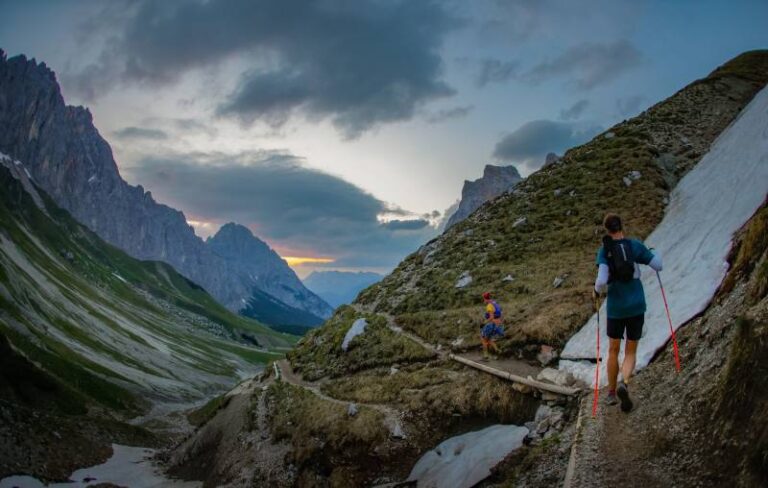
These figures come from the official Trail Verbier St-Bernard by UTMB website and may change between editions. Expect Valais alpine terrain: long climbs, passes, lakes, high pastures, areas close to glaciers and steep descents. The 4314 m Grand Combin towers over the route, though the course does not climb it. In July, alpine weather can turn fast: heat in the valleys, cold wind on the ridges and afternoon storms.
What makes Trail Verbier St-Bernard demanding
Start with the numbers: 9300 m over 140 km on X-Alpine, and even 3000 m over 43 km on the Verbier Marathon X-Treme. You will hike a large part of the race, and the long, technical descents will hammer your quads. The famous 1200 m wall near the end of X-Alpine and X-Traversée arrives exactly when fatigue peaks.
According to the official site, X-Alpine starts in Verbier at 22:00 with a 42-hour limit, so you go straight into a night and many runners will face a second one. X-Traversée starts in La Fouly at 09:00 with a 26-hour limit. Add altitude, high-mountain terrain and changeable weather, and self-sufficiency and kit management matter as much as fitness.
How long do you need to train?
For X-Plore (28 km and 1700 m), plan 12 to 16 weeks if you already trail run regularly: it is short, but it is real mountain running. For the Verbier Marathon and Verbier Marathon X-Treme, aim for 16 to 20 weeks with a 25 to 30 km mountain race behind you; our trail marathon and 50K training plan gives you a base to build vertical on.
For X-Traversée, allow 20 to 24 weeks after at least one 50 km mountain race. For X-Alpine, 24 weeks or more, with a mountain ultra of at least 100 km completed and solid night-running experience. Our 100-mile training plan guide and our UTMB Mont-Blanc training tips cover similar alpine demands. Treat these as guidelines, not rules.
The phases of your training plan
Base: winter
Build volume gradually at easy aerobic effort, with one quality session a week and strength work twice a week. Start with bodyweight; adding load later can help you progress. Ski touring is an ideal way to accumulate vertical without the impact of running.
Specific: April to mid-June
Vertical, vertical and more vertical. Long climbs, technical descents and multi-hour days as soon as the mountains open up. For the ultras, two or three back-to-back weekends and a hilly tune-up race about six weeks out.
Taper: late June
Two to three weeks of reduced volume, short uphill reminders and lots of rest. Check your mandatory kit and prepare for cold conditions up high.
Key sessions for Trail Verbier St-Bernard
Long power-hiking climbs. 2 to 3 reps of 20 to 30 minutes on a steep slope at a strong effort. They prepare you for the long ascents and the final wall. See our tips on improving uphill performance.
Technical descents. One session per week on steep, rocky trail to build eccentric quad strength and sharpen your reading of the terrain.
Long high-mountain days. 5 to 8 hours for the ultras, ideally above 2000 m, carrying your full kit. Test fuelling, poles if you use them, and how you handle the cold.
Night back-to-back (X-Alpine). A long run starting in the evening and partly in the dark, followed by a medium run the next day. It is the best rehearsal for a 22:00 start.
| Day | Sample specific week (X-Traversée, experienced runner) |
|---|---|
| Monday | Rest |
| Tuesday | 3 × 20 minutes steep uphill |
| Wednesday | Easy 1-hour run + strength |
| Thursday | Technical downhill session, 1 h 15 |
| Friday | Rest |
| Saturday | Long high-mountain day, 6 to 7 hours |
| Sunday | 2 h 30 run-hike |
All that descending stresses knees and tendons. If pain persists, back off and see a health professional.
To tackle a race this alpine with a plan that adjusts every week to your sessions and schedule, the RunMotion Coach app, the official online coach of the UTMB World Series, combines vertical, strength, recovery and mental preparation. Free 7-day trial: get started with RunMotion Coach.
Build your race strategy with Race Strategy
In high mountains, average pace means very little. Race Strategy by RunMotion works out your plan kilometre by kilometre, adjusting pace for gradient, altitude and terrain technicality. You get estimated split times at key points, a fuelling and hydration plan per section (carbs, water, sodium) and a race-day weather adjustment. Import the official GPX of your race, then compare your projected splits with the cut-offs.
Running Stones and the UTMB World Series
According to the official site, X-Alpine awards 4 Running Stones, X-Traversée 3, the two Verbier Marathon races 2 each and X-Plore 1. To fit Verbier into your season, see our UTMB World Series training plan.
FAQ
Can you use poles on X-Alpine?
They are optional, but the official race page makes one point clear: if you start with poles, you carry them for the whole race. You cannot pick them up or drop them along the way, so decide in advance and train with them.
What level do you need for X-Traversée?
77 km and 5300 m of climbing in an alpine setting: you should have finished a 50 km mountain race and feel at ease on technical ground.
Verbier Marathon or X-Treme?
The Verbier Marathon is 47 km with 2900 m of climbing, the X-Treme 43 km with 3000 m. The second is shorter but steeper.
How much weekly vertical for X-Alpine?
At peak, 5000 to 7000 m per week is a reasonable guide for an experienced runner, with regular lighter weeks. Think in hours of effort as well.
Ready for the Valais Alps
Trail Verbier St-Bernard is a playground for mountain runners. RunMotion founders Guillaume and Romain Adam, twin brothers, come from the Alps: mountains, vertical and ultra distance are their home ground, and that culture runs through our plans. For a build tailored to your level, try RunMotion Coach free for 7 days.
Article updated by the RunMotion Coach team.
Sources: