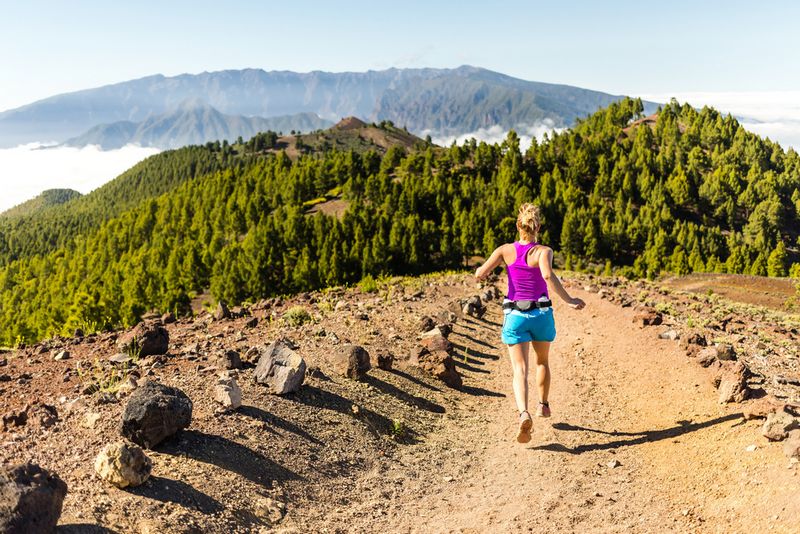
 Trail running and mountain races are booming, with more runners lining up every year. Beyond the athletic challenge, trail lovers are chasing one thing above all, epic courses with stunning, ever-changing scenery. A trail is run in the wild, usually in the mountains, but also across hills, through forests, along narrow singletrack, and sometimes even in deserts. Here are a few of the toughest trail races on the planet, the ultra-trails.
Anyone who makes it to the finish line of these superhuman events is a true hero. Some will say they’re crazy to take on challenges like this. On this ultra-trail world tour, we’ll (re)discover only the non-stage races…
Contents
Before we take on the world, let’s start with a Tour de France of ultra-trails
UTMB® (Ultra-Trail du Mont-Blanc)
France is lucky to have terrain made for mountain running, whether in the Alps or the Pyrenees. When you talk about ultra-trail, how can you not think of the Ultra-Trail du Mont-Blanc. UTMB® crosses the French, Italian, and Swiss Alps with no less than 10,000 m of elevation gain over 170 km. While the same paths are often covered in 7 days on the Tour du Mont-Blanc hiking routeTour du Mont-Blanc hike, winners typically take a little over 20 hours.
The hype is so huge that registration is snapped up instantly. Getting a bib number, through a lottery, can feel almost harder than running the race… OK, that’s an exaggeration, but out of around 2,000 runners, only a bit more than half make it back to the finish in Chamonix.
Those who do are cheered like real heroes. In 2007, the first to reach the finish in Chamonix was Marco Olmo, aged 60. The following year, his successor Kilian Jornet won at just 20… Another great story, the winner of the very first CCC, Courmayeur-Champex-Chamonix, in 2006 (the “little sister” of UTMB, with 98 km and 5,550 m of elevation gain) was… a woman, Corinne Favre!
Diagonale des Fous, on Réunion Island
The Grand Raid de la Réunion is a legendary race, better known as the Diagonale des Fous. It crosses the island from southeast to northwest through the rugged highlands, finishing at the Stade de la Redoute in Saint-Denis. The course changes slightly every year. In the 2010 edition, it came close to 10,000 m of elevation gain over 163 kilometers.
Don’t be fooled, Réunion is seriously steep, with a high point at 3,071 m on Piton des Neiges. This race has a special place on the island, where every local dreams of seeing a Réunionnais take the win. After 20 years of French dominance, the 2010 edition saw Spain’s Kilian Jornet, nicknamed the ultra-terrestrial, take the crown. He was celebrated when he arrived in Saint-Denis while most of the field was still only halfway through!
To feel the magic of the Diagonale des Fous, nothing beats watching the stunning Inside Sport documentary (on this page you can find all the Inside Sport features in track & field and trail runningInside Sport features in track & field and trail runningInside Sport features in track & field and trail runningInside Sport in track & field and trail running).
Festival des Templiers
Before we head off to even more far-flung races, and Réunion was already a taste of that, let’s wrap up this quick Tour de France of ultra-trails with the Endurance Trail held during the Festival des Templiers.
The Festival des Templiers is a true trail-running celebration. It brings together nearly 7,000 runners across a wide range of distances. The event takes place in Aveyron, in Millau, also famous for its 100 km race and its spectacular viaduct. The Endurance Trail is the longest race of the Festival des Templiers, with 111 km and 4,590 m of elevation gain.
The American dream of ultra-trail
The Grand Slam of Ultrarunning
How could we start exploring international trail races anywhere other than the United States, home to some of the most iconic ultra events. The Grand Slam of Ultrarunning is like tennis Grand Slams, but for ultrarunners. Four races of 100 miles (160km), with between 4,000 m and 8,000 m of elevation gain, help identify the best ultra-trail runners on the planet.
The races are the Western States 100 in California, the Vermont 100 Mile Endurance Run, the Wasatch 100 Mile Endurance Run in Utah, and the Leadville Trail 100 in Colorado. Leadville is among the toughest trail races in the world, with a start line above 3,000 m (around 10,000 ft) altitude.
The Leadville Trail 100 is famous for more than one reason. It has seen multiple victories by Tarahumara runners, from the tribe of the same name, who cover dozens of miles running every day.
In the book “Born to Run”, author Christopher McDougall goes in search of this northern Mexico tribe for whom running is a way of life. A true bestseller in the US and a bible for minimalist and barefoot runners, the book recounts several epic battles on the Leadville Trail 100. It includes the 1993 win by Tarahumara runner Victoriano Churro, aged 52, as well as the 1994 showdown between the Tarahumaras and runner Ann Trason, who went out at an unbelievable pace.
The course record is held by Matt Carpenter, considered one of the greatest mountain runners in history. In 2005, he shattered the benchmark time by more than an hour and a half to finish in 15h42’59. With an unofficial world-record VO2 max for a runner (measured at 90.2 ml/kg/min by a highly reputable American lab), it certainly doesn’t hurt.
Badwater Ultramarathon, or how to come back from Death Valley
Before we leave American soil, we have to talk about the race that calls itself the toughest in the world. Its signature twist is starting below sea level and finishing at 2,500 m altitude, over a total of 135 miles, or 217 km. This is the Badwater Ultramarathon, run in Death Valley, California…
Temperatures can push close to 50°C on the asphalt, a true hell for feet trapped inside shoes. Beyond blister risk, dehydration danger is constant. And as if that weren’t enough, some runners keep going all the way to Mount Whitney, which the race is not authorized to climb. To reassure you, fewer than a hundred athletes attempt the adventure each year.
More mountain ultra-trails
Those 135 miles are also the distance of the Brazil 135 Ultramarathon, with more than 10,000 m of elevation gain, likely the toughest race in South America. To round out mountain ultra-trail running, we also have to mention Himalayan ultras. They’re less publicized and less crowded, probably because of travel costs, but races like the Annapurna 100 and the Everest Ultra are out there.
Their elevation profiles are staggering, and they become even more brutal because oxygen gets thinner at altitude.
Africa, also a land of ultra-trails
African ground is also home to some seriously impressive ultramarathons. Even when the difficulty isn’t about terrain, you quickly realize climate can be just as devastating. The Namibian 24h Ultra Marathon covers the equivalent of three marathons back-to-back in the Namib Desert.
No less than 126 km in conditions that can reach 45°C during the day and drop to 0°C at night, basically switching from summer heat to winter cold in the same race. The desert is also the playground of the famous Marathon des Sables. It takes place in Morocco over 250 km, but this time spread across 6 stages.
Comrades, an event like no other
Even if it’s less well-known in Europe, the Comrades Marathon is the oldest ultramarathon still run today. This 90 km race in South Africa has taken place every year since 1921 (except for the interruption during World War II).
Surprisingly, the race alternates each year between an “up” profile from Durban to Pietermaritzburg and a “down” profile on the reversed route. In 2010, it counted 85 editions and more than 300,000 cumulative finishers… It only surpassed 100 finishers in a single year in 1962, but the popularity exploded. Since the 1990s, more than 10,000 runners finish every year.
In South Africa, the race is broadcast non-stop and is a major national sporting event. Journalist John Aerni-Flessner explains that there, every South African runner naturally takes part in Comrades. At school, his teachers didn’t ask if he would ever run Comrades, they asked when he would run it, because participating feels like the obvious next step. By contrast, in Europe and the United States, when he said he was racing it, people wondered if he was out of his mind.
Spartathlon, with a powerful historical echo
Back to Europe for our virtual journey, and back to the roots of long-distance running. Spartathlon follows the route of Pheidippides, the Athenian messenger who ran to Sparta to ask for help against the Persians before the Battle of Marathon in 490 BC. Historical accounts describe a run of roughly 250 km, stating he arrived the day after he left.
In 1982, runners set out to see whether this feat was actually possible, and the race was born the following year. The course record belongs to 24-hour and 48-hour specialist Yiannis Kouros. He reached Sparta in 1986 in 20h25. And because 246 km wasn’t enough for him, he once decided to do it again, there and back. For that round trip with historical flavor, you’ll still need to account for at least 53h43.
Our whirlwind look at some of the most mind-blowing ultra-trails on Earth is coming to an end. There are so many that it’s impossible to list them all. We could have talked about the many ultras in Australia and New Zealand, like the Melbourne to Sydney race at more than 800 km, the Hardrock 100 Mile Run, the Barkley 100 Mile Run and its 16,500 m of elevation gain, the SaintéLyon, …
Let’s finish, though, with the Antarctic 100km Ultra Race, the coldest 100 km in the world, in Antarctica, as the name suggests. The course record is 12h49. You’ll need to budget around €10,000 for participation costs, and temperatures down to -20°C… Totally frozen, right?
Did this ultra-trail world tour fire you up? To train for your next trail races, here are the specifics of a trail running training plan. And if you don’t feel ready to race these ultra-trails but still want to discover breathtaking places in trail mode, the Contrastes Running travel agency offers incredible getaways, with 10-day hike-and-trail trips.