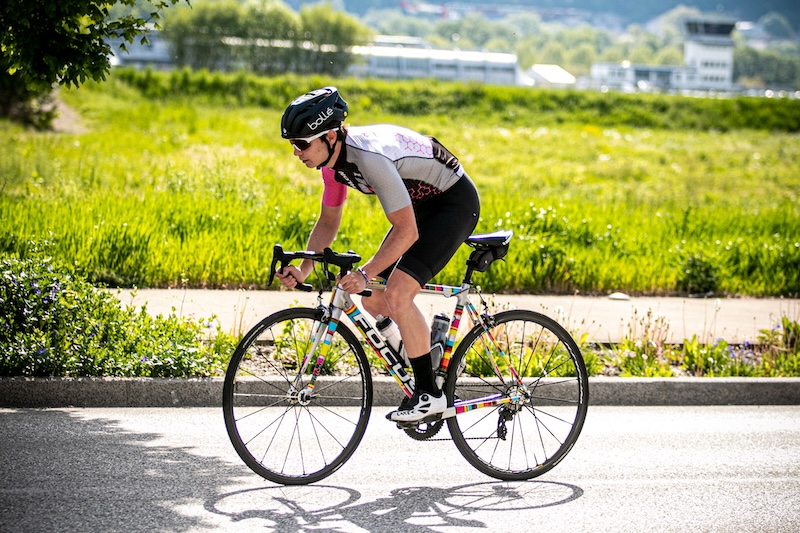
With its 750 m swim, 20 km bike, and 5 km run, the Sprint triathlon is often the perfect format to discover triathlon, or to challenge yourself with a short, intense effort.
But heads up, “Sprint” does not mean winging it. If you want to enjoy race day, it is worth following a structured Sprint triathlon training plan that matches your level.
In this article, you will find a training plan outline plus all our tips to nail your preparation in the best conditions.
Contents
Sprint triathlon: the essentials
Short, punchy, and fast-paced, the Sprint triathlon is probably the most accessible distance to jump into the swim-bike-run.
You do not need to train 15 hours a week. With a smart, well-built training plan, you can absolutely prepare for a Sprint triathlon while balancing work, family, and real life.
To reach the finish line, expect roughly 1h to 1h20 for experienced triathletes, and 1h30 to 2h for beginners. Even though the distances are “short,” Sprint racing still demands endurance, solid pacing, and above all efficient transitions. The goal is not only to be good in each discipline, it is to learn how to link them together smoothly.
Triathlon pacing plans will be available soon on RunMotion Coach.
How many weeks do you need to prepare for a Sprint triathlon?
If you are new to triathlon, we generally recommend 8 to 12 weeks of preparation. The objective is not to stack huge training volume, but rather to:
- learn to combine the three disciplines,
- build a strong endurance base,
- and set a consistent routine.
At the start, consistency will always matter more than intensity.
And if you are not comfortable in the water, we even recommend starting earlier and focusing on swimming with 2 sessions per week to progress faster. The closer you get to race day, the more specific your training becomes, intensity, transitions, pacing, and “brick” workouts (bike + run).
For more experienced triathletes, the Sprint distance is often used as an early-season race, a tune-up for a longer event, or a way to sharpen speed and explosiveness. It is also a great format to work on pacing, transitions, and high-intensity efforts.
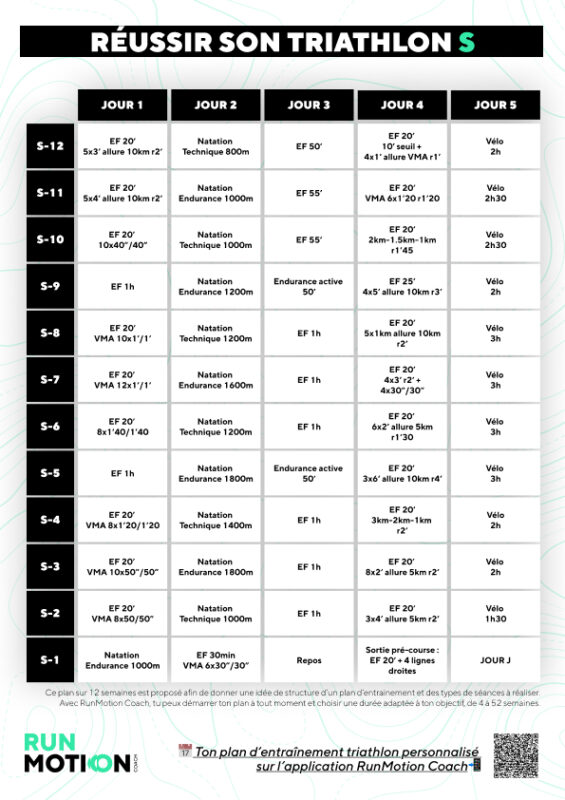
Discover your 12-week Sprint Triathlon training plan
How many workouts per week for a Sprint triathlon?
To prepare effectively for a Sprint triathlon, plan on 1 swim session, 1 to 2 bike sessions, and 2 to 3 run sessions. That is about 5 to 6 workouts per week for a complete training plan. Not every session needs to be long. For Sprint triathlon performance, quality often beats quantity.
For example, you might include:
- a swim technique session,
- a hard bike session,
- a run interval workout,
- an easy endurance session,
- and a brick workout
A strength training or general conditioning session can also be a great addition to improve stability, prevent injuries, and handle training load better. Here is more on Strength & Conditioning (S&C).
If you want to go further, check out our article on How to organize your triathlon training week ?
Most importantly, do not neglect recovery.
In triathlon, your body has to handle three different sports. Muscle and mental fatigue can show up faster than you think. Easier days are a real part of improving.
With RunMotion Coach, your plan adapts to your level, your schedule, and how you are feeling right now.
Key sessions in a Sprint triathlon training plan
Swim technique sessions
Swimming is often the discipline that worries people the most, and it is also the one they train the least. Yet being comfortable in the water can completely change your race-day experience. In swimming, technique often matters more than raw strength.
Sessions will mainly aim to improve:
- front crawl,
- breathing,
- movement efficiency,
- body position in the water.
So you will usually prioritize drills, kick work, and breathing exercises, using short, technical sets.
To go a little further, here are 12 technique drills to improve for triathlon.
And good news, you can absolutely finish a Sprint triathlon without being a great swimmer and even without swimming front crawl. The real goal is to feel in control and exit the water without burning too much energy.
Bike intensity sessions
In any triathlon, whatever the distance, the bike is the longest leg. The challenge is not only to ride fast, but to keep enough energy to run well afterward. Bike sessions therefore often target intensity, cadence, and power.
For more experienced triathletes, some sessions can be done with a power meter to manage training zones more precisely.
An indoor trainer can also be a great option for short, efficient workouts when time is tight.
Run sessions
For running, focus on easy aerobic endurance and short intervals, like 30/30s or 400 m repeats, plus 5K-pace work. But in triathlon, running fast is not enough, you need to learn to run after cycling. Your legs are already under heavy muscular load, and the sensations can feel very different from “classic” run training.
Brick workouts
When we talk about brick workouts, we mean combining two disciplines back-to-back, bike + run, or sometimes swim + bike.
The goal is to teach your body to switch efforts quickly and improve how you feel during transitions. It is one of the most triathlon-specific sessions you can do.
A classic example:
- 45 minutes on the bike,
- then 15 minutes of progressive running right after.
At first, the sensations might feel a bit weird, but it quickly becomes a real advantage on race day.
Brick workouts are not available yet in the app RunMotion Coach, but this feature is coming soon.
In the meantime, we suggest either adding 1 to 2 km of running after your bike ride, or scheduling two sessions on the same day directly in the app.
Nutrition and recovery
Whether you are a beginner or chasing a time, recovery is part of the training.
Getting enough sleep, staying well hydrated, and eating well will help you absorb workouts, avoid energy crashes, and string training weeks together with more confidence.
For example, we recommend carbohydrates to support training load, protein after workouts, daily hydration of course, and regularly scheduling lighter weeks.
The most important thing is consistency, it is better to do a little less but stick with it for several weeks than to try to do everything from day one.
Your personalized Sprint triathlon training plan with RunMotion Coach
Training for a Sprint triathlon? RunMotion Coach offers personalized, adaptive triathlon training plans built around:
- Your schedule,
- Your fitness,
- Your personal constraints,
- and even your other sports and activities.
You will find swim, bike, and run workouts, strength training, plus guidance for recovery, nutrition, and race strategy.
All within a flexible plan designed to fit your daily life.
FAQ: Sprint triathlon
Can you prepare for a Sprint triathlon in 8 weeks?
Yes. For most athletes who already have a basic endurance foundation, 8 weeks can be enough to get ready for a Sprint triathlon. The main objective is to build consistency across all three disciplines and help your body get used to the combinations. With a progressive, realistic plan, you can absolutely make the start line in good shape.
How many training hours per week for a Sprint?
Sprint triathlon preparation usually requires between 4 and 7 hours of training per week, depending on your level, experience, and goals. A beginner can do well with short, regular sessions, while performance-focused athletes will progressively increase volume and intensity. Consistency matters more than a few isolated big weeks.
What bike do you need for a Sprint triathlon?
A standard road bike is more than enough to start a Sprint triathlon and have fun on race day. You do not need to invest right away in a time trial bike or highly technical gear. What matters most is a reliable bike that fits well and feels comfortable in training and in competition.
I am not a strong swimmer, is a Sprint triathlon still doable?
750 meters may look short to a triathlete, but it can feel long if you are a beginner or a “weak swimmer.” It is recommended to be comfortable with that distance in the pool, and ideally be able to go beyond 1000 m so you do not panic on race day. To progress, it is best to start swimming at least 3 to 4 months before the triathlon, and do at least 2 swim sessions per week to improve technique and build confidence.
Can you prepare for a Sprint triathlon without a club?
Yes, you can absolutely prepare for a Sprint triathlon without joining a club. With a structured, progressive training plan adapted to your level, you can train effectively on your own. You can also rely on coaching apps like RunMotion Coach, which includes triathlon training plans and adapts to your level and progress.