A Tenerife Bluetrail training plan has to prepare you for a unique volcanic crossing: on the longest race you start by the sea, climb to Mount Teide at 3555 m, then descend all the way to the ocean on the other side of the island. Between lava fields, pine forests and coastal trails, it combines huge climbs, altitude and big temperature swings. Here is how to train for every race.
The short answer
- Allow 8 to 12 weeks for the Vertical Night Challenge and the 24k, 14 to 16 weeks for the 47k and 5 to 6 months for the 68k, 82k and 110k.
- Indicative peak load: 40 to 60 km and 1500 to 2500 m of climbing per week for the short races, 60 to 90 km and 3000 to 4500 m for the ultras, depending on your level.
- Key sessions: very long climbs with power hiking, long descents on volcanic ground, night long runs and, if possible, time at altitude.
- Number one challenge: climbs and descents of exceptional length, from sea level to high altitude on the 110k.
Contents
Tenerife Bluetrail distances and elevation
Tenerife Bluetrail by UTMB takes place in April in the Canary Islands, through Teide National Park. Figures come from the official Tenerife Bluetrail website; check them before race day.
| Race | Distance | Elevation gain | Profile/notes |
|---|---|---|---|
| Tenerife Bluetrail 110k (100M category) | 110 km | 6250 m | Los Cristianos beach to Puerto de la Cruz, high point at Teide (3555 m); night start; 27-hour limit; 4 Running Stones |
| Tenerife Bluetrail 82k (100K category) | 82 km | 3300 m | 3 Running Stones |
| Tenerife Bluetrail 68k (100K category) | 68 km | 3600 m | Shorter than the 82k but more climbing; 3 Running Stones |
| Tenerife Bluetrail 47k (50K category) | 47 km | 2600 m | 2 Running Stones |
| Tenerife Bluetrail 24k (20K category) | 24 km | 1300 m | 1 Running Stone |
| Tenerife Bluetrail 47k Relay | 47 km | 2600 m | Relay; 1 Running Stone |
| Vertical Night Challenge | 6.5 km | 850 m | Night vertical race; no Running Stones listed |
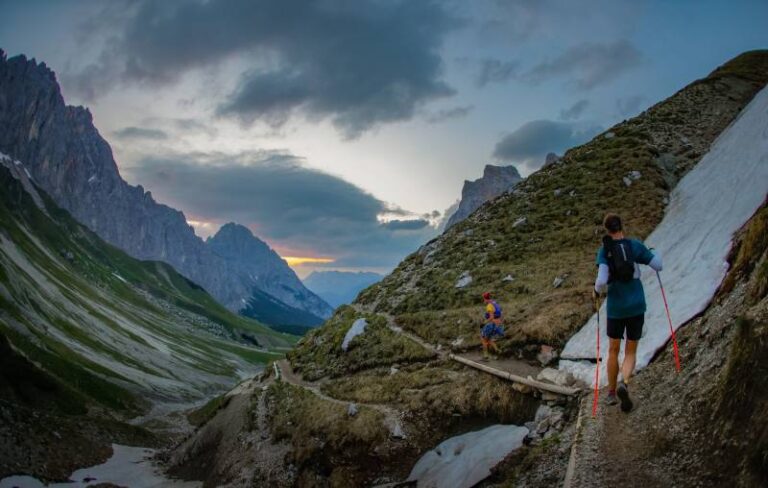
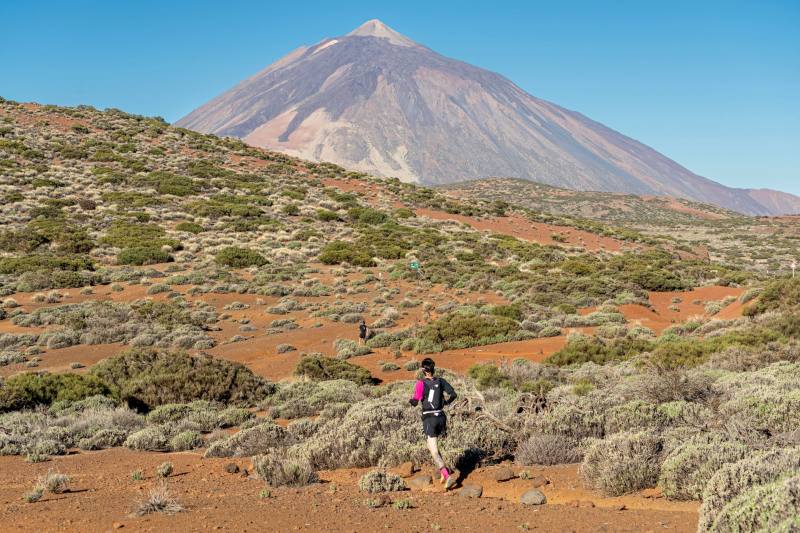
There is also a Kids & Family format and the Reto & Joëlettes, with no published distance. The terrain is volcanic: the site mentions the jagged rocks of the malpaíses (lava fields), volcanic cones, pine and laurel forests and seaside trails on the north coast. Temperatures can differ widely between the coast and the heights of Teide.
What makes Tenerife Bluetrail so demanding
The scale of the climbs is extraordinary. On the 110k you start close to sea level and reach 3555 m: hours of climbing followed by an equally long descent to the north coast. Altitude is the second factor: above 2500 to 3000 m, effort feels harder and your pace drops, especially after a night of racing. Finally, volcanic ground is harsh: loose stones, lava sand and sharp rock that wear your feet down and demand focus until the end.
How long do you need to prepare?
For the Vertical Night Challenge and the 24k, 8 to 12 weeks is enough if you already run trails. The 47k needs 14 to 16 weeks and a previous 30 km mountain race with at least 1500 m of climbing. The 68k and 82k take 5 to 6 months after at least one ultra over 50 km. The 110k is classed as 100M by the organisers: climbing, altitude and a night start justify 6 months of preparation and mountain ultra experience of at least 15 hours. Our guide to increasing distance in trail running will help you progress safely.
The phases of your training plan
Base phase. Easy running, one quality session per week and two strength sessions (squats, lunges, box step-ups, core). Start building regular climbing.
Specific phase. Long continuous climbs, long descents and multi-hour mountain runs, increasing climbing gradually with a lighter week every three or four weeks. For the 110k, add night runs and, if possible, a training camp or weekend at altitude. Test kit for both the cold heights and the warm coast.
Taper. One to three weeks depending on the race: 30 to 50% less volume, a few short efforts and plenty of sleep.
Key sessions for Tenerife Bluetrail
Long continuous climbs: for example 2 to 3 x 20 to 30 minutes uphill at a sustained effort, mixing running and power hiking.
Long descents: your quads will be tested on the way down to Puerto de la Cruz. Practise descents of 20 minutes or more, ideally on stony ground.
Night long runs: for the 110k, get used to running by headtorch and eating when your body wants to sleep.
Vertical Night Challenge: for this short, very steep race, focus on 5 to 10 minute steep hill repeats and calf and thigh strength.
The RunMotion Coach app builds your personalised plan and adjusts it every week to your completed sessions, level and availability, including climbing, strength, recovery and mental preparation. RunMotion Coach is the official online coach of the UTMB World Series, and its founders, twins Guillaume and Romain Adam, come from the Alps, so big climbs are their home ground. Try it free for 7 days.
Plan your race strategy with Race Strategy
Between the coast and Teide’s 3555 m, an average pace is meaningless. Race Strategy by RunMotion calculates your strategy kilometre by kilometre, with pace adjusted for elevation, altitude and terrain technicality, estimated split times at key points, a nutrition and hydration plan per section (carbs, water, sodium) and a race-day weather adjustment. Just import the official GPX of your race.
Running Stones and the UTMB World Series
Tenerife Bluetrail is part of the UTMB World Series. According to the official site, the 110k earns 4 Running Stones, the 82k and 68k 3, the 47k 2, and the 24k and relay 1. To plan your season, see our UTMB World Series training plan guide and our article on preparing a UTMB World Series season.
FAQ
Do you need poles for Tenerife Bluetrail?
Check the official race regulations. On such long climbs many runners like them, but you need to train with them to benefit.
Is Teide’s altitude a problem?
For most runners, altitude slows you down above 2500 to 3000 m without major risk over a short period. If you notice unusual symptoms (severe headache, nausea, dizziness), slow down and speak to the race medical team, and ask a health professional beforehand if you have any doubts.
What is the difference between the 68k and the 82k?
The 68k is shorter but has more climbing (3600 m vs 3300 m), so it is more mountainous, while the 82k demands more ability to keep running for longer.
Conclusion
Tenerife Bluetrail rewards runners who can handle very long climbs, big descents and altitude. Train patiently and progressively, and test all your kit before race day. For a plan that adapts to you, start your 7-day free trial of RunMotion Coach.
Article updated by the RunMotion Coach team.
Sources: tenerife.utmb.world, 110k race page.