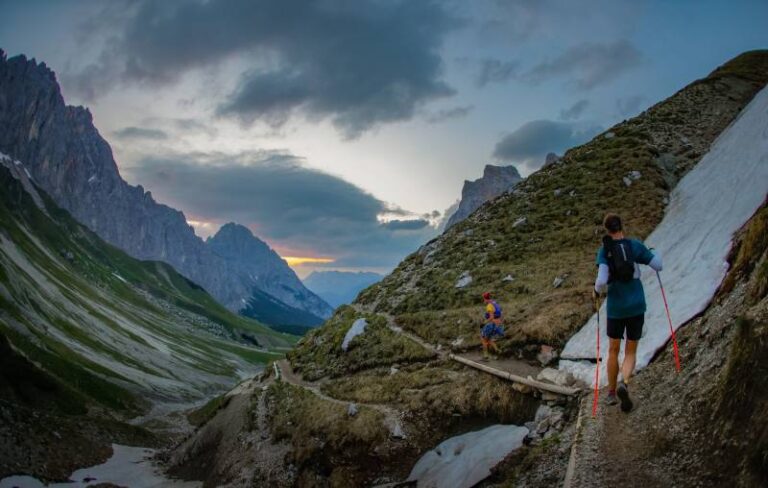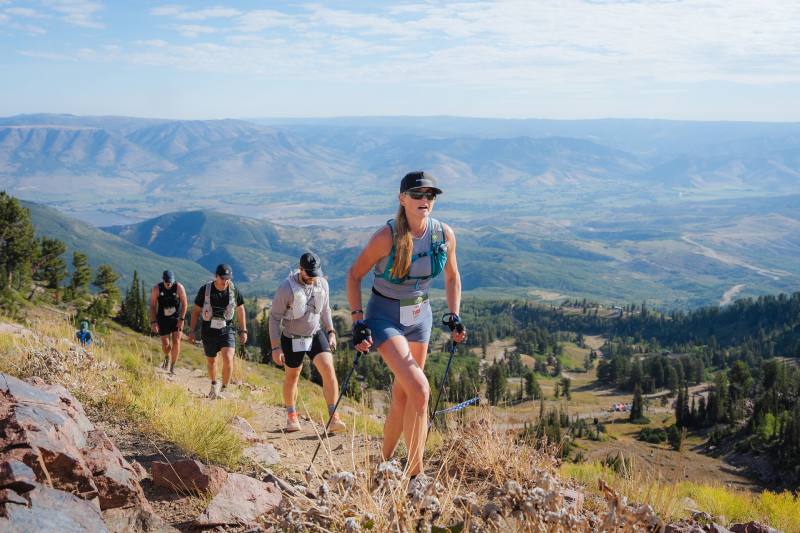
A Snowbasin training plan should prepare you for courses the organisers themselves call “tough but runnable”: singletrack through sagebrush, aspen and fir above Ogden and the Great Salt Lake, in Utah’s Northern Wasatch. Held in mid-September, Snowbasin by UTMB offers two races, a 58K and a 28K. Here are the official numbers and how to train for each.
The short answer
- Typical build: 10 to 14 weeks for the 28K, 4 to 5 months for the 58K, on top of consistent running.
- Specific-phase volume: roughly 4 to 7 hours a week for the 28K, 6 to 10 hours for the 58K, depending on your level.
- Key sessions: runnable hilly long runs, threshold hill repeats, surging on gentle grades and fast descents.
- The defining feature: a very runnable profile for mountain trail, which rewards genuine running endurance over pure climbing.
Contents
Snowbasin distances and elevation
Figures come from the official race pages. Both races are slightly longer than their names suggest.
| Race | Distance | Elevation gain | Profile / notes |
|---|---|---|---|
| 58K (50K category) | 59 km (36.7 mi) | 1,800 m (5,906 ft) | Starts at Snowbasin Resort; sagebrush, aspen and fir, views of Ogden and the Great Salt Lake; 12-hour limit; 2 Running Stones |
| 28K (20K category) | 29 km (18 mi) | 800 m (2,625 ft) | Loop of the resort on singletrack, forests and mountain meadows; 7-hour limit; 1 Running Stone |
At about 30 m of gain per kilometre (roughly 160 ft per mile) on the 58K, and less on the 28K, Snowbasin is noticeably more runnable than most mountain trail races. The 58K moves from sagebrush to stands of aspen and fir with views over Ogden and the Great Salt Lake; the 28K circles the resort on its best singletrack. The organisers note that hot- or cold-weather gear kits may be required depending on conditions. Full details on the official website.
What makes Snowbasin hard
Runnable does not mean easy. When almost everything can be run, there are no natural breaks like a long hiked climb: heart and legs work continuously. Over 59 km, the ability to keep running well in the second half usually makes the difference.
The mountain setting is the other variable. It is a ski resort, so altitude may be noticeable for lowland runners, and late-summer conditions can swing enough for the organisers to impose a hot or cold gear kit. Be ready to adapt on race day.
How long to train for each distance
The 28K suits regular runners with a 15 to 20 km trail race behind them: allow 10 to 14 weeks. The 58K is an ideal first step into ultra distance if you have already run a 30 to 40 km trail race: plan 4 to 5 months and extend your long runs gradually, as explained in our guide to increasing distance. These are benchmarks; your history and available time come first.
The phases of your training plan
For a mid-September race, the base phase sits in spring: progressive easy volume, one quality session a week (intervals or hills) and two strength sessions. Aerobic base matters more than ever here, since you will run most of the course. The specific phase runs through summer, over 8 to 10 weeks: hilly long runs where you run the gentle grades, threshold blocks and fast downhill work, plus a few mountain weekends if you can. Practise race nutrition on any run longer than two hours. Take a lighter week every three or four. The taper lasts about a week for the 28K, one to two weeks for the 58K.
Key workouts for Snowbasin
The runnable long run. Run as much as possible on rolling terrain, including gentle climbs, at easy effort. Build toward 4 hours or more for the 58K depending on your level; 2.5 to 3 hours is usually enough for the 28K.
Threshold hill repeats. Reps of 6 to 12 minutes on moderate climbs at threshold effort (roughly what you could hold for an hour), to run the climbs you would otherwise hike.
Fast descents. On smooth singletrack, work on cadence and relaxation downhill, ideally late in a session.
Race-pace rehearsal (58K). Once or twice in the specific phase, a 2- to 3-hour run with a portion at goal effort and your planned fuelling.
Want a plan that adapts every week to the sessions you complete, your level and your schedule? The RunMotion Coach app, official online coach of the UTMB World Series, builds in elevation, strength and recovery. Try it free for 7 days.
Plan your race with Race Strategy
On a runnable course, the main risk is starting too fast. Race Strategy by RunMotion builds a kilometre-by-kilometre plan with pace adjusted for gradient, altitude and terrain, estimates your splits at key points, and gives you a per-section nutrition and hydration plan (carbs, water, sodium) adjusted to race-day weather. Import the official GPX for your race.
Running Stones and the UTMB World Series
The 58K earns 2 Running Stones and the 28K earns 1, usable in the UTMB Finals lottery in Chamonix. To build a season around several events, see our UTMB World Series training plans and how to plan your trail running season. RunMotion’s founders, twin brothers Guillaume and Romain Adam, come from the Alps: mountains, vertical and ultra distance are home turf.
FAQ
Is the Snowbasin 58K a good first ultra?
Yes, it is an accessible way to go beyond 50 km: moderate climbing and a 12-hour limit. You should still have a 30 to 40 km trail race behind you and be comfortable with long runs.
Do I need poles at Snowbasin?
On courses this runnable they are rarely essential. Check whether they are allowed in the regulations and only race with them if you have trained with them.
How many miles a week for the 28K?
Think in hours: 4 to 7 hours a week in the specific phase is a common range, adjusted to your level and history.
Snowbasin rewards runners who can keep running and surging, more than pure climbers. Build a strong aerobic base, run your gentle grades and save something for the second half. For a plan that adapts to you, start your free 7-day RunMotion Coach trial.
Article updated by the RunMotion Coach team.
Sources