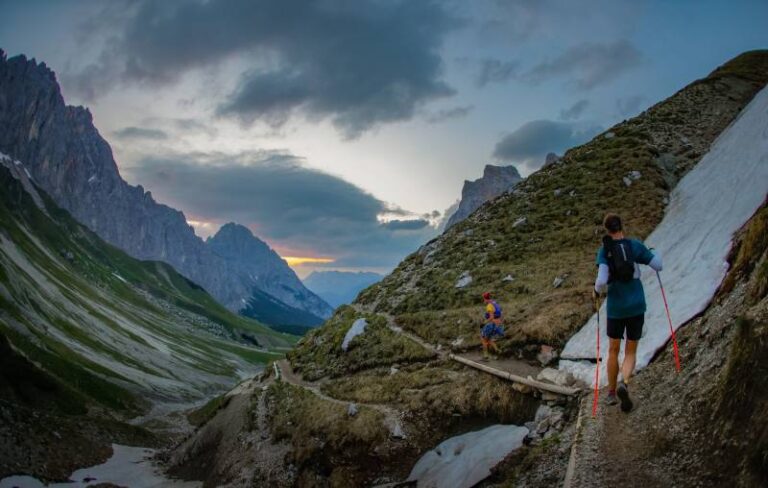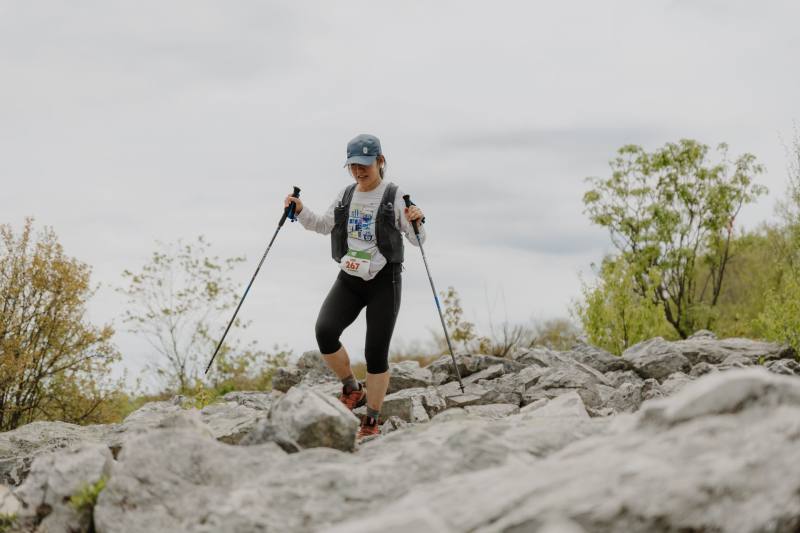
This Rothrock by UTMB training plan guide will get you ready for the 50K or the 25K of this May race in Rothrock State Forest, central Pennsylvania. Sandstone ridges, fern-covered valleys and rhododendron tunnels make for a wild forest trail that is tougher than it looks. Below are the official numbers, recommended training time and the workouts that prepare you for this terrain.
The short answer
- Training time: 12 to 16 weeks for the 25K, 16 to 20 weeks for the 50K, starting from a regular running base.
- Indicative 50K peak: 50 to 70 km (30 to 45 mi) per week with 1200 to 2000 m (3900 to 6500 ft) of climbing, depending on your level.
- Key sessions: short and long hill repeats, technical downhills, long forest runs.
- Main challenge: the 25K is steeper than the 50K (about 44 m of gain per km versus 29), so do not underestimate it.
Contents
Rothrock distances and elevation
| Race | Distance | Elevation gain | Profile/notes |
|---|---|---|---|
| 50K | 53.3 km (33.1 mi) | 1550 m (5085 ft) | 50K category (2 Running Stones). Starts at Tussey Mountain, through Bear Meadows and along Tussey Ridge Trail, 12-hour max race time. |
| 25K | 26.9 km (16.7 mi) | 1188 m (3898 ft) | 20K category (1 Running Stone). Short but steep. |
The 50K starts at Tussey Mountain, crosses Bear Meadows Natural Area, a National Natural Landmark, and then follows the Tussey Ridge Trail. The organizers describe sandstone ridges, shaded forest, cliffs and streams. Altitude is modest and late spring brings mild weather and dense foliage that keeps much of the trail shaded. All figures come from the official Rothrock by UTMB website; check them again before race day.
What makes Rothrock demanding
Total climbing only tells part of the story. Ridge trails in the eastern US forests are often rooty and rocky, forcing you to watch every foot strike and making it hard to settle into a steady rhythm. That constant focus tires your mind as much as your legs, especially late in the race.
The 25K deserves special attention: 1188 m of gain over 26.9 km is a much higher climbing density than the 50K. Runners who treat it as a “short trail race” meet climbs that force them to hike and descents that hammer the quads. On the 50K, the challenge is more spread out, with ridges, valleys and runnable sections, and a 12-hour limit that gives you room but still demands careful pacing over time.
How long do you need to train?
For the 25K, allow 12 to 16 weeks if you already run three times a week and are used to hills. Without trail experience, add a few weeks to toughen up your ankles and quads.
For the 50K, aim for 16 to 20 weeks, ideally after a 25 to 40 km trail race completed comfortably. If you have never gone beyond the marathon distance, our trail marathon training plan is a useful stepping stone, and our guide to increasing your distance explains how to progress safely.
The phases of your training plan
Base (6 to 8 weeks). Build easy volume, preferably on trails, to get your feet used to roots and rocks. Add one or two strength sessions a week (balance, calves, quads, core) and a lighter week every three or four weeks.
Specific (6 to 8 weeks). Your key sessions start to resemble the course: more vertical gain, long runs on hilly forest trails and downhill work on every outing. Test your gear and fueling on runs of three hours or more for the 50K.
Taper (10 to 14 days). Cut volume by 30 to 50 percent while keeping a few short hill efforts, so you arrive with fresh quads.
Key workouts for Rothrock
Steep hills with power hiking. 6 to 10 climbs of 3 to 5 minutes on a steep grade, mixing running and fast hiking depending on the slope. This is the key session for the 25K, and it also prepares you for the steepest parts of the 50K.
Long threshold climbs. 3 to 4 × 8 to 10 minutes on a steady hill at threshold, the effort you could hold for about an hour in a race.
Technical downhill. 20 to 30 minutes of controlled downhill running on rocky or rooty trail, looking a few meters ahead, upper body relaxed, quick light steps.
Long forest run. From 2 hours (25K) to 4 hours (50K) on hilly, technical terrain with your race pack and nutrition.
The right mix depends on your level, history and available time. The RunMotion Coach app, the official online coach of the UTMB World Series, builds your personalized plan, includes vertical gain and strength work, and adjusts it every week to what you have actually done. Its founders, twin brothers Guillaume and Romain Adam, come from the Alps, so mountains, climbing and ultra running are their home turf. Try RunMotion Coach free for 7 days.
Plan your race with Race Strategy
On a forest course where pace changes constantly, a single target time is not enough. Race Strategy by RunMotion calculates a kilometer-by-kilometer plan with pace adjusted for elevation, altitude and terrain technicality, estimated split times at key points, a carbs, water and sodium plan for each section and a race-day weather adjustment. Import the official course GPX to get yours.
Running Stones and the UTMB World Series
According to the official website, the 50K earns 2 Running Stones and the 25K earns 1, improving your odds in the UTMB World Series Finals draw. To build a full season, see our UTMB World Series training plan hub.
FAQ
Do you need poles for Rothrock?
Many runners go without on these distances, but poles can help on steep climbs if you already train with them. Check the official rules to see whether they are allowed.
Is the Rothrock 25K beginner friendly?
Yes, if you run regularly and train specifically for climbs and descents. With nearly 1200 m (3900 ft) of gain, it is not an easy first trail race, so give yourself at least 12 weeks.
How many miles a week for the Rothrock 50K?
As a rough guide, 50 to 70 km (30 to 45 mi) per week at peak for an intermediate runner. With less time, keep the long run and the hill session and reduce the rest.
Bottom line
Rothrock rewards runners who are at ease on forest singletrack, strong on climbs and focused on descents. Work on your footwork, stack up the hills and respect the 25K. For a plan that adapts to you, start your 7-day free trial of RunMotion Coach.
Article updated by the RunMotion Coach team.
Sources