This HOKA Pacific Trails California training plan guide covers both races of the November event held on a vast cattle ranch in California’s Santa Ynez Valley: the 50K and the 25K. Historic ranch roads, flowing singletrack and oak-lined canyons make for a very runnable course, and that is exactly what catches people out. Below you will find the official numbers, how long to train, how to structure your build and the key workouts.
The short answer
- Training time: 12 to 16 weeks for the 25K, 16 to 20 weeks for the 50K if you already run regularly.
- Indicative 50K peak: 4 to 5 runs a week, roughly 50 to 70 km (30 to 45 mi) and 1000 to 1500 m (3300 to 4900 ft) of climbing, depending on your level.
- Key sessions: rolling long runs where you run almost everything, threshold hill repeats, fast smooth downhills.
- Main challenge: a highly runnable course (about 30 m of gain per km on the 50K) that rewards sustained running more than power hiking.
Contents
- HOKA Pacific Trails California distances and elevation
- What makes HOKA Pacific Trails California demanding
- How long do you need to train?
- The phases of your training plan
- Key workouts for HOKA Pacific Trails California
- Plan your race with Race Strategy
- Running Stones and the UTMB World Series
- FAQ
- Bottom line
HOKA Pacific Trails California distances and elevation
| Race | Distance | Elevation gain | Profile/notes |
|---|---|---|---|
| 50K | 51 km (31.7 mi) | 1550 m (5085 ft) | 50K category (2 Running Stones). Point-to-point on ranch roads and singletrack, 10-hour max race time. |
| 25K | 25 km (15.5 mi) | 650 m (2133 ft) | 20K category (1 Running Stone). Short, runnable, a good first UTMB World Series race. |
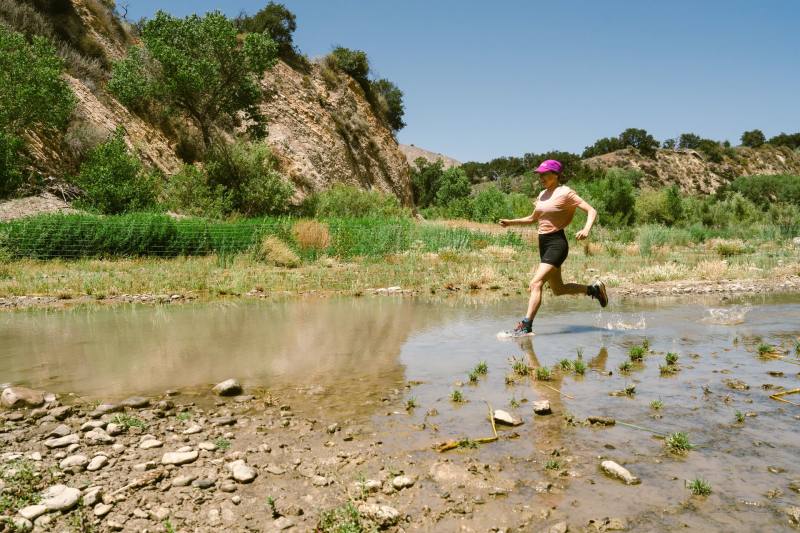
Both races take place on Rancho San Fernando Rey, a property of around 30000 acres crossed by the Santa Ynez River. Its high point, Loma Alta, tops out at 840 m (2758 ft), so altitude is not a factor. The 50K mostly follows old ranching roads and wagon tracks, with sections of flowing singletrack through coastal sage scrub and live oak woodland. All figures come from the official HOKA Pacific Trails California by UTMB website; check them again before race day, as the organizers note that course markings take priority over the GPX.
What makes HOKA Pacific Trails California demanding
On paper, 1550 m of gain over 51 km looks gentle. On the day, a course you can run almost entirely never gives you a natural break: no long climb where you hike and recover, no technical section that resets your rhythm. You string together rollers, short climbs and downhills on wide tracks where it is tempting to open up your stride. Your quads absorb thousands of impacts, and fatigue usually shows up in the last third, when the pace that felt easy early on becomes heavy.
Pacing is the other trap. With a 7 a.m. start and a fast profile, many runners go out too hard. Conditions in central California in November can also shift from a cool morning to strong midday sun, so train yourself to drink and eat regularly while running, not only while walking.
How long do you need to train?
For the 25K, plan 12 to 16 weeks if you already run three times a week and have finished a 10K or a short trail race. Coming from a lower base, add 4 to 6 weeks so you can build up without getting hurt.
For the 50K, aim for 16 to 20 weeks of focused training, ideally after a 25 to 30 km trail race or a comfortable half marathon. It is an accessible first ultra, but it still means several hours on your feet, so you need long runs of three hours or more in your legs. Our guide on increasing your distance safely explains how to progress.
The phases of your training plan
Base phase (6 to 8 weeks). Build easy aerobic volume at a conversational pace, increase load gradually and take a lighter week every three or four weeks. Add one or two strength sessions a week focused on quads, calves and core: they will handle the fast descents.
Specific phase (6 to 8 weeks). Make your training look like the ranch: rolling long runs on wide trails, threshold hill work, and race-pace finishes to long runs. Threshold is the effort you could hold for about an hour in a race, “comfortably hard”. This is also when you test fueling and gear in real conditions.
Taper (10 to 14 days). Cut volume by roughly 30 to 50 percent while keeping a few short, sharp efforts. The goal is fresh legs, not cramming in missed sessions.
Key workouts for HOKA Pacific Trails California
The “run it all” long run. On a gently rolling route, run 2 h 30 to 4 h at a steady effort, including the small climbs. This is the most race-specific session you can do.
Threshold hill repeats. For example 4 to 6 × 6 minutes on a moderate grade, jogging back down. You build power for the short climbs without blowing up.
Fast, smooth downhills. Add 10 to 20 minutes of downhill running on wide trails to your weekly runs, working on short, quick steps to limit impact.
Race-pace finish. End a long run with 30 to 45 minutes at your goal 50K effort, eating and drinking on the move. For the 25K, 3 × 10 minutes at race effort is enough.
Adjust all of this to your level and schedule. That is exactly what the RunMotion Coach app, the official online coach of the UTMB World Series, does: a personalized plan that adapts every week to the sessions you complete and the time you have, synced with Garmin, COROS, Suunto or Apple Watch. Our founders, twin brothers Guillaume and Romain Adam, come from the Alps, so mountains, climbing and ultra distance are home ground for them. Try it free for 7 days.
Plan your race with Race Strategy
On a fast course, going out too quickly is the classic mistake. Race Strategy by RunMotion builds a kilometer-by-kilometer plan with pace adjusted for elevation, altitude and terrain, estimated split times at key points, a fueling and hydration plan for each section (carbs, water, sodium) and a race-day weather adjustment. Import the official course GPX to generate yours.
Running Stones and the UTMB World Series
According to the official website, finishing the 50K earns 2 Running Stones and the 25K earns 1. Running Stones improve your odds in the draw for the UTMB World Series Finals in Chamonix. To plan a full season around them, see our UTMB World Series training plan hub and our guide on planning your trail running season.
FAQ
Do you need poles for HOKA Pacific Trails California?
The very runnable profile makes poles of limited use for most runners. Check the official rules and mandatory gear list before deciding.
How many miles a week to train for the Pacific Trails 50K?
As a rough guide, 40 to 70 km (25 to 45 mi) per week at peak, depending on your level and history. Consistency and a weekly long run matter more than total mileage.
Is the 25K a good first trail race?
Yes. With 650 m (2133 ft) of gain over 25 km, it is accessible if you already run regularly. Give yourself at least 12 weeks to get used to trails and downhills.
Bottom line
HOKA Pacific Trails California rewards consistent runners who can hold a moderate pace for a long time on terrain that never quite lets you rest. Build your endurance, train your downhills, practice fueling on the run and start conservatively. For a plan that adapts to you week after week, start your 7-day free trial of RunMotion Coach.
Article updated by the RunMotion Coach team.
Sources