An Oman by UTMB training plan has to prepare you for rock, heat and long climbs: the event runs through the canyons and ridgelines of the Hajar Mountains, with up to 8000 m of elevation gain on the longest format. This guide covers every distance, from the 20K to the 100M, and explains how to train for each one.
The short answer
- Indicative build-up: 10 to 12 weeks for the 20K and 30K, 16 to 20 weeks for the 50K, 6 to 9 months for the 100K and 100M, starting from a solid trail base.
- Peak weekly climbing as a rough guide: around 1500 to 2500 m for the 50K, 3000 to 5000 m for the 100K and 100M, adjusted to your level and history.
- Key sessions: long climbs at a steady effort, descents on rough ground, long hike-run days, back-to-back weekends.
- The defining feature: very rocky, technical terrain with big swings between daytime heat and cold nights.
Contents
Oman by UTMB distances and elevation
There are five races, all listed on the official Oman by UTMB website. Figures below come from each race page.
| Race | Distance | Elevation gain | Profile / notes |
|---|---|---|---|
| 100M – Hajar Ultra (100M category) | 154 km | 8000 m | Al Hamra to Birkat Al Mouz across ridgelines, wadis and remote plateaus; 48 h cut-off |
| 100K – Jabal Classic (100K category) | 103 km | 5000 m | Starts in Al Hamra, rugged ridges and rocky paths; 30 h cut-off |
| 50K – Skyward Canyon (50K category) | 50 km | 2400 m | High traverses and exposed canyon terrain; 15 h cut-off |
| 30K – Old Capital Trail (20K category) | 32 km | 1400 m | Technical, rocky single track; distance and gain to be confirmed |
| 20K – Scenic Ascent (20K category) | 21.5 km | 550 m | Stone paths and desert slopes down to the Birkat Al Mouz palm gardens; 5 h cut-off |
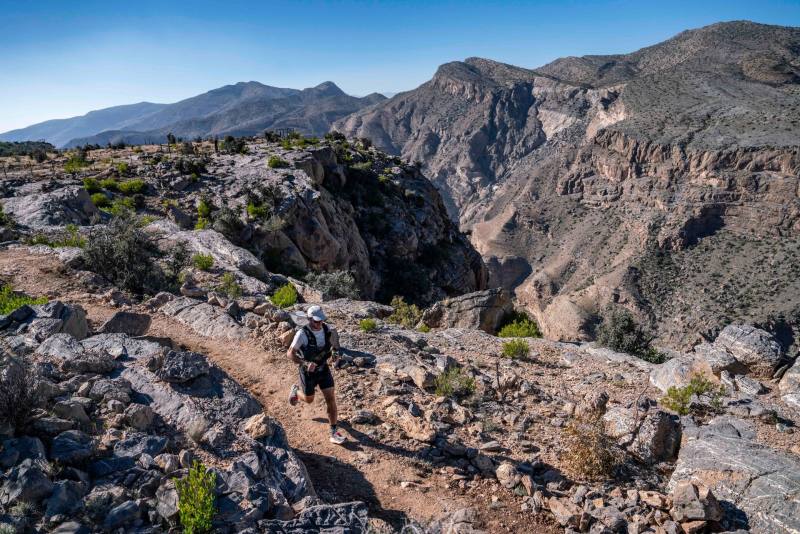
The races take place in the Hajar range, Oman’s highest mountains, around Jabal Akhdhar and the oasis of Birkat Al Mouz. The event is held in December, and the official gear page warns that conditions at altitude can change fast, with strong winds, cold nights and sudden temperature drops. Underfoot it is mostly rock: slabs, scree and dry riverbeds that hammer your ankles and quads.
What makes Oman by UTMB hard
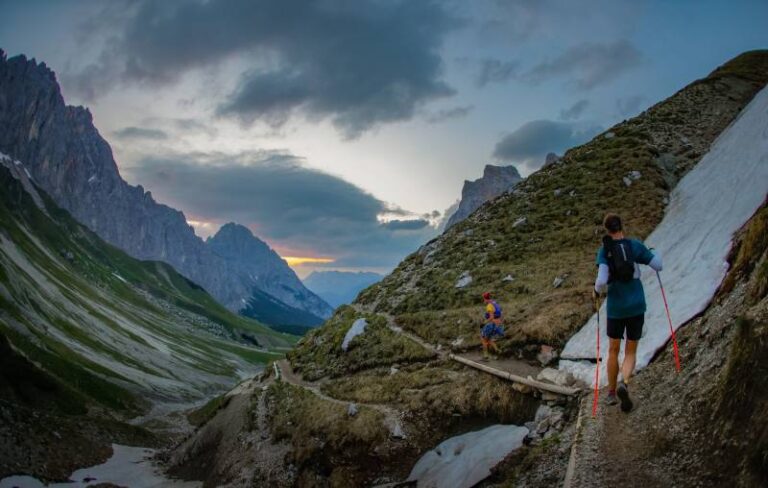
Terrain comes first. The race pages describe steep ridgelines, deep wadis, exposed traverses and routes carved into cliffs. On ground like this, your pace depends less on your engine than on precise footwork sustained for hours, and the descents are where most runners lose time.
Then there is the temperature range between hot days and cold nights. The rules set a minimum water capacity (2 litres on the 100M and 100K), add a hot-weather kit and require two head torches on the two longest races. Training your drinking and fuelling routine is as important as training your legs.
Finally, the climbing density is high: more than 50 m of gain per kilometre on the 100M. Power hiking is a core skill here, not a backup plan.
How long do you need to prepare?
20K and 30K: if you already run regularly and have a few trail races behind you, 10 to 12 weeks of specific work is usually enough. The Old Capital Trail is more technical than its name suggests, so get used to rocky ground first.
50K: allow 16 to 20 weeks, ideally with a 30 to 40 km trail race already completed and some confidence on technical terrain.
100K and 100M: plan 6 to 9 months, after one or more seasons of ultra racing. Before the Hajar Ultra, you should ideally have finished a mountain 100 km and raced through a night. These are guidelines; your history, recovery and available time matter more than any theoretical calendar.
The phases of your training plan
Base. Build easy aerobic volume, restart strength work for quads, calves, core and ankles, and add climbing gradually. Keep one short interval session a week to maintain speed, and schedule a lighter week every three or four weeks.
Specific. Over the last 8 to 12 weeks, everything should resemble Omani terrain: long climbs, technical descents, long days on stony trails, and full rehearsals with your mandatory kit and race fuel. If you live somewhere cool, a few sessions in warmer conditions or with extra layers can help you adapt to heat, without overdoing it.
Taper. In the final two to three weeks, cut volume by 30 to 50% while keeping a little intensity. The goal is to arrive fresh, not to catch up on missed training.
Key sessions to train for Oman by UTMB
Long climbs. Three to five efforts of 10 to 20 minutes uphill at a strong but controlled intensity. They build climbing power and teach you to hold a steady effort on the long ascents to the plateaus.
Descents on rough ground. Pick a rocky trail and repeat 5 to 15 minute descents, focusing on flow rather than speed. This is the session that protects your quads most on race day.
Long hike-run days. Several hours in the mountains, alternating running and power hiking, carrying your pack and race food. The organisers recommend poles on every race: if you plan to use them, train with them from the start of the specific phase.
Back-to-back weekends. For the 100K and 100M, two long runs on consecutive days teach you to move on tired legs. Start one of them late in the day to practise running by head torch.
Want these sessions built into a plan for you? RunMotion Coach, the official online coach of the UTMB World Series, creates a personalised trail and ultra plan that adapts every week to the sessions you complete and the time you have. You can try it free for 7 days.
Build your race plan with Race Strategy
On a course this rough, pacing cannot be improvised. Race Strategy by RunMotion calculates your strategy kilometre by kilometre, adjusting pace for gradient, altitude and terrain technicality. It gives you estimated split times at key points, a fuelling and hydration plan for each section (carbs, water, sodium) and a race-day weather adjustment. Import the official GPX of your race to get a plan built on the real Hajar profile, which is especially useful for anticipating water needs between aid stations.
Running Stones and the UTMB World Series
Oman by UTMB is part of the UTMB World Series. Finishing a race earns Running Stones, which improve your odds in the draw for the Chamonix finals: the Hajar Ultra page lists 4, and each race page shows its own allocation. To plan a season around the circuit, see our UTMB World Series training plan guide, and if Chamonix is your long-term goal, read how to succeed in your UTMB with a personalised plan.
FAQ
Do I need poles for Oman by UTMB?
The gear list marks them as recommended on all five races, not mandatory. On steep, rocky climbs they save your legs, as long as you have trained with them.
What level do I need for the Hajar Ultra 100M?
With 154 km, 8000 m of gain and a 48 h cut-off, it is aimed at runners who have already finished at least one mountain 100 km and know how to manage a night on course. Our guide to increasing your distance safely can help you step up.
How many kilometres a week to train for the 100K?
Time on feet and weekly climbing matter more than mileage. Many runners peak somewhere between 50 and 90 km a week, but the right volume depends on your experience and recovery.
Final word
Oman by UTMB rewards runners who are comfortable on technical ground and disciplined with heat, cold and hydration. At RunMotion, mountains, vertical gain and ultras are home ground: our founders, twin brothers Guillaume and Romain Adam, come from the Alps. For a plan built around your race and your schedule, start your free 7-day trial of RunMotion Coach.
Article updated by the RunMotion Coach team.
Sources