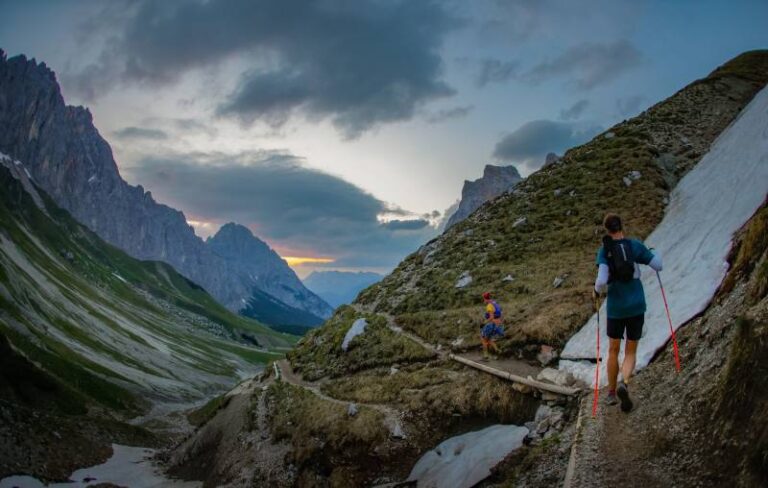
An Oh Meu Deus training plan prepares you for Portugal’s most mountainous race: Oh Meu Deus – Center Of Portugal by UTMB crosses the Serra da Estrela and surrounding ranges, up to Torre, the highest point in mainland Portugal. With 8900 m of climbing on the 100M, the name (“Oh my God”) is well earned. Here is how to train for the four races.
The short answer
- Allow 10 to 12 weeks for the 20K, 14 to 16 weeks for the 50K, 5 to 6 months for the 100K and 6 to 12 months for the 100M.
- Indicative peak load: 40 to 60 km and 1500 to 2500 m of climbing per week for the shorter races, 60 to 90 km and 3000 to 4500 m for the 100K and 100M.
- Key sessions: long power-hiking climbs, technical descents, long mountain runs and back-to-back weekends.
- Number one challenge: a very high climbing ratio (over 50 m per km on the 100M) and technical descents such as the Loriga glacial valley.
Contents
Oh Meu Deus distances and elevation
Oh Meu Deus by UTMB takes place between late April and early May in central Portugal. Figures come from the official Oh Meu Deus website; check them before race day.
| Race | Distance | Elevation gain | Profile/notes |
|---|---|---|---|
| Oh Meu Deus 100M (100M category) | 167 km | 8900 m | Climb to Torre then a technical descent of the Loriga glacial valley; 44-hour limit; 4 Running Stones |
| Oh Meu Deus 100K (100K category) | 94 km | 5300 m | Demanding mountain ultra; 3 Running Stones |
| Oh Meu Deus 50K (50K category) | 52 km | 2900 m | 2 Running Stones |
| Oh Meu Deus 20K (20K category) | 22 km | 1000 m | Entry-level format; 1 Running Stone |
The site describes a course through the Serra da Estrela, a UNESCO Global Geopark and Biosphere Reserve, and the Açor and Lousã ranges, schist villages and historic villages: Roman roads, transhumance paths, quartzite crags, deep valleys and farming terraces. In spring, expect cool conditions up high and milder valleys.
What makes Oh Meu Deus so demanding
Climbing first: 8900 m over 167 km on the 100M and 5300 m over 94 km on the 100K mean long climbs followed by long, technical descents. Terrain second: Roman cobbles, schist paths, quartzite rock and terrace tracks mean your foot never lands the same way twice. The site highlights the technical, demanding descent of the Loriga glacial valley after Torre. On the 100M, plan for one or two nights out depending on your level, so sleep and fuelling management matter as much as fitness.
How long do you need to prepare?
The 20K takes 10 to 12 weeks if you already run trails. The 50K needs 14 to 16 weeks and a previous 30 km mountain race with at least 1500 m of climbing. The 100K calls for 5 to 6 months after at least one ultra over 50 km with big climbing. The 100M needs 6 to 12 months and experience of at least one mountain 100 km or an effort lasting over 20 hours. Our guide to increasing distance in trail running explains how to progress.
The phases of your training plan
Base phase. Easy running, one quality session per week and two strength sessions (squats, lunges, box step-ups, core, balance). With a spring race, this phase usually falls in winter: build your base and strength without chasing climbing.
Specific phase. Increase climbing gradually with long climbs, technical descents and multi-hour mountain runs, plus a lighter week every three or four weeks. For the 100K and 100M, add back-to-back weekends and night runs.
Taper. One to three weeks depending on the race, cutting volume by 30 to 50% and keeping a few short efforts.
Key sessions for Oh Meu Deus
Long power-hiking climbs: for example 3 to 4 x 15 to 20 minutes uphill at a sustained effort, mixing running and fast hiking.
Technical descents: repeated descents on rocky trails, then long descents at the end of a run on tired legs.
Long mountain runs: 4 to 7 hours for the ultras, testing fuelling and kit.
Back-to-back weekends: two long runs on consecutive days, ideally with some night running.
The RunMotion Coach app builds your personalised plan and adapts it every week to your completed sessions, level and availability, with climbing, strength, recovery and mental preparation. RunMotion Coach is the official online coach of the UTMB World Series, and its founders, twins Guillaume and Romain Adam, come from the Alps: mountains and ultras are their home ground. Try it free for 7 days.
Plan your race strategy with Race Strategy
With so much climbing, knowing where to hold back and where to push changes everything. Race Strategy by RunMotion calculates your strategy kilometre by kilometre, with pace adjusted for elevation, altitude and terrain technicality, estimated split times at key points, a nutrition and hydration plan per section (carbs, water, sodium) and a race-day weather adjustment. Import the official GPX of your race to use it.
Running Stones and the UTMB World Series
Oh Meu Deus is part of the UTMB World Series. According to the official site, the 100M earns 4 Running Stones, the 100K 3, the 50K 2 and the 20K 1. To plan your season, see our UTMB World Series training plan guide and our article on preparing a UTMB World Series season.
FAQ
Do you need poles for Oh Meu Deus?
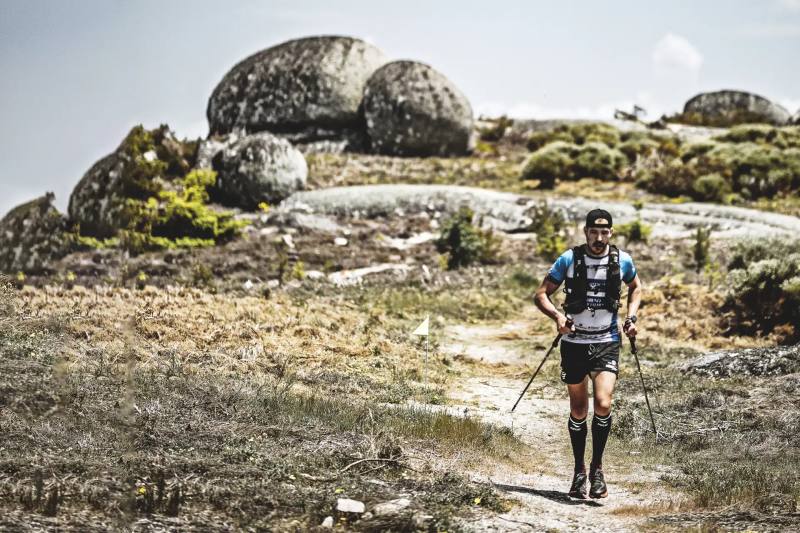
Check the official race regulations. On such long climbs they can save your legs, provided you have trained with them.
What level do you need for the Oh Meu Deus 100K?
With 5300 m of climbing over 94 km, you should have finished at least one mountain ultra over 50 km with big climbing and be comfortable on technical descents.
What is the 100M time limit?
The official site gives a 44-hour time limit for the 100M.
Conclusion
Oh Meu Deus demands strong legs, good descending technique and patience on varied terrain. Train progressively and you will enjoy the landscapes of the Serra da Estrela. For a plan that adapts to you, start your 7-day free trial of RunMotion Coach.
Article updated by the RunMotion Coach team.
Sources: ohmeudeus.utmb.world, 100M race page.