A mozart 100 training plan has to cover two very different kinds of terrain: runnable lakeside sections in the Salzkammergut and, on the flagship race, two big climbs to the Schafberg and the Zwölferhorn. The mozart 100 by UTMB, near Salzburg in Austria, offers six races from 12 km to 119 km, including a relay. Here is how to train for the mozart 100 and its shorter races, with the official figures.
The short answer
- mozart Lake Trail and Half Marathon: 8 to 12 weeks; mozart Marathon: 12 to 16 weeks; mozart Ultra and mozart 100: 5 to 8 months on a solid ultra base.
- Rough guide in the specific phase for the mozart 100: 9 to 14 hours a week and 1500 to 3000 m of elevation gain, depending on your level.
- Key sessions: steady rolling runs, long hill repeats, long hike-run days, descents.
- The main challenge: 6000 m of climbing over 119 km within a 24-hour limit. You need to run the easy sections well without burning out.
Contents
mozart 100 distances and elevation gain
Figures from the official mozart 100 by UTMB website.
| Race | Distance | Elevation gain | Profile/notes |
|---|---|---|---|
| mozart 100 | 119 km | 6000 m | 100M category, 4 Running Stones. 5 a.m. start in Fuschl am See, 24-hour limit, climbs to the Schafberg and Zwölferhorn |
| mozart Ultra | 84 km | 4800 m | 100K category, 3 Running Stones |
| mozart Ultra Relay | 84 km | 4800 m | Relay version of the mozart Ultra |
| mozart Marathon | 44 km | 1600 m | 50K category, 2 Running Stones |
| mozart Half Marathon | 28 km | 1100 m | 20K category, 1 Running Stone |
| mozart Lake Trail | 12 km | 200 m | Entry-level race, category not stated |
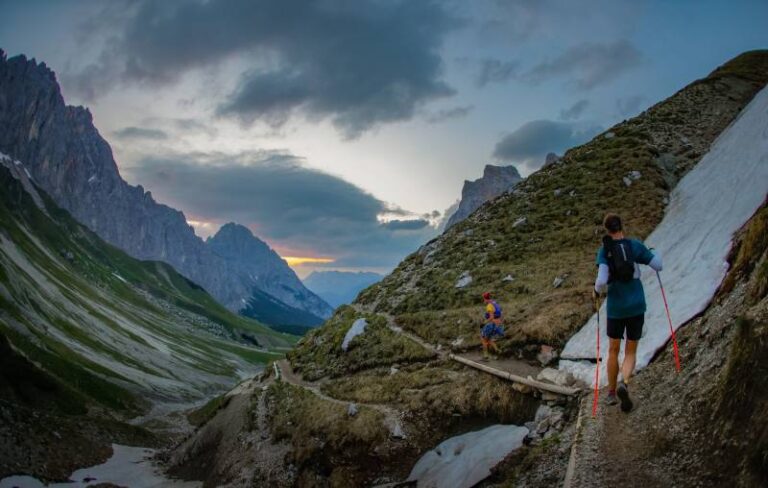
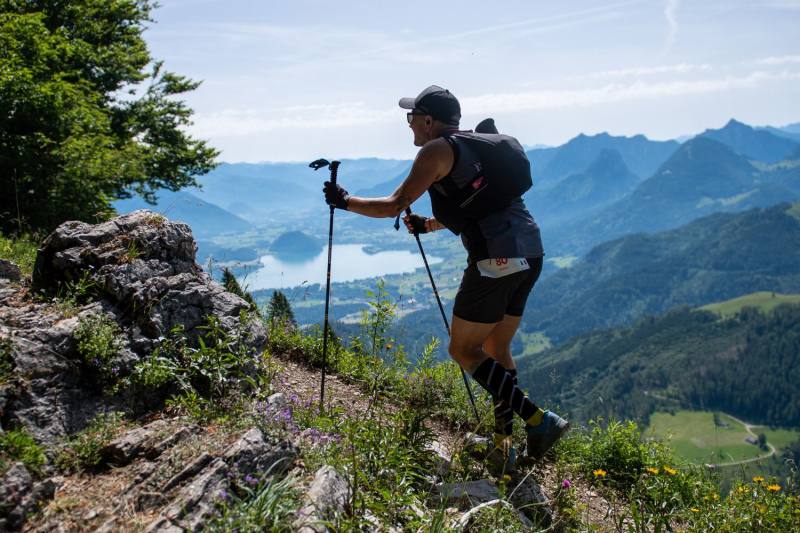
The terrain combines forest trails, lakeshores (Fuschlsee, Wolfgangsee) and steeper mountain sections. The official site describes the Schafberg and Zwölferhorn ascents as demanding, calling for endurance and sure footing. The event takes place in early June, so specific training falls in spring.
What makes the mozart 100 demanding
The time limit comes first. 119 km and 6000 m in at most 24 hours leaves limited margin for slower runners, so you need to run the flat and rolling sections efficiently, not just hike the climbs.
Then there is the variety. Switching between long runnable stretches and steep climbs draws on different qualities: running endurance, uphill power and strong descending. The classic mistake is going too fast along the lakes and then suffering on the two big climbs.
Finally, it is a long day. With a 5 a.m. start, most mozart 100 runners spend the whole day on course and some finish in the dark. Our guide on fuelling for trail and ultra races helps you build a strategy that lasts.
How long do you need to train?
For the Lake Trail, a few weeks of regular running is enough. For the Half Marathon (28 km, 1100 m), allow 8 to 12 weeks if you already run two or three times a week.
For the mozart Marathon, 12 to 16 weeks is a good benchmark. With 1600 m over 44 km, you will run a lot, so steady running endurance matters as much as climbing.
For the mozart Ultra and mozart 100, plan 5 to 8 months including 12 to 16 specific weeks, with a 50 km+ race already completed. Our guide to increasing your trail distance explains how to step up. These are benchmarks, not guarantees.
The phases of your training plan
Base building
Easy aerobic volume, one quality session a week (intervals or hills) and two strength sessions. Keeping some basic speed is useful here: the mozart 100 rewards runners who can run for a long time at moderate pace.
Specific phase
Over the last 10 to 12 weeks, gradually extend long runs and elevation. Alternate long runnable outings with mountain days featuring big climbs to mirror the course.
Taper
Two to three weeks of reduced volume (30 to 50 %), a few pace reminders and good sleep before a very early start.
Key workouts for the mozart 100
Steady rolling runs: 1 h 30 to 2 hours on runnable terrain with sections at a sustained but comfortable effort. This teaches you to move fast on easy ground without draining your reserves.
Long hill repeats: 3 to 5 climbs of 10 to 15 minutes at a controlled effort, to prepare for the Schafberg and Zwölferhorn.
Long hike-run days: 4 to 6 hours with 1500 to 2500 m of climbing, running the flats and hiking the steep parts, with race nutrition.
Descents: one session a week in the specific phase to prepare your quads for the long late-race descents.
The RunMotion Coach app builds this plan for you and adjusts it every week based on completed sessions, level and availability, including elevation, strength and recovery. RunMotion Coach is the official online coach of the UTMB World Series, and its founders, twin brothers Guillaume and Romain Adam, come from the Alps: mountains and ultras are their home ground. Try the app free for 7 days.
Plan your race strategy with Race Strategy
With a tight time limit, knowing where you stand at each key point is invaluable. Race Strategy by RunMotion calculates your race plan kilometre by kilometre, with pace adjusted for elevation, altitude and technical terrain, estimated split times at key points and a fuelling and hydration plan per section (carbohydrates, water, sodium). Import the official course GPX from the race website, then adjust for race-day weather to check your goal fits within the limit.
Running Stones and the UTMB World Series
The mozart 100 is part of the UTMB World Series. According to the official site, the mozart 100 earns 4 Running Stones, the mozart Ultra 3, the Marathon 2 and the Half Marathon 1, improving your chances in the lottery for the Finals in Chamonix. For season planning, see our UTMB World Series training plan guide and our article on succeeding at UTMB with a personalised plan.
FAQ
Are poles allowed at the mozart 100?
Check the official race regulations. On the mozart 100 and mozart Ultra they help on the two big climbs, but get in the way on runnable sections, so practise stowing them quickly.
What level do you need for the mozart 100?
A first 50 to 80 km race with real climbing is a sensible prerequisite. The 24-hour limit also demands the ability to keep running on flat ground after many hours.
Is the mozart Marathon a good first long trail race?
With 44 km and 1600 m of climbing, it is accessible if you have already run a 20 to 30 km trail race. It is more runnable than the long races and closer to a continuous running effort.
Conclusion
The mozart 100 calls for an all-round runner: steady on the flat, strong uphill, comfortable downhill. Choose your race according to your experience, train on varied terrain and test your nutrition well before race day. Start your free RunMotion Coach trial.
Article updated by the RunMotion Coach team.
Sources: