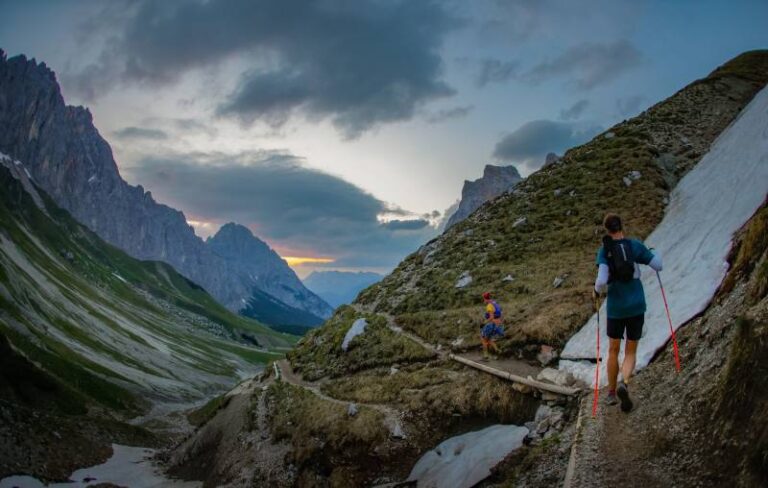
A Lavaredo Ultra Trail training plan has to prepare you for the Dolomites: long climbs, rocky descents and, on the longer races, a night start from Cortina d’Ampezzo. La Sportiva Lavaredo Ultra Trail by UTMB offers five races, from 10 km to 120 km, all around the Tre Cime di Lavaredo. Here is how to train for Lavaredo, race by race, with the official figures and the workouts that matter.
The short answer
- 20K: 8 to 12 weeks of focused training if you already run regularly; 50K: 12 to 16 weeks; 80K and 120K: 5 to 8 months on top of a solid ultra base.
- Rough guide in the specific phase for the 80K or 120K: 8 to 14 hours of training per week and 1500 to 3000 m of elevation gain, adjusted to your level and history.
- Key sessions: long hill repeats, long hike-run outings, downhill practice, back-to-back weekends.
- The main challenge: the 120K starts on Friday at 11 p.m. with a 30-hour time limit, so night running, fuelling and tired technical descents all need training.
Contents
Lavaredo Ultra Trail distances and elevation gain
These figures come from the official Lavaredo Ultra Trail by UTMB website.
| Race | Distance | Elevation gain | Profile/notes |
|---|---|---|---|
| Lavaredo 120K | 120 km | 5800 m | 100M category, 4 Running Stones. Start and finish in Cortina, night start, 30-hour limit |
| Lavaredo 80K | 80 km | 4600 m | 100K category, 3 Running Stones. Start in Val Marzon (Auronzo di Cadore), finish in Cortina, 22-hour limit |
| Lavaredo 50K | 50 km | 2600 m | 50K category, 2 Running Stones. Loop around Cortina, 12-hour limit |
| Lavaredo 20K | 20 km | 1000 m | 20K category, 1 Running Stone. Steep climbs and technical descents, 4-hour limit |
| Lavaredo 10K | 10 km | 300 m | Entry-level race, category not stated |
The courses stay within a UNESCO World Heritage mountain range, mixing mountain paths, scree, forest tracks and a few faster sections. The event usually takes place in late June, so most of your specific training happens in spring. Check the official regulations for the maximum altitude and the mandatory gear list.
What makes Lavaredo demanding
Night comes first. The 120K starts late on Friday evening, so you begin climbing after a full day of waiting and run through the night until sunrise near the Tre Cime.
Then there is the ratio of distance to climbing. At 5800 m over 120 km, the 120K is more runnable than a very steep alpine 100K, and many runners go out too fast on the easier sections. Their quads pay for it later on the long descents. The 80K is denser, with 4600 m over 80 km and a 22-hour limit.
Self-sufficiency matters too. The race pages mention water points such as fountains and streams between aid stations, and ask runners to bring their own cup and cutlery. Your long runs should be done carrying what you will carry on race day.
How long do you need to train?
For the 10K and 20K, 8 to 12 weeks is enough if you already run two or three times a week and have some mountain experience. On the 20K, comfort on technical descents is what makes the difference.
For the 50K, allow 12 to 16 weeks. Ideally you have already finished a 30 to 40 km trail race with real climbing, so you know how your body behaves after five or six hours.
For the 80K and 120K, plan 5 to 8 months, with 12 to 16 weeks of truly specific work. Previous experience over 50 to 80 km in the mountains is strongly recommended before the 120K. Our guide to increasing your distance safely explains how to make that jump. These are benchmarks, not guarantees.
The phases of your training plan
Base building (winter)
Build aerobic volume at easy effort without chasing elevation at all costs. Add strength work twice a week, with squats, lunges, core and eccentric quad exercises, plus one quality session such as short intervals or hill repeats. Treadmill incline, stairs or cycling can fill the gaps if snow keeps you off the trails.
Specific phase (spring)
In the 10 to 12 weeks before the race, increase weekly elevation gain gradually and make your long runs look like the course: long climbs, rocky descents, power hiking with or without poles. Test your food, drinks and gear in real conditions, including at night for the long races.
Taper
Over the last two to three weeks, reduce volume by 30 to 50 % while keeping a few short, sharp efforts. For the 120K, sleep in the final days becomes a priority because the race starts late in the evening.
Key workouts for Lavaredo
Long hill repeats: 3 to 5 climbs of 10 to 15 minutes at a strong but controlled effort, jogging or walking back down. They build the uphill strength you need for the long climbs.
Long hike-run sessions: 4 to 7 hours on mountain terrain, running the flats and descents and power hiking the steep sections. This is the session that teaches you to keep going.
Downhill practice: once a week in the specific phase, repeated descents on rocky ground at progressively faster speeds. Your quads adapt, and so does your technique.
Back-to-back weekends: two long runs on consecutive days, for example 4 hours on Saturday and 3 hours on Sunday, so your legs learn to run tired without one huge session.
| Day | Sample specific week (80K or 120K, intermediate runner) |
|---|---|
| Monday | Rest or mobility |
| Tuesday | Hill repeats: 4 × 12 minutes uphill, easy descent recovery |
| Wednesday | Easy 1-hour run + strength work |
| Thursday | 1 h 15 rolling run with 6 fast descents |
| Friday | Rest |
| Saturday | 5-hour mountain long run, hike-run, fuelling test |
| Sunday | Back-to-back 2 h 30 at easy effort |
The RunMotion Coach app builds this kind of plan for you and adjusts it every week based on the sessions you complete and the time you have, with elevation gain built in. RunMotion Coach is the official online coach of the UTMB World Series, and its founders, twin brothers Guillaume and Romain Adam, come from the Alps: mountains and ultras are home ground for them. You can try the app free for 7 days.
Plan your race strategy with Race Strategy
On a course like the 120K, going out ten minutes too fast in the first hours costs a lot at dawn. Race Strategy by RunMotion calculates your race plan kilometre by kilometre, with pace adjusted for elevation, altitude and technical terrain. You get estimated split times at key points and a fuelling and hydration plan for each section (carbohydrates, water, sodium).
You can import the official course GPX from the race website, then fine-tune the plan with the race-day weather adjustment.
Running Stones and the UTMB World Series
Lavaredo is part of the UTMB World Series. According to the official site, finishing earns 4 Running Stones on the 120K, 3 on the 80K, 2 on the 50K and 1 on the 20K, which increase your chances in the lottery for the Finals in Chamonix. To plan a full season around these races, see our UTMB World Series training plan guide and how to plan your trail running season.
FAQ
Are poles allowed at Lavaredo?
Check the official race regulations to see whether poles are allowed. On the 80K and 120K they help a lot on long climbs, as long as you have trained with them.
What level do you need for the Lavaredo 120K?
There is no universal minimum, but a first 100 km+ race without mountain experience is rarely a good idea. Having finished one or more 50 to 80 km mountain races gives you reliable benchmarks for fuelling and pacing.
How many hours a week should you train for Lavaredo?
In trail running, time on feet and elevation gain matter more than kilometres. For the 50K, 5 to 8 hours a week in the specific phase is a common benchmark; for the 80K and 120K, closer to 8 to 14 hours, always built up gradually.
Conclusion
Training for Lavaredo means learning to last in the mountains, to descend on rocky ground and, for the 120K, to run through the night. Pick your race according to your experience, give yourself time to build a base, and test everything in training. For a personalised plan that adapts to your life, start your free RunMotion Coach trial.
Article updated by the RunMotion Coach team.
Sources: