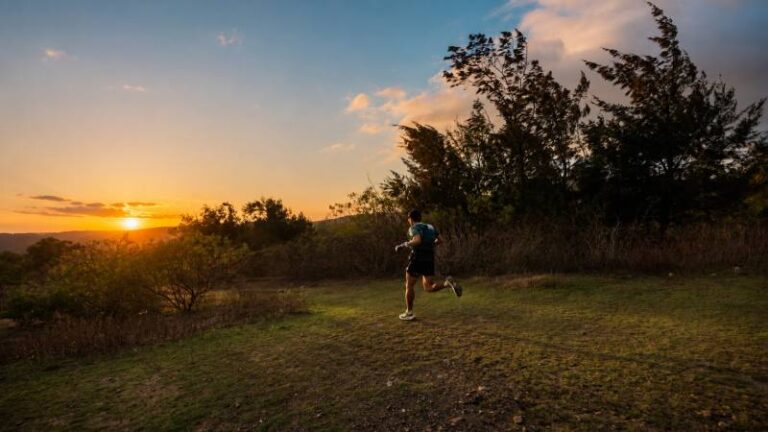
A Kullamannen training plan looks nothing like one for a mountain ultra. This trail race in Skåne, southern Sweden, is held in the autumn, largely at night, on coastal trails with little climbing but technical sections on the Kullaberg massif, sea wind and cold. Here is how to train for Kullamannen, from the 22 km to the 100 miles.
The short answer
- Allow 10 to 12 weeks for North Shore, 14 to 16 weeks for Seventh Seal, 5 to 6 months for the Sprint Ultra and 6 to 12 months for the Ultra 100 Miles.
- Indicative peak volume: 40 to 60 km per week for the short races, 70 to 100 km for the ultras; climbing matters little, the ability to run for a long time matters a lot.
- Key sessions: long runs that are mostly running, threshold work, night runs, back-to-back weekends and training in cold, windy weather.
- Number one challenge: darkness and autumn weather on a course where you run almost all the time.
Contents
Kullamannen distances and elevation
Kullamannen by UTMB takes place in late October or early November between Höganäs, Kullaberg and Båstad. Figures come from each race page on the official Kullamannen website; where the site is inconsistent, we flag it.
| Race | Distance | Elevation gain | Profile/notes |
|---|---|---|---|
| Ultra 100 Miles (100M category) | 173 km | 2020 m | Evening start at Höganäs Church, finish in Båstad; 32-hour time limit |
| Sprint Ultra (100K category) | 108 km | 749 m | Night start, finish in Båstad; 28-hour limit; 3 Running Stones |
| Seventh Seal (50K category) | 53 km | 727 m | Starts in Båstad, climbs the Hallandsåsen ridge then follows the coast; 10-hour limit; 2 Running Stones |
| North Shore | 22 km | 96 m | Beachside paths and pine forest; 4-hour limit |
| Legacy Run | about 16.5 km | not published | Untimed charity run, not a race |
The profile is mostly flat to rolling. For the 100 miles, the site describes a relatively flat course with technical single track on Kullaberg, through 15 nature reserves, and warns of south-westerly gales and long hours of darkness. Kids races also take place in Höganäs and Båstad.
What makes Kullamannen so demanding
Low elevation is deceptive. In a mountain ultra, climbs force walking breaks that rest your muscles. Here you run almost all the time, which wears your legs down differently and demands real running endurance. The 100-mile race page mentions a DNF rate of 40 to 60%. Night and weather are the other challenge: the 100 miles starts in the evening and the Sprint Ultra at night, so you spend long hours by headtorch, in cold, wind and sometimes rain, reaching the technical Kullaberg trails with tired legs and a tired mind.
How long do you need to prepare?
North Shore takes 8 to 12 weeks if you already run regularly. Seventh Seal needs 14 to 16 weeks and previous experience of a half marathon or a 30 km trail. The Sprint Ultra takes 5 to 6 months and at least one finished ultra over 50 km. The Ultra 100 Miles needs 6 to 12 months and experience of at least one 100 km race or an effort lasting more than 15 hours, ideally including a full night. Our guide to increasing distance in trail running explains how to build up.
The phases of your training plan
Base phase. Lots of easy running, one or two quality sessions a week (intervals and threshold) and strength work. For Kullamannen, this running base matters more than for an Alpine ultra.
Specific phase. Lengthen your long runs while running most of the time, add threshold sessions and blocks at goal race pace. For the ultras, add back-to-back weekends and several night runs, testing headtorch, windproof layers and cold-weather fuelling. Keep some technical trail work for Kullaberg.
Taper. One to three weeks depending on the race, cutting volume by 30 to 50% with a few short pace reminders.
Key sessions for Kullamannen
The running long run: on flat to rolling ground, running almost all the time at easy pace, building to 4 to 6 hours for the 100 miles. You can train effectively far from the mountains.
Threshold: for example 3 x 10′ at threshold (a hard but controlled effort you could hold for about an hour), 3′ recovery, to hold a steady pace for longer.
Night runs: running by headtorch takes practice, both for footing and for your sleep-wake rhythm.
Back-to-back: for the ultras, an evening long run finishing in the dark, then another run the next morning.
The RunMotion Coach app builds a personalised plan that adjusts every week to your completed sessions, level and availability, with strength, recovery and race nutrition advice. RunMotion Coach is the official online coach of the UTMB World Series, and its founders, twin brothers Guillaume and Romain Adam, come from the Alps: ultra running is their home ground. Try it free for 7 days.
Plan your race strategy with Race Strategy
On a flat course, the temptation to start too fast is strong. Race Strategy by RunMotion calculates your strategy kilometre by kilometre, with pace adjusted for elevation, altitude and terrain technicality, estimated split times at key points and a nutrition and hydration plan per section (carbs, water, sodium). Import the official GPX of your race and apply the race-day weather adjustment, invaluable when the wind picks up.
Running Stones and the UTMB World Series
Kullamannen is part of the UTMB World Series. According to the official site, the Sprint Ultra earns 3 Running Stones and Seventh Seal 2. To plan your season, see our UTMB World Series training plan guide and our article on preparing a UTMB World Series season.
FAQ
Do you need poles for Kullamannen?
Check the official race regulations. With so little climbing, they are rarely useful and most runners go without.
Can you train for Kullamannen without mountains?
Yes, it is one of the few races on the circuit where that really works. Focus on long runs, night running and bad weather, plus some technical trail practice for Kullaberg.
How many km per week for the Kullamannen 100 miles?
At peak, 70 to 100 km per week for most runners, depending on your history. Consistency and recovery matter more than one record week.
Conclusion
Kullamannen demands running endurance, tolerance of cold and darkness, and patient pacing. Train accordingly, without neglecting technique for Kullaberg. For a plan that adapts to you week after week, start your 7-day free trial of RunMotion Coach.
Article updated by the RunMotion Coach team.
Sources: kullamannen.utmb.world, Ultra 100 Miles, Sprint Ultra, Seventh Seal, North Shore, Legacy Run.