A Kaga Spa Trail Endurance 100 by UTMB training plan prepares you for Japanese mountain trails starting from the hot springs of Yamanaka Onsen, in Kaga City, Ishikawa Prefecture. Three races take place in June, from 20.7 to 97.4 km, and the 100K starts in the evening. Here are the official figures for each race and how to train for Kaga Spa with confidence.
The short answer
- Allow 8 to 12 weeks for the 20K, 14 to 16 for the 50K and 20 to 24 for the 100K, from a regular running base.
- Indicative peak weeks: 40 to 60 km and 1500 to 2500 m of climbing for the 50K, 70 to 90 km and 3000 to 4500 m for the 100K.
- Key sessions: long climbs, technical descents, a long night run and preparation for humid heat.
- The defining feature: a 100K with 5122 m of gain that starts in the evening, meaning a full night on steep mountain trails.
Contents
Kaga Spa Trail Endurance distances and elevation gain
The event takes place in June around Yamanaka Onsen. Figures come from each race page on the official Kaga Spa Trail Endurance website.
| Race | Distance | Elevation gain | Profile / notes |
|---|---|---|---|
| KAGASPA 100K | 97.4 km | 5122 m | 100K category, 3 Running Stones; evening start from Yamanaka Onsen, 27 h limit |
| KAGASPA 50K | 56.8 km | 2607 m | 50K category, 2 Running Stones; 14 h limit, via Mt Kariyasu and Kutani Dam |
| KAGASPA 20K | 20.7 km | 649 m | 20K category, 1 Running Stone; starts at Kenmin no Mori, 6 h limit |
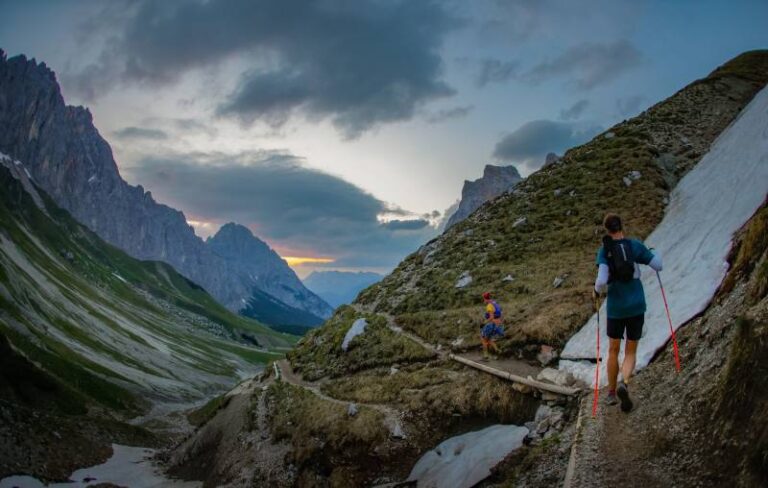
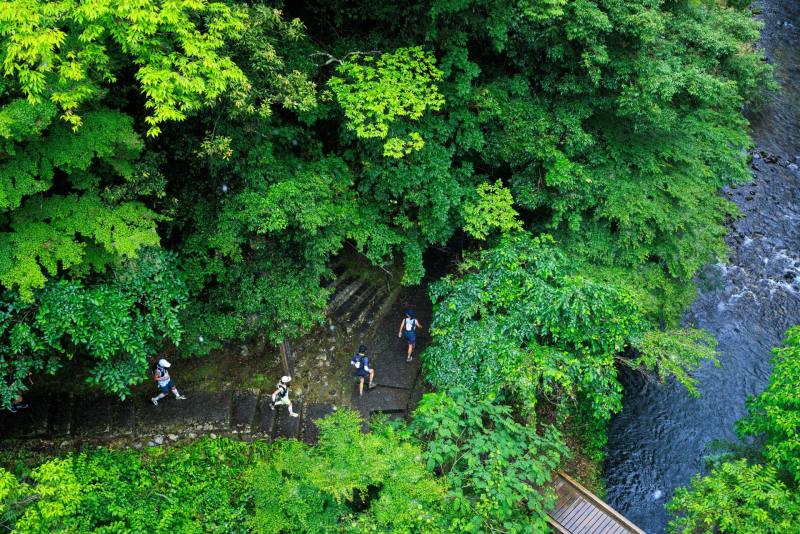
The organisers describe steep mountain trails, singletrack along a mountain stream and scenic ridgeline paths, through often misty forests and the Kanan Sanzan mountains. The 100K and 50K start and finish in Yamanaka Onsen; the 20K runs from Kenmin no Mori to Yamanaka Onsen. No maximum altitude is published, so focus on climbing density: more than 52 m of gain per kilometre on the 100K. June usually falls in Japan’s rainy season, so expect humid warmth and potentially slippery trails.
What makes Kaga Spa demanding
The 100K stacks three challenges. The climbing is substantial, on steep slopes where power hiking takes over. The evening start means running through the entire first night with a day’s fatigue already in your legs, then staying sharp at dawn when your body wants sleep. And the terrain, with roots, forest sections and descents, turns technical as soon as it rains.
On the 50K, the 14-hour limit gives a prepared runner some margin, but 2607 m over about 57 km is a real mountain race. The 20K is more runnable and makes a good first UTMB World Series experience, as long as you work on your descending.
How long should you train?
KAGASPA 20K: 8 to 12 weeks, three sessions a week including one on hills.
KAGASPA 50K: 14 to 16 weeks, after a trail race of around 30 km. If this is a step up, our guide to increasing trail distance will help you progress safely.
KAGASPA 100K: 20 to 24 weeks, with at least one mountain 50K finished and some night-running experience.
The phases of your training plan
Base. Easy aerobic volume, one quality session a week and two strength sessions. For a June race this phase runs through winter and early spring: use an inclined treadmill and stairs if you lack hills.
Specific. For eight to ten weeks, weekly climbing increases and long runs move to the mountains, with your race nutrition. For the 100K, start at least two long runs in the evening to rehearse the night. A lighter week every three or four weeks helps you absorb the load. Our article on fuelling for trail and ultra races will help you test your nutrition.
Taper. Two weeks for the 20K and 50K, three for the 100K. Volume drops while a few short efforts remain. If you are flying in from another continent, plan around jet lag and your sleep rhythm, especially before an evening start.
Key workouts for Kaga Spa
Long climbs. 3 to 5 reps of 8 to 12 minutes uphill, mixing running and brisk hiking depending on gradient. You build climbing endurance and the ability to hold a steady effort.
Technical descents. One session a week on uneven ground, occasionally in wet conditions to learn how to handle slippery footing.
Long night run. For the 100K, head out in the evening for 3 to 5 hours with climbing, headlamp and race food. You test lighting, sleep management and focus.
Humid heat preparation. In the final weeks, a few easy runs in warm conditions or with an extra layer help your body cope with heat. Progress carefully and drink regularly.
Want a plan built and adjusted for you? The RunMotion Coach app, the official online coach of the UTMB World Series, adapts your trail or ultra plan every week to the sessions you complete, your level and your availability, with strength and recovery included. Try it free for 7 days.
Build your race plan with Race Strategy
On a night 100K, knowing when you will reach each aid station helps you plan lighting, clothing and food. Race Strategy by RunMotion calculates a kilometre-by-kilometre plan with pace adjusted for gradient, altitude and technicality, and estimates split times at key points. Import the official GPX of your race to also get a section-by-section fuelling and hydration plan (carbs, water, sodium), adjusted to race-day weather.
Running Stones and the UTMB World Series
Kaga Spa awards 3 Running Stones for the 100K, 2 for the 50K and 1 for the 20K. To fit it into a season, read our UTMB World Series training guide, and if Chamonix is your long-term goal, our advice on preparing for UTMB with a personalised plan.
FAQ
Are poles allowed at Kaga Spa Trail Endurance?
Check the rules and gear list for your race. On the steep climbs of the 100K they often help, provided you have trained with them.
What level do you need for the KAGASPA 100K?
A mountain 50K finished in good shape, a first night of racing and a tested nutrition plan. With a 27-hour limit, pacing matters more than speed.
How many kilometres a week for the KAGASPA 50K?
At peak, 40 to 60 km with 1500 to 2500 m of climbing is a common guideline for amateur runners. Your history and available time remain the real deciding factors.
Final thoughts
Kaga Spa calls for strong climbing legs, comfort at night and patience on wet ground. Mountains, vertical gain and ultras are home ground for RunMotion: our founders, twin brothers Guillaume and Romain Adam, come from the Alps. Start your free trial.
Article updated by the RunMotion Coach team.
Sources
- kagaspa.utmb.world (races, Running Stones)
- KAGASPA 100K official page
- KAGASPA 50K official page
- KAGASPA 20K official page