Your Hiroshima Ultra-Trail by UTMB training plan has to prepare you for an unusual course: it starts and finishes in the heart of the city, and in between it climbs the steep ring of mountains around the Hiroshima delta. Three races run in spring, from 24.7 to 94.6 km, and this guide explains how to train for each of them.
The short answer
- Allow 10 to 12 weeks for the 25K, 14 to 16 for the 50K and 20 to 24 for the 100K, starting from a regular running base.
- Indicative peak weeks: 40 to 60 km and 1500 to 2500 m of climbing for the 50K, 70 to 90 km and 3000 to 4500 m for the 100K.
- Key sessions: long threshold hills, repeated technical descents, rollercoaster long runs and eccentric strength.
- The defining feature: a very high climbing ratio (about 59 m per km on the 100K), framed by flat city and riverside sections at the start and finish.
Contents
Hiroshima Ultra-Trail distances and elevation gain
The event takes place in April. Figures below come from the homepage of the official race website.
| Race | Distance | Elevation gain | Profile / notes |
|---|---|---|---|
| HIROSHIMA 100K | 94.6 km | 5587 m | 100K category, 3 Running Stones; early-morning start, 29 h limit, high point close to 900 m on Mt Shiraki |
| HIROSHIMA 50K | 48.7 km | 2755 m | 50K category, 2 Running Stones; summits above 800 m |
| HIROSHIMA 25K | 24.7 km | 873 m | 20K category, 1 Running Stone; held the day after the longer races |
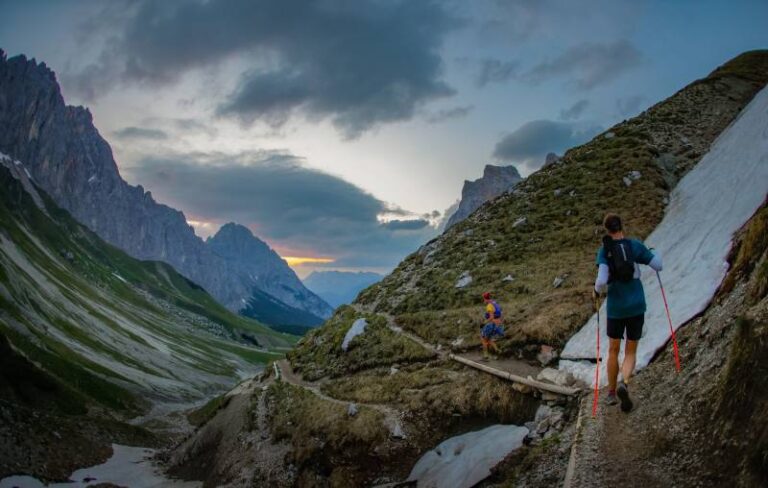
The 100K leaves central Hiroshima along the Ota River, passes a shrine carved into the rock beside a sacred waterfall, then strings together the peaks around the delta. The high point approaches 900 m on Mt Shiraki, with a second big climb on Mt Abu. The organisers describe ridgelines, steep climbs, technical descents and long forest roads, before a flat riverside return and a finish on the Peace Line beneath the A-Bomb Dome. Altitude is modest: the difficulty comes from accumulation.
What makes Hiroshima demanding
Don’t be fooled by summits below 1000 m. With 5587 m of gain over 94.6 km, the 100K has a climbing ratio close to some alpine ultras, spread over countless short, sharp ups and downs. You climb, drop almost back to the valley, and go again. Your quads take a beating, and the real race starts in the second half.
The course also mixes very runnable sections (riverside paths, forest roads) with technical ground. You need to be able to run properly on the flat after hours of climbing, which takes solid general endurance, not just climbing legs. And with an early start and a 29-hour limit, many runners on the 100K will finish in the dark.
How long should you train?
HIROSHIMA 25K: 10 to 12 weeks with three sessions a week, one of them on hills. A great entry point into the UTMB World Series.
HIROSHIMA 50K: 14 to 16 weeks, after a first 25 to 30 km trail race.
HIROSHIMA 100K: 20 to 24 weeks, with at least one 50K finished in good shape. If that is a big jump for you, read our guide on increasing trail distance safely.
The phases of your training plan
Base. With an April race, much of your base phase falls in winter. Accumulate easy aerobic volume, keep one quality session a week and add two strength sessions. If snow or short days limit mountain runs, an inclined treadmill and stairs do the job well.
Specific. Over eight to ten weeks, increase weekly climbing, move long runs onto rollercoaster terrain and finish some of them with 20 to 30 minutes of steady running on the flat to mimic the return to the city. Alternate loading weeks with lighter ones. Our article on the specifics of a trail running training plan goes deeper.
Taper. Two weeks for the 25K and 50K, three for the 100K. Cut volume, keep a few short efforts and protect your sleep, especially if you are travelling across time zones.
Key workouts for Hiroshima
Long threshold hills. 4 to 6 reps of 6 to 8 minutes uphill at a hard but controlled effort (threshold is roughly what you could hold for an hour).
Repeated descents. Climb easily, descend fast but relaxed, several times in a row. That is exactly the pattern of the course.
Rollercoaster long run. 3 to 6 hours depending on your race, on terrain that never stops going up and down, with your race fuel. For the 100K, stack two long days from time to time.
Eccentric strength. Lunges, slow squats, step-downs. Bodyweight or loaded, they prepare your quads for repeated downhills.
For a plan that fits your level and schedule, the RunMotion Coach app, the official online coach of the UTMB World Series, builds your trail or ultra preparation and adjusts it every week based on the sessions you complete. Try it free for 7 days.
Build your race plan with Race Strategy
Between flat city sections and steep climbs, the gap between your fastest and slowest kilometres is huge. Race Strategy by RunMotion calculates a kilometre-by-kilometre plan with pace adjusted for gradient, altitude and terrain, and estimates your split times at key points. Import the official GPX to get a section-by-section fuelling and hydration plan (carbs, water, sodium), adjusted to race-day weather.
Running Stones and the UTMB World Series
Hiroshima awards 3 Running Stones for the 100K, 2 for the 50K and 1 for the 25K. To build a full season around the circuit, see our UTMB World Series training plan guide and our tips on planning your trail running season.
FAQ
Are poles allowed at Hiroshima?
Check the official mandatory gear page. They can help on the climbs, but the runnable sections can make them a burden at times.
What level do you need for the HIROSHIMA 100K?
A 50K finished in good shape, confident descending and experience of long runs with lots of climbing. The climbing ratio makes it a demanding 100K, not an easy first ultra.
The races are full: what now?
The official site listed all three races as full with a waitlist, with freed places offered in order. Start training anyway: the work will carry over to another race on the circuit.
Final thoughts
Hiroshima demands legs that can handle climb after climb, then still run to the Peace Line. Mountains, vertical gain and ultras are home ground for RunMotion: our founders, twin brothers Guillaume and Romain Adam, come from the Alps. Start your 7-day free trial.
Article updated by the RunMotion Coach team.
Sources
- hiroshima.utmb.world (races, distances, elevation gain, Running Stones)
- HIROSHIMA 100K official page