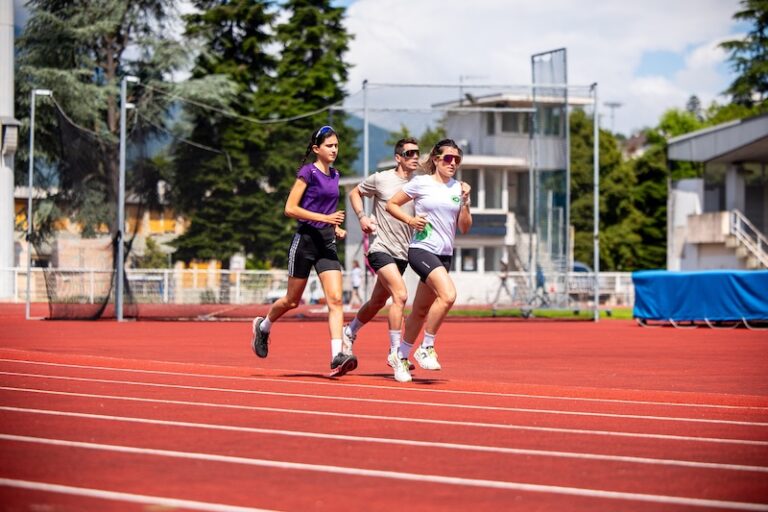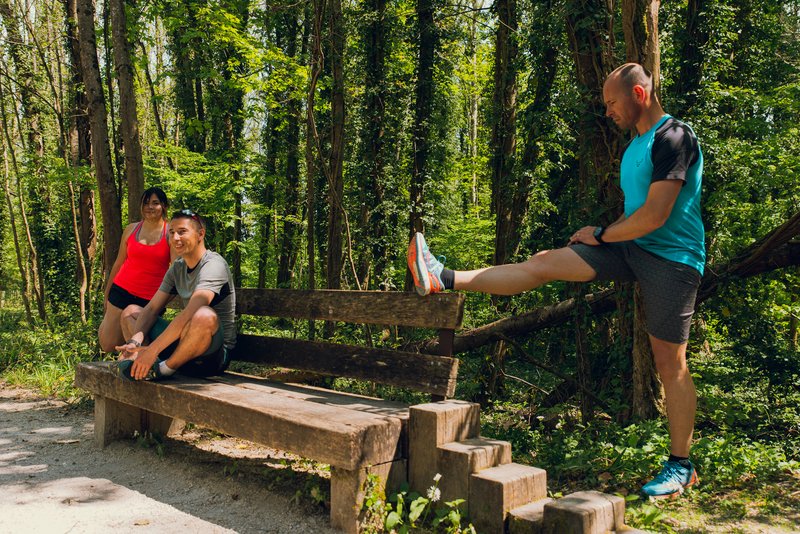
Do you spend your days sitting down, and do the first few kilometres of every easy run feel like a slow warm-up for stiff joints? Mobility for runners is your joints’ ability, starting with your hips, to move freely and under control through the full range your stride needs. A few well-placed minutes before you run and on rest days are often enough to make your stride feel smoother, as long as you don’t expect miracles.
The short answer
- Mobility is the range of motion you actively control; flexibility is your passive range.
- The hip is the runner’s key joint: it lets your leg travel behind you without your lower back compensating.
- Before running, choose 5 to 8 minutes of dynamic mobility over long static stretches.
- Stretching alone doesn’t prevent injuries: always pair mobility with strength training.
- For guided sessions, the Stretching module in the RunMotion Coach app offers more than 50 video exercises, including hip mobility to do before you run.
- Pain that keeps coming back needs a health professional, not a stretching routine.
Contents
- Mobility, flexibility, stretching: what’s the difference?
- Why the hip is the runner’s key joint
- The most common hip problems in runners
- What the science says (and doesn’t say) about mobility
- Before, after, rest days: when should you work on mobility?
- Pre-run hip mobility routine (8 minutes)
- Rest days: going further into your range
- Mistakes to avoid
- Mobility and strength: the right combination for your hips
- FAQ
- In short
- Sources
Mobility, flexibility, stretching: what’s the difference?
These three words are often used interchangeably, but they don’t mean the same thing. Flexibility is the range a joint can reach passively, for example when someone pushes your leg or you pull it with a strap. Mobility is the range you can reach and control with your own muscles. Stretching is just one tool among others to work on either.
For a runner, mobility is what counts. You never need to do the splits on a run, but you do need your hip to open and close smoothly, thousands of times per run, without other parts of your body stepping in to compensate. A very flexible joint that you can’t control does nothing for your stride.
Why the hip is the runner’s key joint
With every stride, your hip flexes to bring your knee forward, then extends to push behind you. It also rotates slightly and, throughout the single-leg stance phase, keeps your pelvis stable. It’s the central hinge of your running.
When hip extension (the ability to take your thigh behind your body) is limited, your body finds another way. Most often, the pelvis tips forward and the lower back arches to finish the movement. A study of 14 elite runners running at 20 km/h (about 12.4 mph) found that those with the least hip extension at the end of stance showed more forward pelvic tilt (Schache et al., 2000).
The interesting detail in this study is that flexibility measured lying on a table did not predict what happened during running. In other words, what matters is not just how flexible you are at rest, but how well you use that range while moving. That’s the whole point of dynamic mobility.
The most common hip problems in runners
Stiff hips after a day at a desk
This is the most common complaint. After hours at a desk or in a car, the hip flexors (the iliopsoas and the rectus femoris, at the front of the thigh) stay in a shortened position for a long time. The result: stiffness when you set off, a stride that lacks range for the first few kilometres, then gradually loosens up. A short mobility routine before you head out often makes the start of your run more comfortable.
A stride that “pulls” behind or a back that arches
If your trailing leg feels stuck, or your lower back gets uncomfortable on long runs, limited hip extension may be part of the explanation. It’s not a certainty: fatigue, running technique and core strength play a role too. But opening up the front of the hip, then learning to push with your glutes rather than your lower back, is a simple thing to try.
A hip that lacks stability
Some runners have perfectly good range, but a pelvis that drops on the opposite side with every footstrike. Here the issue isn’t flexibility, it’s control and strength in the glutes, especially the gluteus medius on the side of the hip. More stretching won’t change anything: strength work will.
Pain: groin, buttock, side of the hip or knee
Groin pain, gluteal tendinopathy on the side of the hip, iliotibial band syndrome (pain on the outside of the knee): these problems often involve the hip region. They are usually linked to increasing training load too quickly and a lack of strength, more than to a simple lack of flexibility. Mobility can make running more comfortable, but it doesn’t treat an injury. If pain persists or comes back on every run, see a physiotherapist or a sports doctor rather than piling on more stretches.
What the science says (and doesn’t say) about mobility
It’s best to be honest here: mobility and stretching don’t have the superpowers they’re often credited with.
A systematic review of runners found no clear link between flexibility or range of motion (including at the hip) and injury risk, with very low-quality evidence (Christopher et al., 2019). A meta-analysis of controlled trials across several sports found no protective effect from stretching, while strength training programmes were associated with about two-thirds fewer injuries in the included studies (Lauersen et al., 2014).
On the performance side, a review focused on running reports that a session of static stretching just before running slightly lowers performance on average. If you really want to stretch beforehand, it recommends no more than 60 seconds per muscle group (Konrad et al., 2021).
Does that mean you should drop mobility? No. It’s still useful to get ready to run, to feel less stiff and to regain the range your stride needs. Just see it for what it is: a complement that works best alongside strength training and a well-managed training load.
Before, after, rest days: when should you work on mobility?
The right exercise depends mainly on when you do it. Before a session, the goal is to prepare your joints without making your muscles sluggish. Afterwards, it depends on how hard the session was. On rest days, you can go further into your range.
| When | What to do | Rough duration | Why |
|---|---|---|---|
| Before running | Dynamic hip mobility, controlled movements | 5 to 8 min | Prepare your joints and activate your muscles |
| After an easy run | Gentle mobility or light stretching, if you feel like it | 5 to 10 min | Cool down and relax |
| After a hard session (intervals, hills, long run) | Nothing intense: walking, very light mobility | A few minutes | Avoid adding stress to tired muscles |
| Rest day | Deeper mobility and stretching | 10 to 15 min | Gradually gain range |
Pre-run hip mobility routine (8 minutes)
Do this routine at home just before heading out, or after 2 to 3 minutes of brisk walking. Keep the movements controlled, increase the range gradually from one rep to the next, and nothing should hurt. If an exercise feels hard, simply reduce the range.
1. Front-to-back leg swings
Hold on to a wall or a tree and swing one leg forward and back, keeping your upper body upright. Start small, then make the movement bigger. Do 10 to 15 swings per leg. The idea is to open the hip in both directions without arching your back when the leg goes behind.
2. Side-to-side leg swings
Facing the wall this time, swing your leg from left to right in front of you, 10 to 15 times per leg. This works the adductors (inner thigh) and the muscles on the side of the hip.
3. Dynamic low lunge
Get into a lunge with your back knee on the floor (on a cushion if needed). Squeeze the glute of your back leg and gently draw in your belly to tilt your pelvis backwards: you should feel the front of the hip open up. Slowly shift your hips forward, hold for 2 seconds, then come back. Do 8 to 10 reps per side. To increase the effect, raise the arm on the same side as your back leg. This is the most useful exercise if you spend your days sitting.
4. 90/90 switches
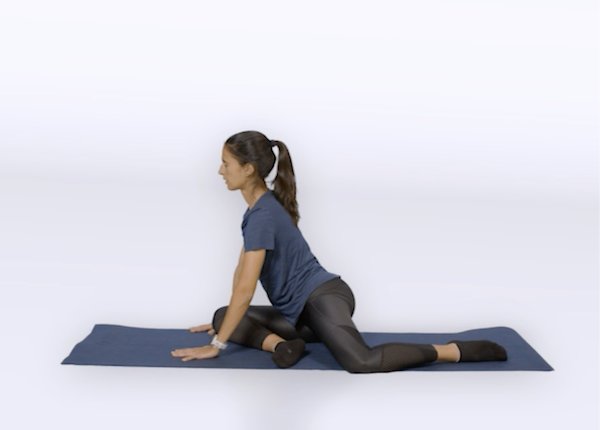
Sit on the floor with both legs bent at 90° in front of you, feet slightly wider than hip-width. Let both knees drop to one side, then to the other, keeping your upper body as upright as possible. Put your hands behind you if it’s too hard. Do 8 to 10 switches. This exercise works internal and external hip rotation, which runners often neglect.
5. Open and close the gate
Standing, lift one knee to hip height, then draw a circle outwards before putting your foot down (“open the gate”). Do 5 to 6 per leg, then reverse the direction (“close the gate”). You can do it on the spot or while walking.
6. Glute bridge
Lie on your back, knees bent, feet flat. Push through your heels to lift your hips, squeezing your glutes without arching your lower back. Do 10 to 12 reps. It isn’t a flexibility exercise, but it teaches your body to produce extension from the hip rather than the lower back: that’s the link between mobility and efficiency.
Then go straight into your warm-up jog. Before an interval session, this routine doesn’t replace your usual warm-up: it comes on top of the easy jog, the drills and a few progressive strides.
So you don’t have to remember all of this, the Stretching module in the RunMotion Coach app brings together more than 50 guided video exercises, organised by timing: before your session (dynamic stretches and hip mobility), after a not-too-intense activity, and on rest days (flexibility). A player guides you in real time, with instructions designed even for the stiffest runners. To add it, tap the RunMotion logo at the bottom left of the home screen, then “Stretching” (here’s the step-by-step guide). The module is part of the Premium plan: you can try it during the 7-day free trial.
Rest days: going further into your range
On non-running days, and well away from your hard sessions, you can hold positions for longer, between 30 seconds and 1 minute, always without pain. Two or three times a week, 10 to 15 minutes is enough.
Three positions are particularly useful for runners. The held low lunge is the routine exercise, but you stay in the position to stretch the front of the hip. The lying glute stretch means crossing one ankle over the opposite knee, then pulling both legs towards your chest. Finally, the butterfly stretch, sitting with the soles of your feet together, targets the adductors.
One last guideline: if you’re very stiff, this rest-day work is probably more useful for you than for a naturally flexible runner. Conversely, if you’re already very flexible, put your energy into strength and control instead.
Mistakes to avoid
The first mistake is pushing into pain. A stretching sensation, yes; sharp pain, no. Forcing doesn’t gain range any faster and can irritate your tendons.
The second is doing long static stretches right before a fast session. Save those held positions for rest days and favour movement before you run.
The third is stretching hard right after a tough session of intervals or hills, when your muscles have already worked a lot.
The fourth, very common, is betting everything on flexibility and forgetting strength. If you only have 15 minutes a week, strengthening your glutes and core is a better investment than stretching.
Finally, an overly ambitious routine usually gets dropped. Eight minutes done regularly beats forty minutes once a month.
Mobility and strength: the right combination for your hips
Mobility opens up range; strength teaches you to control it. The two go hand in hand. For the hip, a few simple exercises are enough to start: the glute bridge, the side plank, or the step-up with a slow, controlled lowering, without letting your knee cave inwards.
What matters most is consistency, and building this work into your overall training rather than doing it in isolated sessions. That’s even more true if you’ve been running for years or you’re over 50: we explain how to adapt your training in our article on running after 50. And if you’re just getting started, our tips for starting running will help you manage your load from day one.
FAQ
How long does it take to improve hip mobility?
It depends on your starting point and how consistent you are. The feeling of looser hips often comes during the session itself, but it’s temporary. For a more lasting gain, allow several weeks of regular practice, several times a week.
Should you stretch before running?
Before running, favour dynamic mobility: controlled movements that prepare your joints. Long static stretches aren’t useful at that point and can slightly reduce your performance. If you really want to, don’t exceed 60 seconds per muscle group.
Can mobility replace a warm-up?
No, it complements it. Before an easy run, a short mobility routine and a few minutes at an easy pace are enough. Before an interval session or a race, keep your full warm-up: easy jog, drills and progressive strides.
My hip hurts when I run: is it a lack of mobility?
Not necessarily. Hip pain can have many causes: too much training load, lack of strength, a tendon or joint problem. If the pain persists, comes back on every run or makes you limp, see a health professional before running again.
In short
For runners, mobility is mostly about the hip: free, controlled extension lets you run without your lower back compensating. A few minutes of dynamic mobility before each run, deeper work on rest days and, above all, glute strengthening make a simple, realistic combination. Start with the 8-minute routine before your next run, and notice how your first few kilometres feel.
If you’d like mobility, strength work and your runs to fit into one programme adapted to your level and goal, that’s exactly what RunMotion Coach is for. Take a look at our training plans or try the app free for 7 days.
Sources
- Schache AG, Blanch PD, Murphy AT. Relation of anterior pelvic tilt during running to clinical and kinematic measures of hip extension. British Journal of Sports Medicine, 2000;34(4):279-283. DOI: 10.1136/bjsm.34.4.279
- Christopher SM, McCullough J, Snodgrass SJ, Cook C. Do alterations in muscle strength, flexibility, range of motion, and alignment predict lower extremity injury in runners: a systematic review. Archives of Physiotherapy, 2019;9:2. DOI: 10.1186/s40945-019-0054-7
- Lauersen JB, Bertelsen DM, Andersen LB. The effectiveness of exercise interventions to prevent sports injuries: a systematic review and meta-analysis of randomised controlled trials. British Journal of Sports Medicine, 2014;48:871-877. DOI: 10.1136/bjsports-2013-092538
- Konrad A, Močnik R, Nakamura M, Sudi K, Tilp M. The impact of a single stretching session on running performance and running economy: a scoping review. Frontiers in Physiology, 2021;11:630282. DOI: 10.3389/fphys.2020.630282