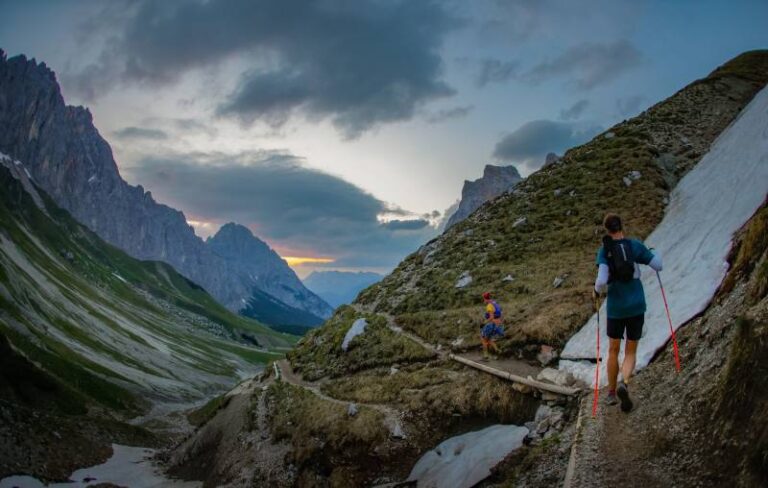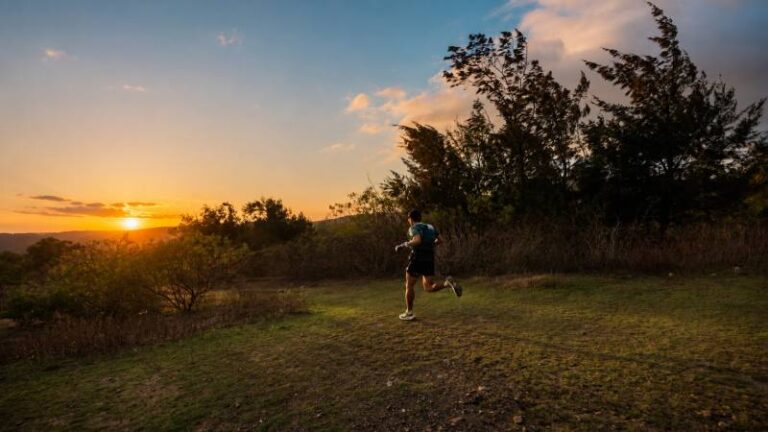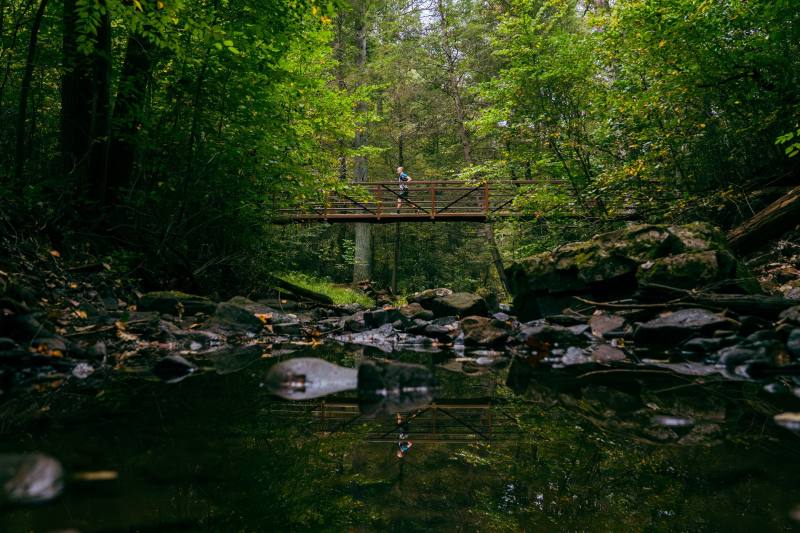
A Grindstone training plan has to prepare you for an unusual 100-miler: 167.4 km (104 miles) and 6,400 m (about 21,000 ft) of climbing in the Virginia forests, with a 6 p.m. start that sends you straight into the night. Held in late September at Natural Chimneys Park, on the western edge of the Shenandoah Valley, the Grindstone Running Festival by UTMB also offers a 100K, a 50K and a 21K. Here are the official numbers and how to build your preparation for each.
The short answer
- Typical build: 10 to 14 weeks for the 21K, 4 to 5 months for the 50K, 5 to 7 months for the 100K, 8 to 12 months for the 100M.
- Specific-phase volume: roughly 4 to 6 hours a week (21K) up to 9 to 15 hours (100M), depending on your level.
- Key sessions: long climbs, steep descents on tired legs, back-to-backs and evening-start long runs for the 100M.
- The defining feature: on the 100M, an evening start that puts the first night right at the beginning of the race, on a ridge course with long climbs.
Contents
Grindstone distances and elevation
Figures below come from the official race pages. All races start at Natural Chimneys Park, Virginia.
| Race | Distance | Elevation gain | Profile / notes |
|---|---|---|---|
| 100M (100M category) | 167.4 km (104 mi) | 6,400 m (about 21,000 ft) | 6 p.m. start; ridges and singletrack, Elliott’s Knob climb (highest point); 36-hour limit; 4 Running Stones |
| 100K (100K category) | 100 km (62.1 mi) | 3,350 m (about 11,000 ft) | Narrow Back, Wolf Ridge, Wild Oak Trail, Grindstone Mountain; 18-hour limit; 3 Running Stones |
| 50K (50K category) | 50 km (31.1 mi) | 1,550 m (5,085 ft) | Singletrack with some fire road; 9-hour limit; 2 Running Stones |
| 21K (20K category) | 21 km (13 mi) | 500 m (1,640 ft) | Fast start, then a short steep climb to the Narrow Back ridgeline; 6-hour limit; 1 Running Stone |
The races run through the George Washington and Jefferson National Forest: singletrack, long ridgelines and what the organisers call “monster climbs”. On the 100M, Elliott’s Knob is the high point of the course, and the Cold Springs Trail drops 2,000 ft in 2 miles. The 100K links Narrow Back Mountain, Wolf Ridge, the Wild Oak Trail and Grindstone Mountain. Course details are on the official website.
What makes Grindstone hard
On the 100M, the clock is the first challenge. A 6 p.m. start means you hit the night only a few hours in, after a full day of waiting, and slower runners heading for the 36-hour limit will see a second night. Managing sleep, alertness and night-time fuelling matters as much as fitness.
The profile is the second. At around 38 m of gain per kilometre (about 200 ft per mile), Grindstone climbs like a mountain ultra, without the altitude. The difficulty comes from long climbs, steep descents like Cold Springs and ridges where you have to keep running. On forest singletrack, especially at night, every footstep needs attention.
How long to train for each distance
The 21K takes 10 to 14 weeks if you already run regularly. The 50K calls for a previous 25 to 30 km trail finish and 4 to 5 months. The 100K suits runners with a 50 to 60 km finish behind them, over 5 to 7 months; our 100 km trail training plan covers that build. The 100M, longer than most 100-milers, ideally follows at least one 80 to 100 km ultra, with 8 to 12 months of preparation and a gradual increase in long-run duration (see our guide to increasing distance). These are benchmarks, not guarantees.
The phases of your training plan
With a late-September race, the base phase sits in spring: progressive easy volume, one quality session a week, two strength sessions. The specific phase covers the summer, over 8 to 12 weeks: long runs on hilly terrain, long climbs, steep descents, and for the 100M, runs that start in the evening. A lighter week every three or four lets the work sink in. Watch the summer heat during this block and shift long runs to cooler hours if needed. The taper lasts one to two weeks for the 21K and 50K, two to three for the 100K and 100M. For the 100M, also rehearse race day itself: how you sleep, eat and rest before a 6 p.m. start.
Key workouts for Grindstone
Long climbs. Climbs of 10 to 20 minutes at a strong effort, running or power-hiking depending on gradient. For the 100M, add longer hiking climbs to build efficiency over time.
Steep descents on tired legs. Finish long runs with a steep, technical descent to prepare your quads for sections like Cold Springs Trail.
The night long run (100M). One to three times in the specific phase, start a long run in the early evening, ideally after a normal day. Test your headlamp, night-time nutrition and focus.
Back-to-backs (100K and 100M). Long on Saturday, shorter on Sunday, to train on fatigue without one oversized session.
Want a plan that adjusts every week to what you actually ran, your level and your schedule? The RunMotion Coach app, official online coach of the UTMB World Series, builds in elevation, strength and mental preparation. Try it free for 7 days.
Plan your race with Race Strategy
On a 100-miler that starts at nightfall, knowing your splits helps you pace and organise your crew. Race Strategy by RunMotion builds a kilometre-by-kilometre plan with pace adjusted for gradient, altitude and terrain, estimates your splits at key points, and gives you a per-section nutrition and hydration plan (carbs, water, sodium) adjusted to race-day weather. Import the official GPX for your race.
Running Stones and the UTMB World Series
Grindstone earns you 4 Running Stones on the 100M, 3 on the 100K, 2 on the 50K and 1 on the 21K, usable in the UTMB Finals lottery in Chamonix. To fit it into a wider season, see our UTMB World Series training plans and how to plan your trail running season. RunMotion’s founders, twin brothers Guillaume and Romain Adam, come from the Alps: mountains, vertical and ultra distance are home turf.
FAQ
Are poles allowed at Grindstone?
Yes, but the regulations require you to carry them for the entire race if you start with them: no picking them up mid-race and none in drop bags. Decide in training whether you really need them.
Are pacers allowed?
According to the regulations, only on the 100M. Pacers must be at least 18 and carry the mandatory 100-mile gear.
What experience do I need for the Grindstone 100?
At least one 80 to 100 km ultra with significant climbing, ideally including some night running. The 36-hour limit gives you margin, but the race is long and demanding.
Grindstone asks for a rare mix: climbing legs, downhill durability and, on the 100M, real night-running preparation. Build in spring, specialise in summer and arrive fresh. For a plan that adapts to you, start your free 7-day RunMotion Coach trial.
Article updated by the RunMotion Coach team.
Sources