A Chianti Ultra Trail training plan is built over winter, for a race that opens the season in March on the Tuscan hills, among vineyards and castles. Chianti Ultra Trail by UTMB offers five races from Radda in Chianti, from 10 km up to the 123 km Ultra Trail Chianti Castles. Unlike the alpine events on the circuit, this is a runner’s course. Here is how to train for the Chianti Ultra Trail, with the official figures.
The short answer
- Chianti Wine Run and Chianti Half Trail: 8 to 12 weeks; Chianti Marathon Trail: 12 to 16 weeks; Chianti Ultra Trail and Ultra Trail Chianti Castles: 5 to 8 months.
- Rough guide in the specific phase for the UTCC: 8 to 13 hours a week and 1200 to 2500 m of elevation gain, with plenty of continuous running.
- Key sessions: steady rolling runs, short hill repeats, long runnable outings, eccentric strength for the descents.
- The main challenge: more runnable terrain than most of the circuit (about 42 m of climbing per km on the UTCC), and a training block that falls in winter.
Contents
Chianti Ultra Trail distances and elevation gain
Figures from the official Chianti Ultra Trail by UTMB website.
| Race | Distance | Elevation gain | Profile/notes |
|---|---|---|---|
| Ultra Trail Chianti Castles (UTCC) | 123 km | 5200 m | 100M category, 4 Running Stones. Loop from Radda in Chianti, 4 a.m. start, 26 h 30 limit, passes 25 castles of the ancient Chianti League |
| Chianti Ultra Trail (CUT) | 73 km | 3000 m | 100K category, 3 Running Stones. Loop from Radda, 7 a.m. start, 16-hour limit. |
| Chianti Marathon Trail (CMT) | 46 km | 1650 m | 50K category, 2 Running Stones |
| Chianti Half Trail (CHT) | 20 km | 920 m | 20K category, 1 Running Stone |
| Chianti Wine Run (CWR) | 10 km | 400 m | Entry-level race, category not stated |
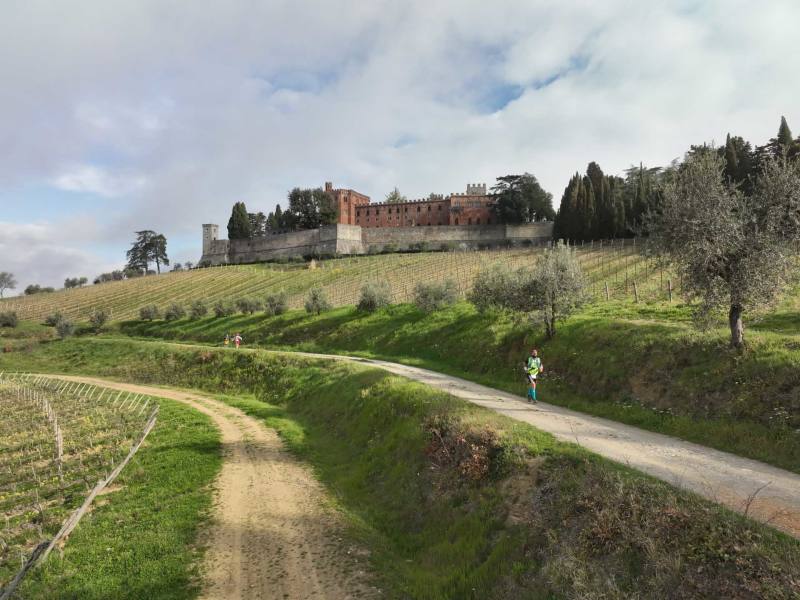
The terrain is that of the Sienese Chianti hills: vineyards, country tracks, woods and a few rougher sections. For the CUT, the site says the first 40 km through the vineyards are tricky in places but mostly fast, and that the biggest climb, to Monte San Michele, peaks around km 60 before the descent to Volpaia. The event takes place in March.
What makes the Chianti Ultra Trail demanding
Runnable terrain comes first. At around 42 m of climbing per kilometre on the UTCC and CUT, this is far from an alpine profile: you will run most of the course. That calls for running endurance and economy more than fast hiking. Road runners have an advantage here; mountain specialists have work to do.
The time limits come next. 73 km in 16 hours on the CUT and 123 km in 26 h 30 on the UTCC remain demanding for runners who walk a lot, so you need to hold a steady running pace for a long time.
Then there is the season. A March race means specific training in December, January and February, with long runs in the cold, short days and sometimes muddy trails at home. On the UTCC, the 4 a.m. start also means running the first hours in the dark. Put this race in your calendar early, as explained in our guide on how to plan your trail running season.
How long do you need to train?
For the Chianti Wine Run and Chianti Half Trail, 8 to 12 weeks is enough if you already run regularly. For the Chianti Marathon Trail, allow 12 to 16 weeks, ideally after a first 25 to 30 km trail race.
For the CUT and UTCC, plan 5 to 8 months including 12 to 16 specific weeks, with a 50 km+ race already completed. Our article on training and racing on runnable trail ultras is especially relevant here. These are benchmarks, not guarantees.
The phases of your training plan
Base building (autumn)
Easy aerobic volume, strength work and speed work. On a runnable course, improving your maximal aerobic speed (the speed at which you reach your maximum oxygen uptake) pays off more than in high mountains.
Specific phase (winter)
Over the last 10 to 12 weeks, extend your long runs on rolling, runnable terrain with sections at race effort. Elevation rises gradually, but the focus is on running for a long time. Test your nutrition and, for the UTCC, your headlamp.
Taper
Two to three weeks of reduced volume (30 to 50 %) with a few pace reminders.
Key workouts for the Chianti Ultra Trail
Steady rolling runs: 1 h 30 to 2 h 30 on runnable terrain with short hills, holding an even running effort on the climbs rather than walking.
Short hill repeats: 8 to 12 efforts of 1 to 2 minutes at high intensity, for power on the short steep sections between the vines.
Long runnable outings: 3 h 30 to 5 h 30 on rolling tracks and trails with race nutrition. This is the key session for the CUT and UTCC.
Eccentric strength: squats, lunges and controlled fast descents, because running downhill for hours on tracks hammers the quads.
The RunMotion Coach app builds and adjusts your plan every week based on completed sessions, level and availability, including elevation, strength and recovery. RunMotion Coach is the official online coach of the UTMB World Series, and its founders, twin brothers Guillaume and Romain Adam, come from the Alps: trail and ultra running are their home ground. Try the app free for 7 days.
Plan your race strategy with Race Strategy
On a runnable course, the classic mistake is starting too fast. Race Strategy by RunMotion calculates your race plan kilometre by kilometre, with pace adjusted for elevation, altitude and technical terrain, estimated split times at key points and a fuelling and hydration plan per section (carbohydrates, water, sodium). Import the official course GPX from the race website, then adjust for race-day weather, which can be cool on March mornings.
Running Stones and the UTMB World Series
The Chianti Ultra Trail is part of the UTMB World Series. According to the official site, the UTCC earns 4 Running Stones, the CUT 3, the CMT 2 and the CHT 1. They improve your chances in the lottery for the Finals in Chamonix, and an early-season race is a good chance to collect some. See our UTMB World Series training plan guide for the bigger picture.
FAQ
Are poles allowed at the Chianti Ultra Trail?
Check the official race regulations. On such a runnable course many runners do without; if you use them, practise stowing and deploying them quickly.
What level do you need for the UTCC?
One or more finished 50 to 80 km races is a sensible prerequisite. The 26 h 30 limit requires steady running over the distance, not just finishing.
How many hours a week to train for the CUT?
In the specific phase, 6 to 10 hours a week is a common benchmark, adjusted to your level and progression. On a runnable course, running volume counts more than in the mountains.
Conclusion
The Chianti Ultra Trail is a runner’s race: consistency, running economy and pacing make the difference. Build it patiently over winter and test everything in training. Start your free RunMotion Coach trial.
Article updated by the RunMotion Coach team.
Sources: