Running a flat trail race is often seen as easier than a mountain trail. In reality, that assumption is way off. No elevation gain does not mean no challenge, quite the opposite.
On shorter formats, a runnable trail from 10 to 30 km can often be prepared much like a road race, with training that looks similar to a 10K or half marathon plan.
Over mid-range distances of 40 to 50 km, preparation becomes closer to marathon training, with a strong focus on aerobic endurance and smart pace management.
But it’s on ultra-distance that flat trail running shows its true teeth. On a 100 km or a 100 miler (160 km), like L’Ultra Marin, the muscular load can become extremely demanding.
Unlike mountain trail running, where climbs naturally force walk breaks and change which muscles do the work, flat trail ultras mean repeating the same stride for hours. Impacts keep coming, uninterrupted, and your legs absorb thousands of nearly identical shocks.
That constant repetition is why so many runners are surprised to discover that a flat ultra-trail can be just as hard, sometimes even harder on the muscles than a mountainous course.
Contents
Flat trail: a different way to experience trail running
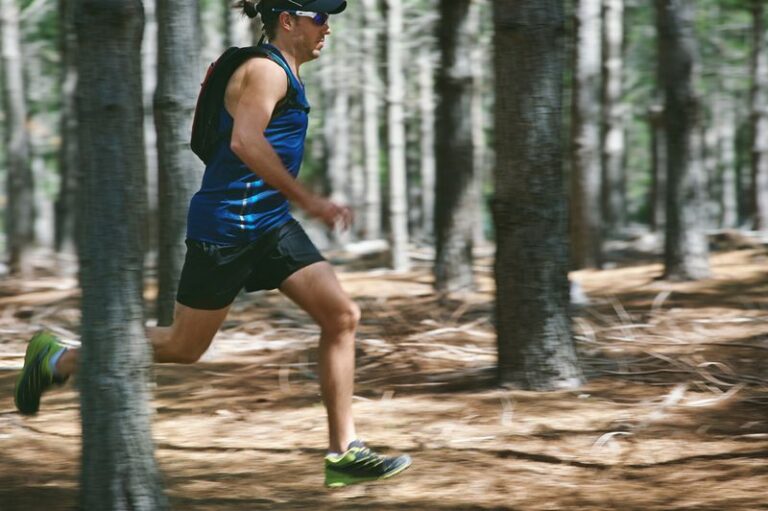
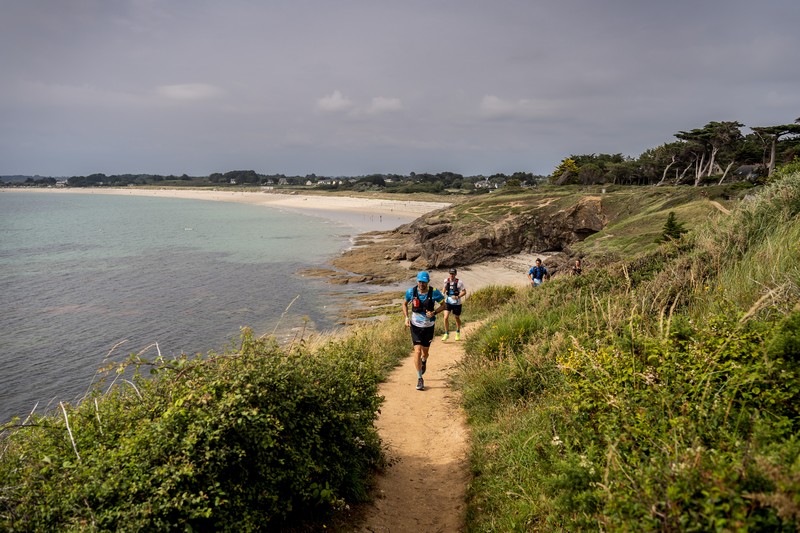
A trail race isn’t defined only by elevation gain, it’s defined by its natural setting. Forest singletrack, farm roads, grassy sections, sand, gravel, or coastal paths: even without mountains, the terrain stays varied and demands constant adaptation.
On a flat trail, the effort is usually more continuous. Where mountains alternate climbs, descents, and hiking, runnable terrain pushes you to run almost all the time. That continuity creates a different kind of fatigue, more gradual, but often more sneaky.
That’s also what traps a lot of runners. Feeling “too good” in the early kilometers can tempt you into an overly ambitious pace that you’ll pay for hours later.
How to train effectively
Your preparation depends heavily on the distance you’re targeting.
Runnable trail up to 50 km
For a short, fast, runnable trail, training can be close to a road 10K or half marathon plan. Building speed, improving your lactate threshold, and learning to hold a strong steady pace becomes the priority.
For a flat or only slightly rolling 40 to 50 km trail, the approach looks more like road marathon training. Long runs become essential to condition your body to keep running for a long time at a moderate intensity.
Runnable ultra trail
For ultras of 100 km and beyond, the key challenge is often muscular endurance. You have to teach your body to handle hours of repeated impact. Long runs, back-to-back sessions on tired legs, and strength training become non-negotiable.
Strength training is essential. Working on core stability, quads, glutes, and calves helps you resist the gradual muscle breakdown that builds hour after hour.
Finally, even without big climbs, it still matters to run regularly on trails and mixed terrain to develop proprioception and adapt to the specific demands of trail running.
Race strategy for a flat trail
The biggest mistake on a runnable trail is believing you can hold a road-race pace evenly from start to finish.
It’s smarter to race by effort or heart rate rather than locking into a strict pace. Even “flat” courses can include energy-draining variations (small rises, technical sections, stairs, etc.) that add up over time.
Surges matter too. The goal isn’t to accelerate every time, it’s to smooth your effort as much as possible to avoid stop-and-go fatigue.
Still alternate running and walking
On long-distance flat trails, it’s often better to stay ahead of fatigue instead of waiting for it to crush you. That’s the idea behind the Cyrano method, widely used in runnable ultras. It means deliberately alternating running and walking from the start or from mid-race, even before heavy fatigue hits.
This strategy helps protect your muscles, reduces cumulative impact, and keeps your average speed steadier over the long haul.
On a flat 100 km or 100 miler, waiting until you’re destroyed to start walking is often a mistake. Experienced ultra runners know it’s usually more efficient to build in regular walk breaks early enough to extend how long you can keep running.
Nutrition
Nutrition and hydration are also crucial. Even on runnable terrain, energy demands are huge, which means taking in carbohydrates and fluids regularly throughout the race.
Road shoes or trail shoes?
In general, road running shoes are lighter than trail shoes. On dry, non-technical terrain, it’s usually better to go with road shoes.
On slippery or muddy terrain, or for an ultra trail, runners tend to prefer trail shoes.
But it also depends on what you’re used to in training, so the right choice also comes down to your preferences.
Note that some brands are developing gravel shoes, a hybrid between road and trail shoes, lighter overall, with a bit of extra grip under the outsole.
Flat trail vs mountain trail: different challenges
Putting flat trail and mountain trail against each other doesn’t really make sense. They test different strengths.
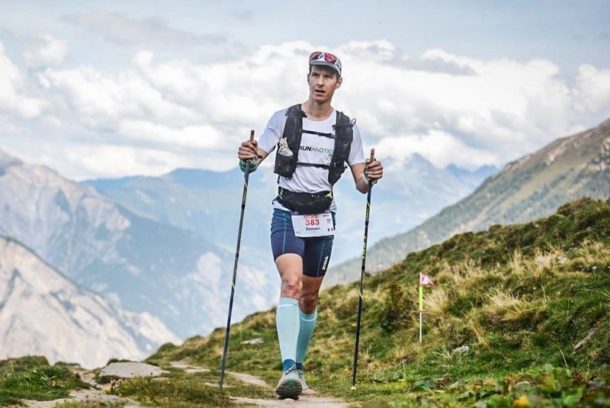
The mountains demand excellent elevation management, strong muscular power, and the ability to move efficiently on sometimes highly technical terrain.
Flat trail racing requires great running economy, exceptional muscular endurance, and the ability to handle hours of continuous effort without a real break in rhythm.
So the lack of elevation doesn’t make the race easier, it simply shifts where the difficulty lives.
Conclusion
Having run the 100 km Raid at L’Ultra Marin, I personally found it brutally demanding on the legs. The first 30 kilometers usually feel smooth, it can even make you think the race will be easy. Yet you often start to feel your legs tighten up as early as the second third of the race.
From kilometer 60 onward, things get noticeably tougher. The impacts you’ve accumulated for hours start to weigh heavily on your muscles, and every kilometer costs more.
In my case, I finished the last 30 kilometers by alternating five minutes of running with one minute of walking. That pacing kept me moving efficiently despite growing muscular fatigue.
That’s one of the big lessons of flat ultras: they look approachable at the start, but they often become extremely hard as the miles stack up. More than ever, success comes down to training, strength work, effort management, patience, and humility.