A Canyons Endurance Runs training plan is really about one thing: the American River canyons around Auburn, California, on the same trails as Western States. Held in late April, the event offers four races from 25 km to 100 miles, and its two longest distances are Western States qualifiers. Here are the official numbers, what makes this terrain hard, and how to train for each distance.
The short answer
- Typical build: 10 to 14 weeks for the 25K, 4 to 5 months for the 50K, 5 to 7 months for the 100K, 7 to 12 months for the 100M, on top of consistent running.
- Specific-phase volume: roughly 4 to 6 hours a week (25K) up to 8 to 14 hours (100M), depending on your level.
- Key sessions: long hill repeats, long runs with steep late descents, back-to-backs for the ultras, quad strength.
- The defining feature: repeated canyon drops and climbs, with more descent than ascent (about 6,700 m / 22,000 ft of descent on the 100M).
Contents
Canyons Endurance Runs distances and elevation
The official name is The Canyons Endurance Runs by UTMB. Figures below are from the official race pages.
| Race | Distance | Elevation gain | Profile / notes |
|---|---|---|---|
| 100M (100M category) | 161 km (100 mi) | 5,550 m (18,209 ft) | Starts at noon from China Wall Trailhead, finishes in Auburn; 35-hour limit; Western States qualifier; 4 Running Stones |
| 100K (100K category) | 100 km (62.1 mi) | 3,750 m (12,303 ft) | Dawn start from China Wall Trailhead; 20-hour limit; Western States qualifier; 3 Running Stones |
| 50K (50K category) | 50 km (31.1 mi) | 1,700 m (5,577 ft) | Loop from downtown Auburn; 10-hour limit; 2 Running Stones |
| 25K (20K category) | 25 km (15.5 mi) | 850 m (2,789 ft) | Late-afternoon start from Auburn; 5-hour limit; 1 Running Stone |
The two longest races follow much of the Western States Trail: Eldorado Canyon, Devil’s Thumb, the Swinging Bridge, Michigan Bluff, Volcano Canyon, Foresthill and Cal Street along the American River. The 100M adds the Rucky Chucky river crossing, the K2 climb and loops around Cool before returning via Robie Point. The 50K and 25K start in historic Auburn, cross No Hands Bridge, and are described by the organisers as “steep climbs and fast descents”. Full course details are on the official website.
What makes the Canyons hard
There are no huge alpine passes here. Instead you drop into canyon after canyon and climb straight back out. The organisers quote about 22,000 ft of descent on the 100M and about 17,000 ft on the 100K, more than the climbing on both. That descent is what wrecks unprepared quads.
The other trap is the runnable terrain between canyons and along the river, which tempts you to go out too fast. On the 100M, the noon start also means running through a full night. And because it is spring in the Sierra foothills, be ready for different conditions between canyon floors and ridgelines.
How long to train for each distance
The 25K suits runners who already train regularly and have a few short trail races behind them: allow 10 to 14 weeks. For the 50K, you should have finished a 25 to 30 km trail race; plan 4 to 5 months. The 100K is for runners with one or more 50 to 60 km finishes and 5 to 7 months to prepare; our 100 km trail training plan covers that build in detail. The 100M ideally comes after at least one 80 to 100 km ultra, with 7 to 12 months of preparation. If you need to stretch your long runs, follow our guide to increasing distance. These are benchmarks, not promises.
The phases of your training plan
With a late-April race, much of your build happens in winter. The base phase grows easy aerobic volume, keeps one quality session a week and adds two strength sessions (squats, lunges, step-downs, eccentric work). The specific phase, over the 8 to 12 weeks before your taper, mimics the saw-tooth profile: sustained climbs, steep descents back to back, and long runs edging toward your expected race duration. For the ultras, rehearse nutrition, and on the 100M, your night set-up. Take a lighter week every three or four weeks. The taper lasts one to two weeks for the 25K and 50K, two to three weeks for the 100K and 100M.
Key workouts for the Canyons
Canyon repeats. Find a 10- to 20-minute climb, push up at a strong effort, run back down under control, repeat. You train climbing power and downhill durability in one session. Two to four reps are plenty for the shorter races; for the 100M, lengthen the climbs rather than adding reps.
Long run with late descents. Save the longest descents for the final hour, on tired legs. That is exactly what the last third of the race feels like.
Back-to-backs (100K and 100M). Long on Saturday, shorter on Sunday, to build tolerance to accumulated fatigue without one oversized run.
Threshold on runnable trail. Blocks of 10 to 20 minutes at threshold effort (roughly what you could hold for an hour) on flat or rolling trail, so you stay efficient on the river sections.
Want a plan that adjusts every week to what you actually ran, your level and your schedule? The RunMotion Coach app, official online coach of the UTMB World Series, factors in elevation, strength and recovery. Try it free for 7 days.
Plan your race with Race Strategy
On a saw-tooth course, even pacing makes no sense. Race Strategy by RunMotion builds a kilometre-by-kilometre plan with pace adjusted for gradient, altitude and terrain, estimates your splits at key points such as Foresthill or No Hands Bridge, and gives you a per-section nutrition and hydration plan (carbs, water, sodium) adjusted to race-day weather. Import the official GPX for your distance and you are set.
Running Stones and the UTMB World Series
Canyons finishers earn Running Stones: 1 for the 25K, 2 for the 50K, 3 for the 100K, and a figure still to be confirmed for the 100M. To plan a season across several events, see our UTMB World Series training plans and our article on how to plan your trail running season. RunMotion’s founders, twin brothers Guillaume and Romain Adam, come from the Alps: mountains, vertical and ultra distance are home turf.
FAQ
Is Canyons a Western States qualifier?
Yes. The 100K and 100M count toward the Western States lottery if you finish within the stated limits (20 hours for the 100K, 35 hours for the 100M).
Should I use poles at Canyons?
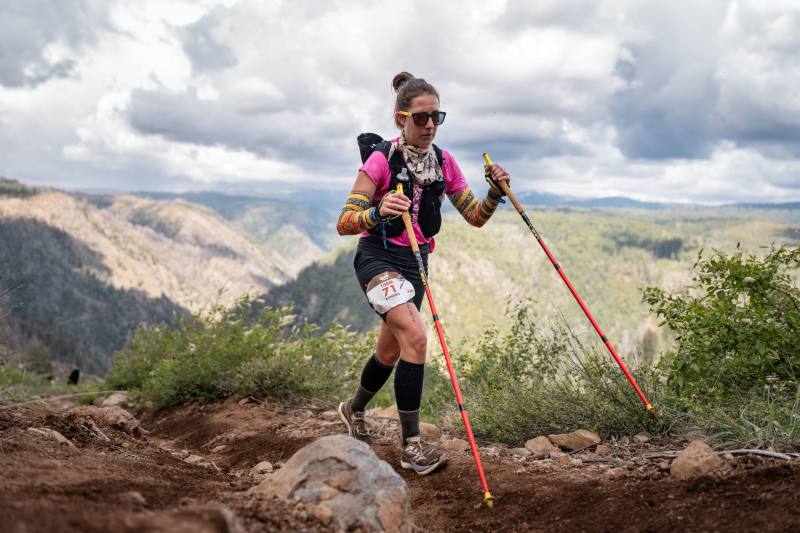
The regulations list them as recommended equipment, particularly in rain or snow. They can help on steep canyon climbs, but train with them before race day.
Are pacers allowed?
According to the regulations, only on the 100M, and pacers may not carry supplies for their runner.
Whether you are lining up for the 25K or the 100 miles, the Canyons reward runners who trained their quads as much as their lungs. Build your base, own the descents and keep something for the runnable miles. For a plan that adapts to you, start your free 7-day RunMotion Coach trial.
Article updated by the RunMotion Coach team.
Sources