An Arc of Attrition training plan has to prepare you for a winter ultra on the South West Coast Path in Cornwall. Altitude is not the problem here: wind, mud, long nights and an endless chain of short, punchy climbs and descents above the Atlantic are. This guide covers how to train for the Arc of Attrition, from the 20K to the 100 miles.
The short answer
- Allow 12 to 16 weeks of specific training for the 20K or 50K, 5 to 6 months for the 100K and 6 to 12 months for the 100M, on top of a solid trail running base.
- Indicative peak volume: 40 to 60 km per week for the 20K and 50K, 60 to 90 km per week for the 100K and 100M, with moderate but highly broken-up elevation gain.
- Key sessions: short steep hill repeats, long runs on slippery rolling terrain, technical downhill work, night runs and back-to-back weekends for the ultras.
- Number one challenge: winter conditions (cold, rain, wind, darkness from late afternoon) and self-sufficiency over long sections between aid stations.
Contents
Arc of Attrition distances and elevation
Arc of Attrition by UTMB offers four races, all on the Cornish coast path. Figures below come from the official Arc of Attrition website; always double-check them before race day, as courses can change between editions.
| Race | Distance | Elevation gain | Profile/notes |
|---|---|---|---|
| Arc 100M (100M category) | 173 km | 5507 m | Coverack to Perranporth; 37-hour time limit; 4 Running Stones |
| Arc 100K (100K category) | 82.7 km | 2708 m | Coast path section; most runners will see some darkness |
| Arc 50K (50K category) | 49.4 km | 1458 m | The most accessible way to experience the course in winter |
| Arc 20K (20K category) | 22.1 km | 744 m | Short format, runnable in places, still fully exposed to the weather |
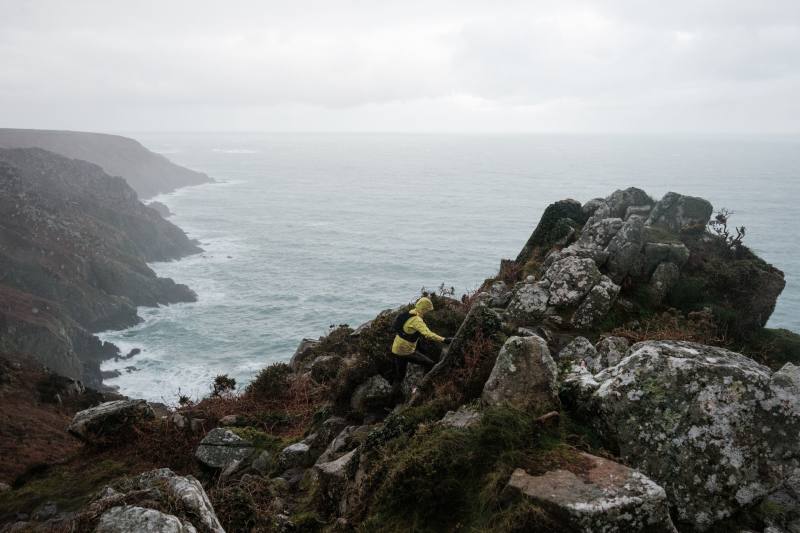
There is nothing alpine about the profile. The trail stays close to sea level but constantly drops into coves and climbs back over headlands, often on steps cut into the cliffs. The official site describes rugged, technical trail, remote headlands, relentless climbs and unpredictable winter conditions. The event takes place in January, so daylight is short and Atlantic weather is often wet and windy.
What makes the Arc of Attrition so tough
Reading “5507 m over 173 km” can fool you into thinking the climbing is easy. In reality it comes in hundreds of short efforts on steps, rocks and soaked grass. Your quads take a beating on the descents and you never settle into a rhythm: accelerate, brake, accelerate again.
Then there is winter. On the 100M, a large part of the race happens in the dark, in the cold and often in the rain. There is a mandatory kit list on the official website, and the organisers stress that you must be able to look after yourself over long stretches between aid stations. Managing layers, gloves, headtorch, batteries and fuelling in the cold matters as much as fitness.
How long do you need to prepare?
For the 20K, 10 to 12 weeks is enough if you already run regularly off-road. For the 50K, plan 14 to 16 weeks and have at least one 30 to 40 km trail race behind you. For the 100K, aim for 5 to 6 months and one or two ultras over 50 km, ideally including some night running. The 100M needs 6 to 12 months and previous experience of a 100 km race or an effort lasting more than 15 hours. A winter 100-miler is not a first ultra. If you need to build up gradually, our guide to increasing distance in trail running explains how.
The phases of your training plan
Base phase. Build aerobic endurance and robustness: plenty of easy running, one quality session per week (short intervals or hills) and two strength sessions (squats, lunges, step-ups, core). As the race is in January, this phase usually falls in the autumn, which is the perfect time to get used to running in rain and early darkness.
Specific phase. Reproduce what the Arc throws at you: short steep hill sessions, long runs on rolling, slippery trails and dedicated downhill work. For the 100K and 100M, add back-to-back weekends and at least two runs that start or finish in the dark. Test your waterproofs, headtorch and cold-weather fuelling every time.
Taper. In the last two to three weeks (one to two for the 20K), cut volume by 30 to 50% while keeping a few short, sharp efforts. Use this time to finalise your mandatory kit and fuelling plan.
Key sessions for the Arc of Attrition
Short hill repeats: for example 10 to 15 x 1′ to 1′30″ uphill on a steep slope, jogging back down. This mirrors the climbs out of every cove. Beginners can start with 6 to 8 reps.
Long run on rolling, muddy terrain: pick a route with lots of short climbs rather than one big hill, and mix running with power hiking on the steepest pitches.
Downhill practice: repeated descents on technical ground, focusing on quick, light steps. This is what protects your quads late in the race.
Night back-to-back (100K and 100M): a long run on Saturday that finishes by headtorch, then a second long run on Sunday morning, to learn how to handle fatigue, cold and eating in the dark.
The RunMotion Coach app builds a personalised plan that adapts every week to the sessions you complete, your level and your availability, including elevation, strength work and recovery. RunMotion Coach is the official online coach of the UTMB World Series, and its founders, twin brothers Guillaume and Romain Adam, come from the Alps, so ultra-distance mountain running is home ground. You can try it free for 7 days.
Plan your race strategy with Race Strategy
On such a broken course, average pace means little. Race Strategy by RunMotion calculates your race plan kilometre by kilometre, with pace adjusted for elevation, altitude and terrain technicality, estimated split times at key points and a nutrition and hydration plan for each section (carbs, water, sodium). Import the official Arc of Attrition GPX file and apply the race-day weather adjustment, a real advantage in a winter race where wind and rain can change everything.
Running Stones and the UTMB World Series
Arc of Attrition is part of the UTMB World Series. According to the official site, the Arc 100M earns 4 Running Stones, which improve your chances in the draw for the Finals in Chamonix; the other races also earn Running Stones according to their category. To plan a full season around these events, read our UTMB World Series training guide and our article on preparing a UTMB World Series season.
FAQ
Do you need poles for the Arc of Attrition?
Check the official race rules for poles. On a course of short climbs, steps and rocky sections, many runners manage without them, but it depends on your habits. If you plan to use them, train with them from the specific phase onwards.
What level do you need for the Arc 100M?
You should already have finished at least one 100 km ultra or an effort of more than 15 hours, ideally including a full night outdoors. The official time limit is 37 hours, and winter conditions plus long unsupported sections make experience essential.
How many km per week to train for the Arc 50K?
For most runners, 40 to 60 km per week at peak is enough, as long as it includes hills, a 3 to 4 hour long run and strength work. Consistency over several months matters more than one big week.
Conclusion
The Arc of Attrition rewards solid, patient and well-equipped runners more than pure climbers. Build your preparation around short climbs, descents, night running and bad weather, and leave room for recovery. For a plan that adapts to you week after week, start your 7-day free trial of RunMotion Coach.
Article updated by the RunMotion Coach team.
Sources: arcofattrition.utmb.world, Arc 100M race page.