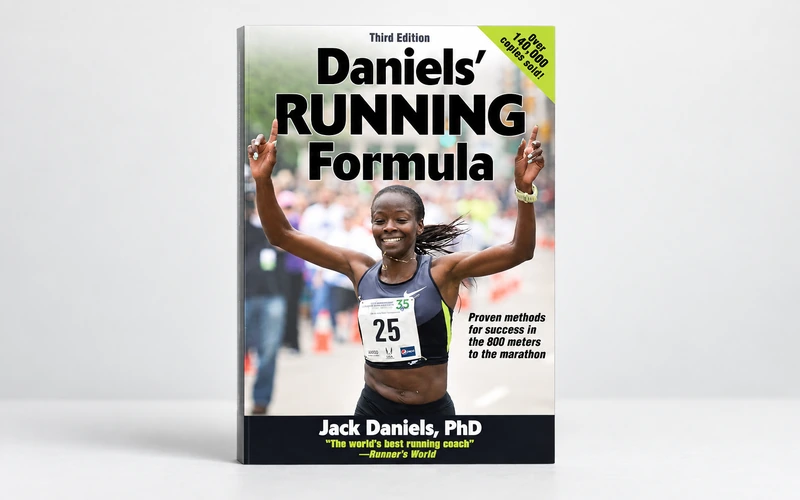
Use our VDOT calculator to estimate your Jack Daniels VDOT from a recent race result and calculate equivalent performances over 5K, 10K, half marathon and marathon.
VDOT is one of the best-known methods for estimating running fitness. Developed by legendary running coach and exercise physiologist Jack Daniels, it converts a race performance into a single fitness score that can then be used to estimate other race performances and training intensities.
It is simple and very useful. But it also has an important limitation: two runners with the same VDOT do not necessarily have the same endurance profile.
This is one of the questions we worked on when developing our own running performance model at the MIT-CNRS joint laboratory. I co-authored this research with Matthew Mulligan and Thorsten Emig, and the model was published in PLOS ONE in 2018.
Contents
- VDOT Calculator: calculate your VDOT from a race result
- What is VDOT?
- How is VDOT calculated?
- How does VDOT predict your race times?
- The main limitation of VDOT: one value has to describe the whole runner
- The running performance model we developed at MIT and CNRS
- What did we find when comparing our model with VDOT?
- A simple example: same 10K time, different runners
- Why the RunMotion Coach model goes further than VDOT
- VDOT vs RunMotion Coach: what is the main difference?
- Why race pace should not simply be a fixed percentage of vVO2max
- Is VDOT still useful?
- From one VDOT value to your individual performance curve
- VDOT Calculator FAQ
- Train at the right pace for your next race
VDOT Calculator: calculate your VDOT from a race result
These are theoretical VDOT equivalent performances, not guaranteed race predictions. Your endurance profile, training, race-specific preparation, elevation, weather, pacing and nutrition can all influence your actual result.
What is VDOT?
VDOT is a performance index developed by Jack Daniels to estimate running ability from a race performance.
Despite its name, VDOT is not exactly the same as a laboratory-measured VO2max. It is a performance-based value that combines the estimated oxygen cost of running at a given speed with the proportion of aerobic capacity that can theoretically be sustained for the duration of the race.
This makes VDOT particularly convenient: instead of doing a laboratory test, you can simply use a recent race result.
If you first want to calculate your actual running speed or pace from a race result, you can also use our running speed and pace calculator.
How is VDOT calculated?
The Jack Daniels VDOT model first estimates the oxygen cost associated with your running speed.
For a running velocity v, expressed in meters per minute:
VO2 = −4.60 + 0.182258 × v + 0.000104 × v²
It then estimates the fraction of VO2max that can theoretically be sustained for the duration t of the race:
%VO2max = 0.8 + 0.1894393 × e−0.012778t + 0.2989558 × e−0.1932605t
The resulting VDOT value can then be used to calculate equivalent performances over other distances.
How does VDOT predict your race times?
Once your VDOT has been calculated from one race result, the same equations can be used in reverse to estimate the times corresponding to the same VDOT over other distances.
For example, a 5K performance can be converted into a theoretical equivalent 10K, half marathon or marathon performance.
You can compare these theoretical VDOT values with our own running race time predictor, which uses both vVO2max and individual endurance characteristics to estimate performance.
This is where an important difference appears.
The main limitation of VDOT: one value has to describe the whole runner
Imagine two runners who both run 10K in 40 minutes.
They will have essentially the same VDOT.
But that does not necessarily mean they have the same running profile.
One runner may come from a 1500m or 5K background and have excellent speed but lose relatively more performance as the distance increases.
The other may have less speed over short distances but be particularly strong over the half marathon and marathon.
Same 10K performance. Same VDOT. Potentially very different marathon performances.
Speed and endurance are not the same thing
When we model running performance, there are two different questions:
How fast can this runner go?
And:
How well can this runner maintain that speed as the duration increases?
These characteristics are related, but they are not identical.
At RunMotion Coach, we notably represent these characteristics through vVO2max, endurance and VO2max.
This distinction is essential: two runners with the same vVO2max can have very different performances over a half marathon or marathon.
The running performance model we developed at MIT and CNRS
In 2018, Matthew Mulligan, Thorsten Emig and I published A minimal power model for human running performance in the scientific journal PLOS ONE.
At the time, I was conducting research at the MIT-CNRS joint laboratory at the Massachusetts Institute of Technology.
Our objective was to build a relatively simple mathematical model capable of describing running performances from middle-distance events to the marathon, while allowing individual runners to have different endurance characteristics.
Instead of describing the runner with a single value, the model uses four independent parameters.
- A characteristic running velocity close to vVO2max
- A characteristic duration associated with this intensity
- A parameter describing short-duration endurance
- A parameter describing long-duration endurance
Put simply, the model distinguishes how fast you are from how enduring you are.
I explain how these parameters relate to training intensities in more detail in our article on how to calculate your running training paces.
What did we find when comparing our model with VDOT?
One interesting part of our research was comparing our model with equivalent performances produced by Daniels’ VDOT model.
Our conclusion was not that VDOT was a poor model. On the contrary, VDOT produces very coherent performance curves.
But the comparison highlighted an important characteristic: VDOT race equivalences implicitly correspond to a particular endurance profile.
This endurance profile can correspond very well to some runners, but less well to others.
In our research, the long-distance endurance associated with VDOT equivalences was relatively strong. Using more conservative endurance characteristics could result in a significantly slower marathon prediction from the same short-distance performance.
This is particularly important when trying to extrapolate a marathon performance from a 5K or 10K.
A simple example: same 10K time, different runners
| Distance | Runner A | Runner B |
|---|---|---|
| 5K | 18:00 | 18:45 |
| 10K | 38:00 | 38:00 |
| Half Marathon | 1:26:00 | 1:22:00 |
Both runners have exactly the same 10K performance.
But Runner A appears relatively stronger over shorter distances, while Runner B maintains a much larger proportion of speed as the distance increases.
If we only know their 10K time, that information is invisible.
If we analyse several performances across different durations, we can begin to estimate their individual endurance profile.
Why the RunMotion Coach model goes further than VDOT
The scientific model we developed provides the foundation for this approach, but the model currently used in RunMotion Coach has evolved significantly since our original research.
1. We can use several race performances
A single race gives useful information about your fitness.
But several performances over different distances allow us to learn much more about the runner.
For example, combining a 5K performance with a half marathon result gives us information about how quickly your performance decreases as race duration increases.
2. We also use relevant training performances
Runners do not race every week.
If your most recent race was six months ago, it may no longer accurately represent your current fitness.
RunMotion Coach can therefore also use relevant performances from recent validated training sessions.
Our latest pace prediction system has been developed from the analysis of more than 1.6 million training sessions.
You can discover more about how RunMotion Coach predicts your running paces using races and training.
Your races tell us what you have achieved. Your recent training helps us understand where you are today.
3. We take elevation into account
Running 4:00/km on perfectly flat terrain is not equivalent to running 4:00/km on a hilly route.
When relevant training performances are analysed by RunMotion Coach, elevation can be taken into account.
This avoids interpreting a strong workout on rolling terrain exactly like the same pace on a completely flat course.
4. Your predicted fitness evolves
A traditional calculator only knows the race performance you enter.
RunMotion Coach can update its estimates when new relevant race or training data becomes available.
This is especially useful during a long training block, when your fitness can evolve considerably between the beginning and end of your preparation.
VDOT vs RunMotion Coach: what is the main difference?
The easiest way to summarize the difference is:
VDOT tells us how strong a performance is.
RunMotion Coach also tries to understand what kind of runner produced that performance.
Are you relatively stronger over short distances? Do you maintain your speed particularly well as the duration increases? Have your recent workouts improved enough that your old race PB no longer reflects your current fitness?
Those differences can change both race predictions and the training paces that are most appropriate for you.
Why race pace should not simply be a fixed percentage of vVO2max
You may sometimes read formulas such as:
“Marathon pace is 80% of vVO2max.”
or:
“10K pace is 90% of vVO2max.”
These percentages can be useful as rough guidelines, but they cannot describe every runner accurately.
The percentage of your vVO2max that you can maintain depends strongly on your endurance characteristics.
Two runners with the same vVO2max can have very different marathon performances. Conversely, two runners with the same marathon time can have different vVO2max values.
This is why RunMotion Coach does not simply calculate all race paces using a fixed percentage of vVO2max.
You can learn more in our complete guide to running training paces.
Is VDOT still useful?
Absolutely.
As both a runner and a researcher, I think VDOT deserves a lot of credit.
Jack Daniels created an elegant and extremely practical way to convert a race performance into information that runners and coaches can immediately use.
Its simplicity is one of its greatest strengths.
With just one race result, you can obtain a useful estimate of equivalent performances over different distances.
The limitation appears when we want to become more individualized.
Instead of asking:
“What marathon time normally corresponds to this 10K performance?”
we can ask:
“Based on this runner’s speed, endurance profile, races and recent training, what marathon performance corresponds to this particular athlete?”
Those are not quite the same question.
From one VDOT value to your individual performance curve
VDOT remains one of the most influential methods in running training.
But today we have access to more data and more computing power.
We can combine several performances, distinguish speed from endurance, analyse recent training, account for elevation and update estimates as the runner progresses.
That is ultimately the philosophy behind our approach at RunMotion Coach.
We are not simply trying to find the universal marathon equivalent of your latest 10K.
We are trying to understand your individual running performance curve.
Because two runners can have the same VDOT or the same 10K personal best and still be very different athletes.
Their training paces and race predictions should reflect that.
VDOT Calculator FAQ
Is VDOT the same as VO2max?
No. VDOT is calculated from a running performance, while VO2max is a physiological measurement of maximal oxygen uptake. The numerical values can sometimes be similar, but they do not represent exactly the same thing.
Which race should I use to calculate my VDOT?
Ideally, use a recent race completed at maximum or near-maximum effort. An old personal best may no longer represent your current fitness.
Can VDOT predict my marathon time?
VDOT can calculate a theoretical marathon equivalent from a shorter race. However, actual marathon performance depends heavily on your endurance profile, marathon-specific training, pacing, nutrition, weather and course elevation.
Why is my RunMotion prediction different from my VDOT prediction?
VDOT applies its performance relationship to your race result. RunMotion Coach can also use several race performances, recent relevant training sessions, individual endurance characteristics and elevation. As a result, the predicted performance can be different.
Does RunMotion Coach use VDOT?
No. RunMotion Coach uses a different performance modelling approach originating from research conducted at MIT and CNRS and published in PLOS ONE. This approach has since been extended using race data and more than 1.6 million training sessions.
Train at the right pace for your next race
Calculating your VDOT or predicting your race performance is only useful if you turn that information into appropriate training.
Depending on your next objective, you can discover our 10K training plans, our half marathon training advice, or our marathon training plans.
Or let RunMotion Coach automatically calculate your personalized training paces and adapt your training plan to your fitness, objectives and schedule.